On this page
- What this estimator does
- How WAEC calculates the 6-subject BECE aggregate and raw-score tie-breakers
- The Category A, B, and C bands
- How to read the result
- Why a strong aggregate does not guarantee a school
- Programme-specific competition and subject prerequisites inside the same school
- Public JHS equity quotas, Boarding vs. Day status, and Catchment selection rules
- Building a resilient choice list
- Worked CSSPS placement scenarios across three student profiles
- Common mistakes with CSSPS choices
- What to do if the estimate looks discouraging
- Step-by-step post-results guide: CSSPS portal, Self-Placement, and Enrollment verification
- Where this estimator stops
- Sources
What this estimator does
This tool takes two pieces of information — your BECE aggregate and the category of school you are considering — and returns a simple placement estimate. It tells you whether your aggregate sits comfortably inside the range that has historically been competitive for that category, at the borderline, or below it. Nothing more, nothing less.
It is a planning aid, not a prediction. The Computerised School Selection and Placement System does not consult a fixed table of categories and aggregates when it runs. It matches every candidate, in order of aggregate, against the schools and programmes they chose, filling vacancies as it goes. Where a specific candidate ends up depends on how many other candidates in that same year happened to want the same school and the same programme.
What the estimate can do is help you avoid the most common mistake in the CSSPS process: building a list of six schools that are all just slightly out of reach for your aggregate, then finding yourself unplaced on the first round. If you know where you sit in the bands, you can put together a mix of ambitious, competitive, and safer choices that gives the system room to place you somewhere you will actually be happy to attend.
How WAEC calculates the 6-subject BECE aggregate and raw-score tie-breakers
Before evaluating Senior High School categories, every candidate and guardian needs a clear grasp of what the Basic Education Certificate Examination (BECE) aggregate actually measures and what happens behind the scenes when thousands of students present the exact same number. Administered by the West African Examinations Council (WAEC) Ghana National Office, the BECE evaluates Junior High School Form 3 candidates on a nine-point numerical scale where Grade 1 is the highest distinction and Grade 9 is the lowest grade. Unlike percentage averages where higher numbers indicate stronger performance, a lower BECE aggregate always indicates stronger academic standing.
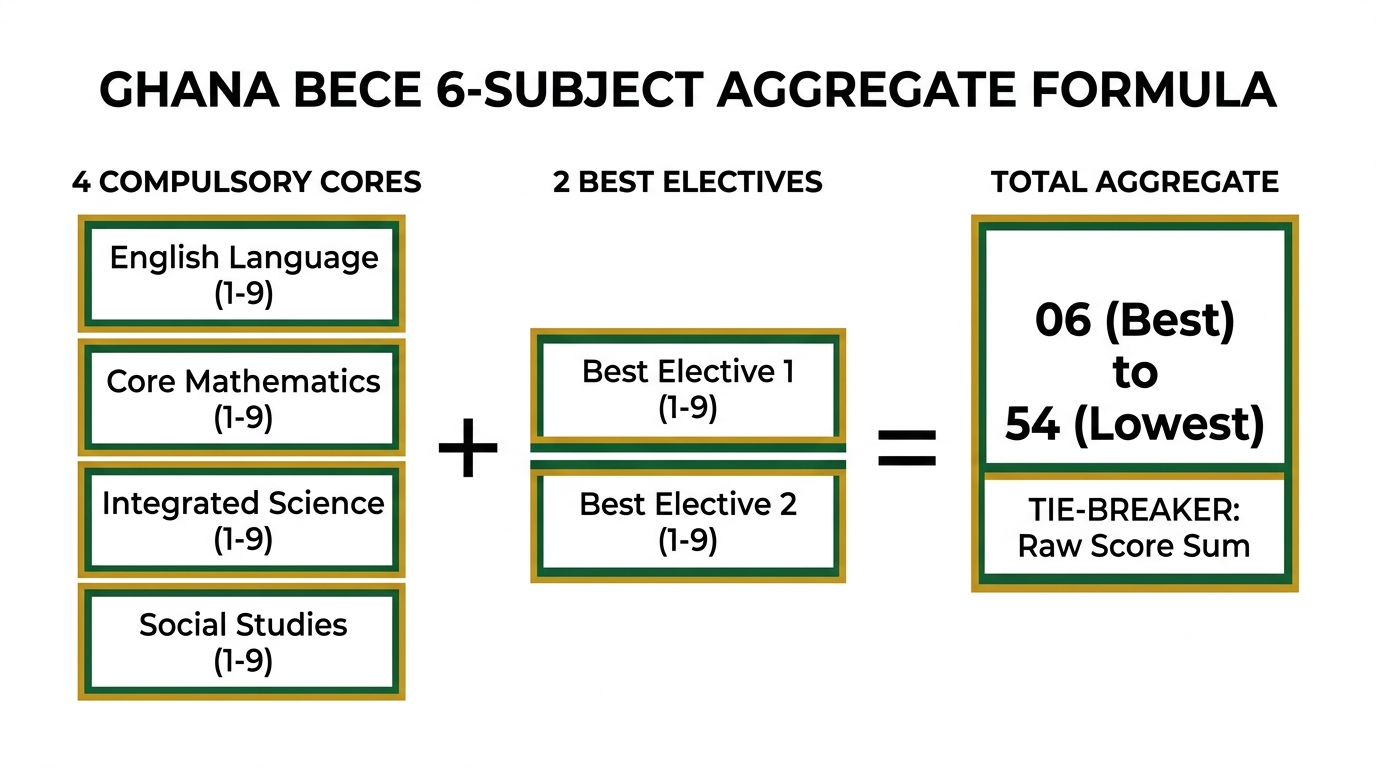
Although Junior High School students typically sit between eight and ten examination papers across the national curriculum, CSSPS computes your placement aggregate from exactly six subjects split into two non-negotiable groups:
- Four Compulsory Core Subjects: English Language, Core Mathematics, Integrated Science, and Social Studies are locked into every candidate's aggregate regardless of performance. Even if a student earns Grade 1 in four electives, a Grade 6 in Core Mathematics or English Language cannot be swapped out and is added directly to the total.
- Two Best Elective Subjects: From all remaining subjects sat by the candidate — such as Computing, Career Technology, Creative Arts and Design, Religious and Moral Education (RME), Ghanaian Language, French, or Arabic — the algorithm selects the two subjects with the lowest numerical grades (strongest performance) and drops the remaining electives from the six-subject sum.
| WAEC Numerical Grade | Official Descriptor | CSSPS Competitiveness Impact |
|---|---|---|
| Grade 1 | Highest | Anchor grade required across core subjects for top Category A boarding tracks. |
| Grade 2 | Higher | Highly competitive for Category A and elite Category B academic programmes. |
| Grade 3 | High | Strong credit level; keeps aggregate inside teens when paired with top electives. |
| Grade 4 | High Average | Solid pass supporting Category B boarding and competitive urban day schools. |
| Grade 5 | Average | Standard pass acceptable for core eligibility across general SHS and TVET tracks. |
| Grade 6 | Low Average | Threshold core pass ceiling; limits access to high-demand Science and Business tracks. |
| Grade 7 | Low | Weak pass; raises aggregate sharply and narrows automatic first-round boarding options. |
| Grade 8 | Lower | Marginal performance; often restricts eligibility if recorded in English or Mathematics. |
| Grade 9 | Lowest | Ungraded fail; recording Grade 9 in core English or Mathematics can block standard placement. |
Summing six Grade 1 results produces the strongest possible BECE aggregate of 06 (1 + 1 + 1 + 1 + 1 + 1 = 6), whereas six Grade 9 results produce 54. However, integer aggregates compress wide differences in actual examination marks. Two students can both earn Grade 1 in all six counted subjects — giving both an official aggregate of 06 — yet one student may have scored an average of 93 percent per paper (558 raw marks out of 600) while the other averaged 81 percent per paper (486 raw marks out of 600).
How CSSPS breaks aggregate ties: When an oversubscribed Category A programme has 40 remaining vacancies at Aggregate 08 and 190 applicants holding Aggregate 08, CSSPS does not pick names at random. The placement engine ranks tied candidates by their cumulative WAEC raw scores across the six counted subjects (which combine continuous assessment / School-Based Assessment marks with external examination paper scores). This raw-score tie-breaker is the exact reason one student with Aggregate 08 secures their first-choice school while a classmate with the same Aggregate 08 is passed down to their second choice.
In addition to the overall six-subject sum, Ghana Education Service enforces core subject pass expectations. Candidates who record Grade 9 in English Language or Core Mathematics frequently face automatic disqualification from standard academic SHS placement regardless of strong elective grades, making steady revision in all four core subjects far more decisive than chasing perfection in electives alone.
The Category A, B, and C bands
The bands below reflect the ranges that have historically been competitive for each category of school. They are indicative rather than official. Use them as a broad guide, not as a precise cut-off.
| Category | Typical band | What falls inside |
|---|---|---|
| Category A | 6 to 10 high chance, 11 to 14 borderline | The most competitive national boarding schools, including the well-known mixed and single-sex institutions that appear at the top of most students' choice lists. |
| Category B | 6 to 18 high chance, 19 to 24 borderline | Strong regional boarding and day schools. Still competitive for popular programmes, but with a wider range of aggregates that get placed each year. |
| Category C | Approximately 6 to 30 high chance, above 30 borderline | District, day, community, and some technical or vocational schools. Demand varies widely, so the band is broader and less precise. |
Two things are worth noting about these bands. First, the Category C band is wider because Category C schools vary a lot. A Category C day school in a busy urban district may be more competitive than its label suggests, while a Category C school in a rural area may have spaces well into the higher aggregates. Second, no single year's cut-off is identical to the last. A school that filled at aggregate 12 two years ago might fill at aggregate 14 this year if demand softens, or at aggregate 10 if demand strengthens.
How to read the result
The estimator returns one of three labels: High Chance, Borderline, or Low Chance. Each one comes with a short explanation and a suggested backup tier, so you can see what to do next rather than just a number.
High Chance
Your aggregate sits comfortably inside the range that has historically been competitive for that category. That does not mean you are guaranteed a place at any specific school in that category — the matching process still runs, and a heavily oversubscribed school can fill before your position comes up. But it does mean your aggregate is in the right range, and a sensible choice list will usually work out well.
Borderline
Your aggregate sits right at the edge of the competitive band. Some candidates with this aggregate will be placed, and some will not, depending on which schools they chose and how much demand those schools saw that year. A well-constructed list with a mix of ambitious and realistic choices usually gets placed. A list made up only of the most competitive schools in the category often does not.
Low Chance
Your aggregate is below the range that has typically been competitive for that category. Placement into a Category A school with an aggregate in the twenties is unlikely, for example, though it is not impossible. The category includes enough variety that a well-chosen list might still work, but the more realistic approach is to shift the balance of your choices towards a category where your aggregate sits more comfortably.
Why a strong aggregate does not guarantee a school
This is the single most important thing to understand about CSSPS placement, and it is the thing that catches the most families by surprise. Having a strong aggregate does not guarantee admission to any specific school. It only guarantees that you will be among the first candidates the system tries to place.
Consider what happens when a very popular Category A school in Accra receives twelve hundred first-choice applications and only has three hundred places across all programmes. The system processes candidates in order of aggregate, so the top three hundred candidates are placed, and everyone below that point is passed on to their second choice. If you had an aggregate of 9 and the three-hundredth candidate had an aggregate of 8, you were one mark away from a place at that school. Your aggregate was excellent by national standards. It was still not enough for that specific school in that specific year.
Three things follow from this. First, aggregate quality and school selectivity are two separate variables. A strong aggregate helps you everywhere, but it does not make every school reachable. Second, the choice list matters as much as the aggregate. A candidate with an aggregate of 12 who chooses carefully can be placed at a school a candidate with an aggregate of 10 misses, if the second candidate's choices were all more competitive. Third, the year's demand matters. A school that was reachable last year may not be reachable this year for the same aggregate.
Programme-specific competition and subject prerequisites inside the same school
One of the biggest misconceptions during CSSPS registration is treating a Senior High School as if it had a single school-wide cut-off. In reality, CSSPS allocates vacancies into separate buckets defined by School + Academic Programme + Residential Status. Within the exact same Category A or Category B campus, admission competition varies dramatically from one academic department to another depending on laboratory seats, studio capacity, and national applicant volume.
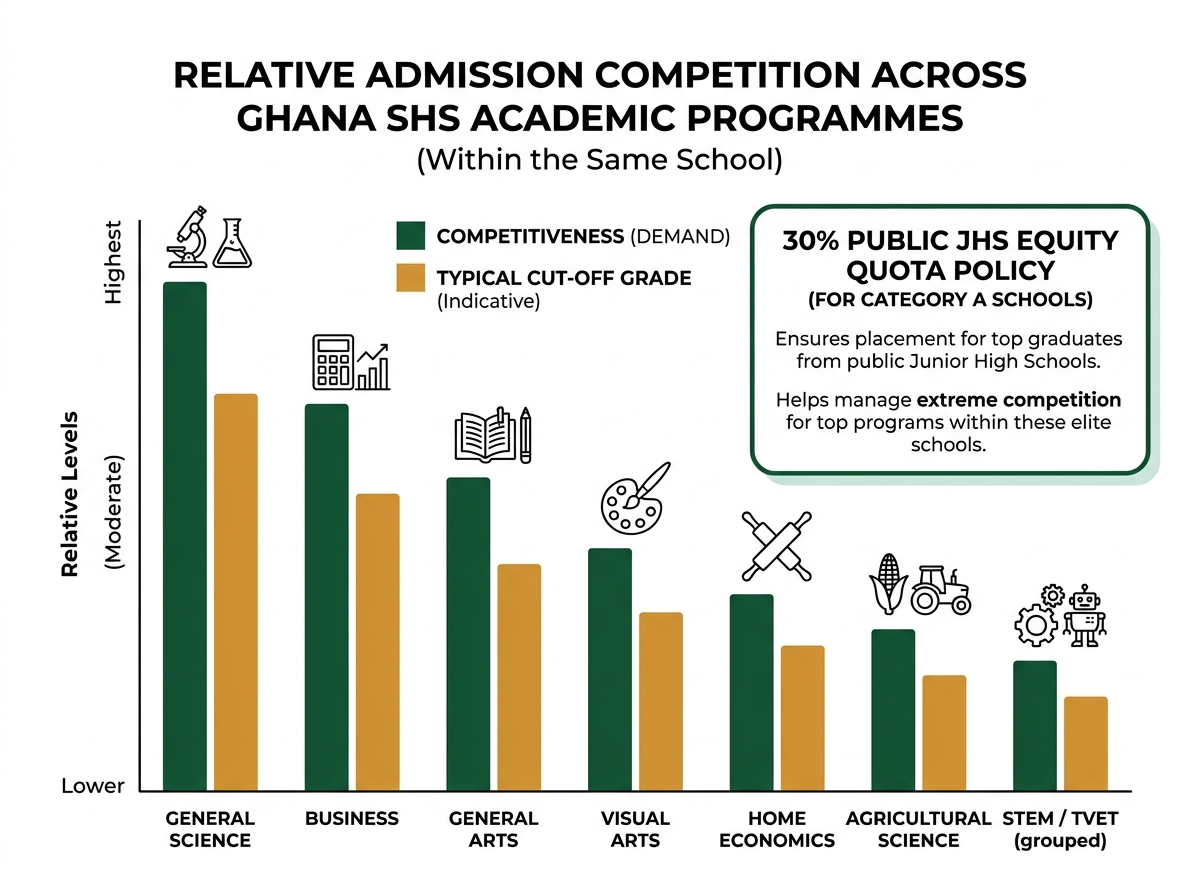
When planning which programme to attach to each of your six schools, compare how demand and subject readiness typically align across Ghana's major Senior High School and technical tracks:
| SHS / TVET Programme | Typical Demand Level | Key JHS Subject Foundations & Planning Notes |
|---|---|---|
| General Science & STEM | Highest in almost every Category A and B school | Requires strong grades (typically Grades 1 to 3) in Integrated Science and Core Mathematics. Laboratory bench capacity caps intake strictly, pushing cut-offs several points tighter than other tracks on the same campus. |
| Business | High to Very High | Strong Core Mathematics and English Language grades help considerably, especially for Financial Accounting and Cost Accounting electives. Often the second or third tightest track at urban boarding schools. |
| General Arts | High (largest intake, widest spread) | Supported by English Language, Social Studies, RME, French, and Ghanaian Language. Most schools run multiple General Arts streams (Economics/Geography vs. Literature/History/Government), creating more total seats than Science, though flagship Arts schools still fill rapidly. |
| Home Economics | Moderate to High | Draws on Career Technology and Integrated Science foundations (Food and Nutrition, Management in Living, Clothing and Textiles). Frequently admits candidates 2 to 5 aggregate points higher than General Science at the same school. |
| Visual Arts | Moderate | Builds on Creative Arts and Design skills (Graphic Design, Picture Making, Ceramics, Textiles, Sculpture). Studio capacity limits class size, but lower first-choice volume often creates accessible entry into top regional schools. |
| Agricultural Science | Moderate to Accessible | Grounded in Integrated Science and practical agronomy. Even prestigious heritage schools with agricultural farms often have meaningfully gentler aggregate cut-offs in Agricultural Science than in General Science. |
| Technical & TVET Institutes | Accessible to Moderate (high hands-on demand in cities) | Administered across GES technical tracks and Ghana TVET Service institutions (Engineering, Building Construction, Electricals, Hospitality, Garment Making, ICT). Offers direct competency pathways to National Polytechnics and Technical Universities. |
Never choose an academic programme you dislike merely to "sneak" into a famous school, because GES and individual heads of school strictly prohibit newly admitted Form 1 students from switching from Home Economics, Visual Arts, or Agricultural Science into General Science after reporting to campus. Only select a less-subscribed track if it genuinely matches your tertiary goals.
Public JHS equity quotas, Boarding vs. Day status, and Catchment selection rules
Beyond raw aggregates and programme demand, three structural policy rules inside the Ghana Education Service CSSPS guidelines directly shape where candidates are placed. Ignoring any one of these three rules is a leading cause of unexpected Round 1 disappointments.
1. The 30 percent Public JHS equity quota in Category A schools
To promote educational equity across districts, the Ministry of Education reserves 30 percent of total admission slots in every Category A Senior High School exclusively for graduates of public Junior High Schools. Placement for public JHS candidates runs across both the general merit pool and this protected 30 percent equity allocation, whereas candidates graduating from private Junior High Schools compete solely for the remaining open merit seats.
In practical terms, if you attended a private JHS in Accra, Kumasi, Tema, or Takoradi, your effective aggregate threshold for elite Category A schools is noticeably tighter than the general band suggests. A private school candidate with Aggregate 09 or 10 applying to the country's five or six most oversubscribed single-sex boarding schools faces intense raw-score competition, making it essential to include strong Category B boarding options from Choice 3 downward rather than filling four or five slots with ultra-competitive Category A choices.
2. Boarding versus Day status under Free SHS
When registering CSSPS choices, you must specify either Boarding or Day residential status for every school that offers both. Across Ghana, Boarding seats attract far heavier national demand than Day seats at the exact same school because families across all sixteen regions compete for finite dormitory beds, while Day seats primarily serve students living within daily commuting distance.
Two practical consequences follow. First, if you live within safe daily travel distance of a respected Category A or Category B school and your mock results sit in the borderline range, selecting that school as a Day student substantially improves your placement probability compared with selecting Boarding. Second, under Free Senior High School regulations, residential allocations are locked to audited dormitory bed counts. Do not select "Day" for a school four hours away from home assuming you can pay or lobby to convert to "Boarding" on reporting day — school heads are barred from unauthorized Day-to-Boarding conversions, leaving families scrambling for off-campus supervision.
3. The compulsory Catchment / Day backup rule
GES selection guidelines require candidates to include a compulsory Day option selected from schools within their immediate catchment area (typically within a 10- to 16-kilometre commuting radius of their home or Junior High School). Treat this compulsory slot seriously rather than picking a random school at the last minute: verify actual trotro or bus routes from your neighbourhood, inspect the programmes offered at nearby municipal or district day schools, and pick a campus where daily attendance for three years is genuinely practical.
Building a resilient choice list
Every BECE candidate selects six schools in ranked order, with a programme attached to each. The goal of a good list is to give the system a realistic path to placing you at a school you will be glad to attend, without leaving you exposed if your top choices fill up.
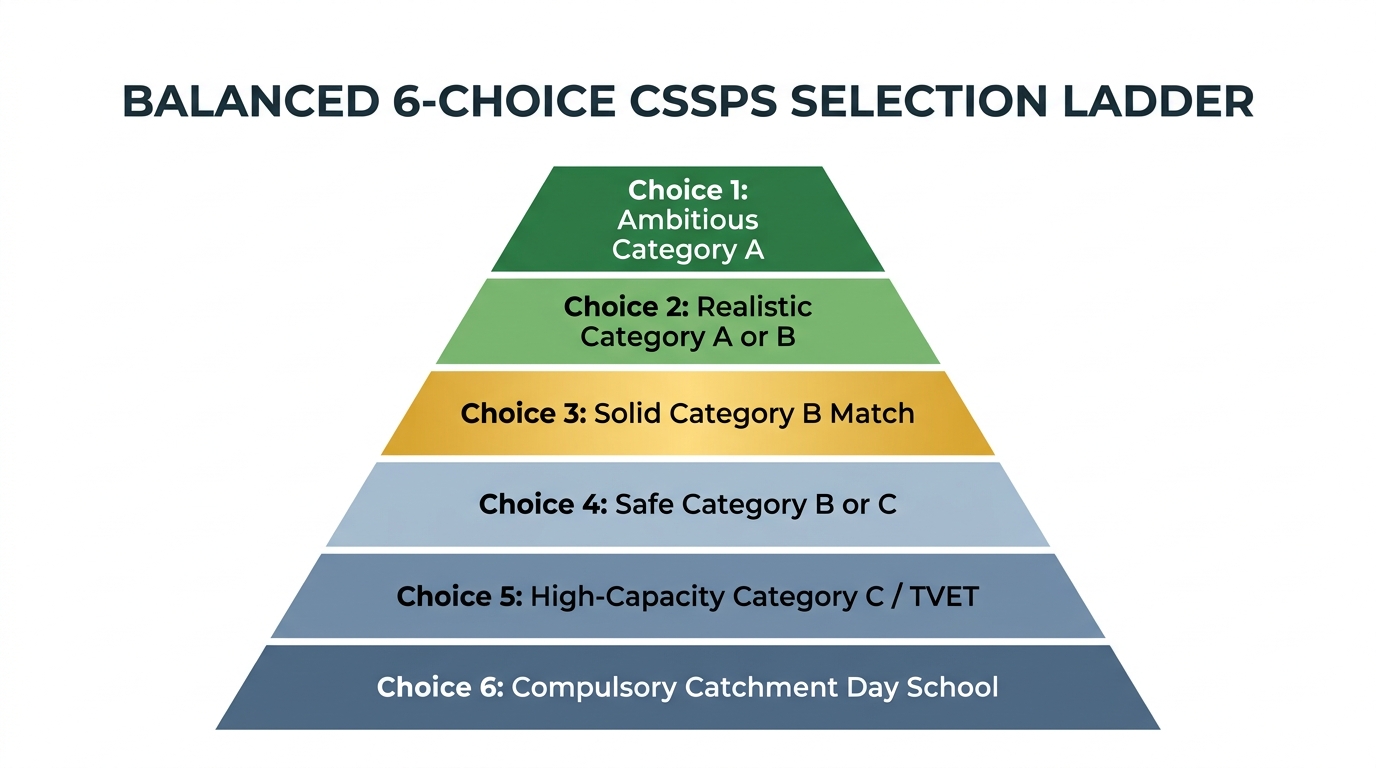
A practical structure looks like this. Two choices where your aggregate sits clearly inside the band, so the school is very likely to have space when your position comes up. Two choices where your aggregate sits at the borderline, giving you a genuine shot at a school you would love. And two choices where your aggregate is comfortably above the band, guaranteeing at least one or two placements even if the more competitive choices are full.
The order matters too, because the system tries your choices in the order you ranked them. Put the schools you most want at the top. Do not put a school you would only tolerate ahead of a school you would genuinely be happy at, on the theory that it is "safer". The safest school is one you would actually attend.
Programme choices matter as much as school choices. Within a single school, a General Science programme may fill at a much higher aggregate than a Visual Arts or Home Economics programme. If your aggregate is borderline for a school, choosing a programme that is less in demand at that school can make the difference between being placed and being passed over.
Worked CSSPS placement scenarios across three student profiles
Seeing how real candidates translate mock or final BECE grades into a six-school list makes abstract band rules concrete. The three scenarios below illustrate how school type, aggregate, programme choice, and residential status interact during CSSPS matching.
Private JHS Candidate in Greater Accra — Aggregate 09 (Targeting General Science)
Subject Breakdown: English 1, Core Maths 1, Integrated Science 1, Social Studies 2, Computing 2, French 2 (Aggregate 09, strong raw scores).
Strategic Analysis: Aggregate 09 sits inside the Category A High Chance band (6 to 10), but because the candidate attended a private JHS and wants General Science Boarding, ultra-oversubscribed Cape Coast and Accra Category A Science tracks could close at Aggregate 06 to 08 on raw-score tie-breakers. Listing four top Category A Science Boarding schools in a row would risk falling into Self-Placement.
Balanced 6-Choice Plan: Choice 1: Dream Category A General Science (Boarding). Choice 2: Less-saturated regional Category A or top-tier Category B General Science (Boarding). Choice 3: Strong Category B General Science (Boarding) where Aggregate 09 sits nine points inside the High Chance ceiling. Choice 4: Respected Accra Category A/B General Science (Day) within commuting distance. Choice 5: Solid Category C STEM/Science option. Choice 6: Compulsory Catchment Day School (General Science).
Public JHS Candidate in Ashanti Region — Aggregate 16 (Targeting General Arts / Business)
Subject Breakdown: English 2, Core Maths 3, Integrated Science 3, Social Studies 2, RME 3, Ghanaian Language 3 (Aggregate 16).
Strategic Analysis: Aggregate 16 is Low Chance for general Category A merit seats, yet because the student attended a public rural/municipal JHS, they qualify for the 30 percent Category A public JHS equity pool. At the same time, Aggregate 16 sits comfortably inside the Category B High Chance band (6 to 18).
Balanced 6-Choice Plan: Choice 1: Regional Category A General Arts (Boarding) to test eligibility under the 30 percent public JHS quota without risking the whole list. Choice 2: Strong Category B General Arts (Boarding). Choice 3: Second Category B Business or General Arts school (Boarding) with moderate historical demand. Choice 4: Category B General Arts (Day) in Kumasi metro/municipality. Choice 5: High-performing Category C Boarding school. Choice 6: Compulsory Catchment Day School (General Arts).
Municipal JHS Candidate — Aggregate 29 (Targeting Practical & Career Pathways)
Subject Breakdown: English 5, Core Maths 5, Integrated Science 6, Social Studies 5, Career Technology 4, Creative Arts 4 (Aggregate 29).
Strategic Analysis: All four core subjects are cleanly passed (Grades 5 and 6), keeping full placement eligibility intact, while the strongest marks sit in Career Technology and Creative Arts. Category A and Category B Boarding tracks are realistically out of reach, whereas Category C schools and Ghana TVET Service technical institutes offer direct first-round placement.
Balanced 6-Choice Plan: Choice 1: Moderate-demand Category B Day or Visual Arts / Technical track near home. Choice 2: Accredited Ghana TVET Service Technical Institute (Electrical Engineering Technology or Building Construction, Boarding). Choice 3: Category C Senior High Technical School (Visual Arts or Home Economics). Choice 4: District Category C Boarding school outside congested urban centres. Choice 5: Second TVET Institute or Community SHS. Choice 6: Compulsory Catchment Day School.
Common mistakes with CSSPS choices
A few errors show up repeatedly when families put together their CSSPS lists.
Choosing only Category A schools. If all six choices are the most competitive schools in the country, and your aggregate sits at the borderline of Category A, you may end up unplaced on the first round. Balance the list.
Ignoring programme demand. Two programmes at the same school can have very different effective cut-offs. Choosing a programme that matches your aggregate rather than the most popular programme at that school makes placement more likely.
Ranking by prestige rather than by fit. A school's category reflects historical demand, not necessarily educational quality for your specific interests. If a Category B school has a stronger programme in the subject you want, put it high on the list.
Submitting late or not at all. The CSSPS portal opens for a defined window. Choices submitted inside the window are the ones the system uses. Miss it, and you rely on self-placement or a second round, both of which narrow your options.
Not double-checking subject-specific requirements. Some programmes require a specific credit at a minimum grade regardless of aggregate. Read the requirements before you list a programme.
Assuming a strong aggregate is enough for any school. It is not. Demand at a specific school in a specific year is the factor no calculator can predict. That is why a balanced list matters.
What to do if the estimate looks discouraging
If the estimator returns a Low Chance result for the category you were hoping for, it is worth pausing before you interpret that as bad news. A few concrete steps can help.
Revisit the specific schools, not the category. Within Category C, for example, some schools are far more competitive than others. Look at the schools that placed candidates with aggregates similar to yours in previous years, and build the list around those.
Consider a technical or vocational route. Ghana's Technical and Vocational Education and Training (TVET) schools and programmes are excellent options for many students, and they often have spaces at higher aggregate bands. A strong TVET placement can lead to skilled employment or to a degree later on.
Speak to your JHS head teacher or the district education office. They see placement outcomes year after year and often have a clearer picture of which schools near you tend to fill up and which tend to have space. A five-minute conversation with them can be worth more than any calculator.
Plan for self-placement if needed. Self-placement exists for exactly this situation. If the first round does not produce a school you want, self-placement lets you choose from schools that still have space. Having a shortlist of two or three such schools ready before the window opens makes the process much faster.
Think about the longer term. A BECE placement is one step in a much longer educational path. Many students who did not get their first choice go on to excel at the school they were placed in, transfer later, or discover interests they would not have found at their original target. The school matters, but it is not the final word on anything.
Step-by-step post-results guide: CSSPS portal, Self-Placement, and Enrollment verification
Once WAEC releases provisional BECE results and the Ghana Education Service activates the annual placement run, families move from planning to formal admission verification. Following the official sequence below saves money, prevents portal mistakes, and protects you against placement fraud.
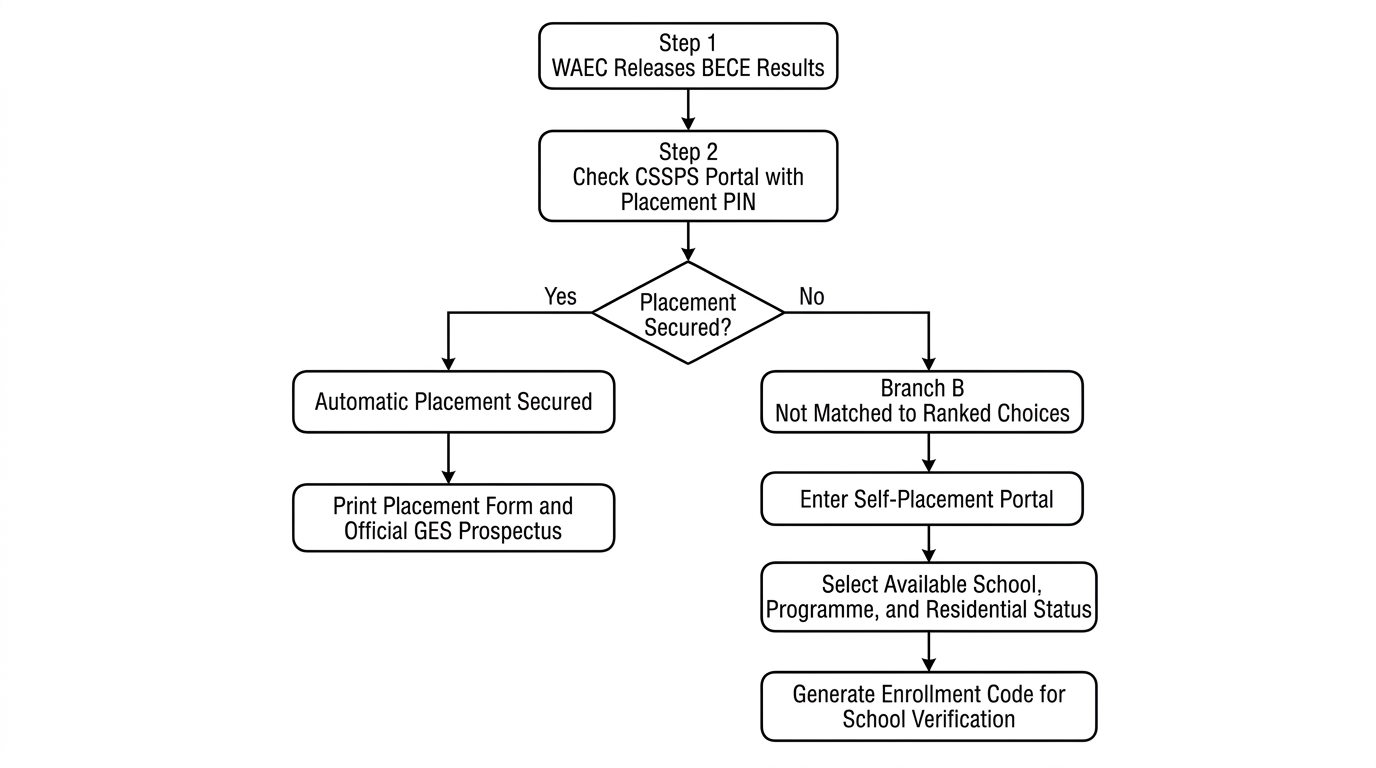
- Confirm submitted choices during the GES verification window: Shortly before the placement algorithm runs, GES typically opens an online or SMS confirmation window so candidates can verify their ten-digit BECE Index Number, gender, public/private JHS classification, and the exact school codes, programme codes, and Boarding/Day selections recorded by their school. Catching a mistyped school code here prevents irreversible misplacement.
- Check your placement status on the official CSSPS portal: When GES announces placement release, visit the official portal (cssps.gov.gh), enter your ten-digit BECE Index Number (ending with the two-digit examination year suffix, such as
26) alongside any required e-voucher PIN or verification credential specified by GES for that academic year, and retrieve your status. - Path A — Automatic Placement secured: If the system matched you to one of your six ranked choices, download and print your official Placement Form and Enrollment Form, note the unique Enrollment Code printed on the slip, and prepare to complete online or on-campus registration at the assigned Senior High School within the reporting dates announced by GES.
- Path B — Self-Placement module (if unmatched in Round 1): If all six ranked choices filled before your position came up, the portal automatically routes you to the Self-Placement screen. Filter live available schools by Region, School, Programme, and Residential Status (Day or Boarding). Because popular vacancies on the Self-Placement portal fill in real time as thousands of unplaced students log in simultaneously, have a pre-researched backup list ready and confirm carefully — GES imposes strict limits on how many times a candidate may change a Self-Placement selection before locking enrollment.
- Use only the harmonised GES National Prospectus and reject placement middlemen: Under Free SHS directives, GES publishes a single standardized National Prospectus categorized into Group A, B, and C basic student items so schools cannot impose unapproved luxury levies prior to admission. Above all, never pay any individual, internet cafe agent, or alleged "protocol contact" claiming they can alter CSSPS placements or buy a Category A slot. CSSPS records are centrally audited against WAEC databases; unofficial placement letters are rejected at school biometric/code verification desks, leaving victims both out of pocket and unplaced. For genuine administrative errors (such as a male student mistakenly placed in a girls' school or incorrect JHS ownership data), visit an official GES Regional or National CSSPS Solution Centre in person with your certified BECE result slip.
Where this estimator stops
This tool applies a set of indicative bands to your aggregate and category. That is all it does. It does not know which schools you will list, which programmes you will choose, how many other candidates will apply to those same schools in the year you are applying, where the vacancies sit, or what the current CSSPS rules are.
What it does give you is a starting point. Use it to understand where your aggregate roughly sits relative to each category. Use it to prompt conversations with your head teacher, your family, and other students who have been through the process before. The actual placement letter that comes out of the CSSPS run is the only thing that decides where you go.
Sources
- Ghana Education Service. Computerised School Selection and Placement System (CSSPS) Selection Guidelines and School Register. ges.gov.gh
- Ministry of Education, Ghana. Secondary Education Policy, Category A Equity Quota, and SHS Placement Directives. moe.gov.gh
- CSSPS Official Portal. National School Selection, Automatic Placement, and Self-Placement Platform. cssps.gov.gh
- West African Examinations Council — Ghana National Office. Basic Education Certificate Examination (BECE) Grading Scale and Subject Regulations. waecgh.org
- Ghana TVET Service (GTVETS). Technical and Vocational Education and Training Placement Institutions and Programmes. gtvets.gov.gh
- Free Senior High School Secretariat, Ghana. Harmonised National SHS Prospectus and Residential Admission Guidelines. freeshs.gov.gh