On this page
- What this calculator does
- The two systems in Ghanaian higher education
- How the 4.0 GPA scale works
- How the CWA percentage scale works
- The GTEC honours classification bands
- Why credit weighting matters more than any single grade
- A worked example
- Common mistakes that damage the cumulative figure
- Where this calculator stops
- UG Legon vs KNUST vs UCC vs UPSA grading regulations
- The mechanics of trailing courses, resits, and academic probation
- Worked CGPA and CWA recovery modeling across academic years
- Long essay, industrial attachment, and project credit weighting
- International postgraduate conversion: WES, UK, and German standards
- Transcript auditing and student portal troubleshooting
- Sources
What this calculator does
This tool takes the courses you registered for a semester, the credit hours attached to each one, and either your letter grade or your raw examination mark, and returns three figures: your semester standing, your cumulative standing if you enter a prior record, and the GTEC degree classification that your current record sits in. It handles both of the two systems Ghanaian universities use, so the same tool works whether you are at UG Legon, KNUST, UCC, UPSA, or any other public or private university.
The arithmetic itself is short. What makes it worth a dedicated page is the split between the two systems. A student at KNUST works with raw percentages while a student at Legon works with letter grades, and the two produce numbers that look different but mean the same kind of thing. Confusing them is the single most common mistake new students make when reading their own transcript for the first time. This calculator keeps the two systems separate and labels every figure with the correct scale, so no one confuses a CWA percentage with a GPA on the 4.0 scale.
Every calculation runs inside the browser. The tool does not upload course codes, grades, or cumulative records to any server. If the AI insight button is pressed, only an anonymous summary of the calculation system, the number of courses, the semester score, the cumulative score, and the classification band is sent to a small serverless function that runs once and then stops.
The two systems in Ghanaian higher education
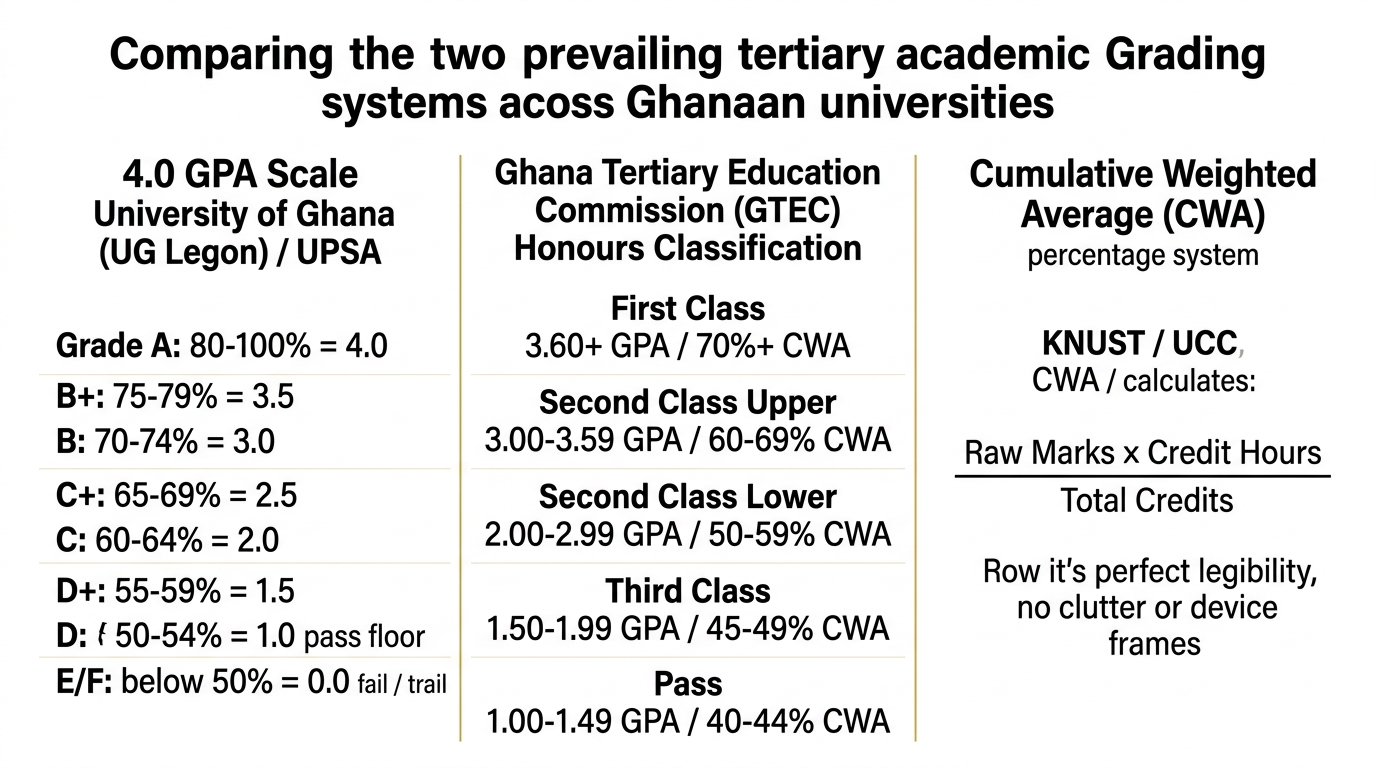
Ghanaian universities operate under a national framework set by the Ghana Tertiary Education Commission, but each institution applies its own specific scale within that framework. In practice, the systems cluster into two groups.
The 4.0 Grade Point Average system is used by the University of Ghana, the University of Professional Studies Accra, Ghana Communication Technology University, and most private universities. Letter grades from A down to F are converted to grade point values, those values are multiplied by the credit hours of each course to produce quality points, and the total quality points are divided by total credits to give the GPA. This is the more widely recognised system internationally, and it is what most graduate school applications expect to see.
The cumulative weighted average system is used by Kwame Nkrumah University of Science and Technology, the University of Cape Coast, the University of Mines and Technology, and the University of Energy and Natural Resources. Under CWA, each course contributes its raw percentage mark multiplied by the credit hours of the course. The total weighted score is divided by total credits to give a percentage figure between zero and one hundred. This system keeps the raw examination performance visible throughout, which many faculty prefer because it avoids the information loss that happens when a mark of 79 per cent and a mark of 70 per cent both become the letter grade B.
Some technical universities and smaller private institutions use either system depending on the programme. The academic handbook for each programme states which one applies, and it is worth checking that handbook before you register, because the two systems are not interchangeable at the level of individual grades.
How the 4.0 GPA scale works
The 4.0 scale is more familiar to most students because it is the standard in the United States, Canada, and much of the English-speaking world. In Ghana the scale runs as follows.
| Letter grade | Percentage | Grade points |
|---|---|---|
| A | 80 to 100 | 4.0 |
| B+ | 75 to 79 | 3.5 |
| B | 70 to 74 | 3.0 |
| C+ | 65 to 69 | 2.5 |
| C | 60 to 64 | 2.0 |
| D+ | 55 to 59 | 1.5 |
| D | 50 to 54 | 1.0 |
| E | 45 to 49 | 0.5 |
| F | 0 to 44 | 0.0 |
Every course produces a quality point value equal to the credit hours multiplied by the grade points of the letter grade earned. A three-credit course with an A contributes twelve quality points. The same course with a C contributes six. The semester GPA is the sum of all quality points divided by the sum of all credit hours, and the cumulative GPA is the same calculation applied across every graded course the student has completed at the institution.
Two grades require a note. The D grade at the 4.0 scale in Ghana is technically a pass, but many programmes require a C or above in prerequisite courses before allowing the student to progress to the next level. The E grade is a trail, meaning the student must resit the course before graduation. The F grade is a straight fail, and it earns zero grade points while still counting toward the credit load, which is why a single F can pull a semester GPA down by more than half a point.
How the CWA percentage scale works
The CWA scale is simpler to describe because it operates directly on percentages. Every course produces a weighted contribution equal to its credit hours multiplied by the raw examination mark. The total weighted contribution is divided by total registered credits to give the weighted average.
An example makes the arithmetic clear. A three-credit course with a mark of 82 contributes 246 to the weighted total. A two-credit course with a mark of 68 contributes 136. A one-credit seminar with a mark of 75 contributes 75. If those are the only three courses in the semester, the total weighted contribution is 457 across six credits, and the semester CWA is 76.17 per cent.
One feature of the CWA scale that students sometimes miss: because the marks are preserved as raw percentages rather than being compressed into letter bands, the same letter equivalent can produce very different CWAs. A mark of 79 per cent is just under the A band, and a mark of 70 per cent is at the top of the B band. Both would round to similar grade points under the GPA system, but under CWA the nine-point difference accumulates across a degree and materially changes the final classification. Students on the CWA system therefore benefit from chasing the last few marks in each course, not just the band boundaries.
The GTEC honours classification bands
The Ghana Tertiary Education Commission publishes the national standard for degree classifications, and every accredited university applies those bands within its own system. The bands are the same for both the GPA and CWA systems, just expressed on the appropriate scale.
| Classification | 4.0 GPA range | CWA percentage range |
|---|---|---|
| First Class Honours | 3.60 to 4.00 | 70.00 and above |
| Second Class Upper | 3.00 to 3.59 | 60.00 to 69.99 |
| Second Class Lower | 2.00 to 2.99 | 50.00 to 59.99 |
| Third Class | 1.50 to 1.99 | 45.00 to 49.99 |
| Pass | 1.00 to 1.49 | 40.00 to 44.99 |
| Fail or Probation | Below 1.00 | Below 40.00 |
The classification is computed on the cumulative standing at graduation, not on any single semester. That distinction matters because it means a student's classification is decided across the whole degree, weighted by credit hours. A strong final year can move the cumulative figure up, but only in proportion to how many credits the student has already completed. This is the arithmetic reality that makes it hard to move from Second Class Lower to Second Class Upper in the final year if the first two years were weak.
Why credit weighting matters more than any single grade
Both systems weight every grade by the credit hours attached to the course, and that weighting is the single most important mechanic in the whole calculation. A three-credit course has three times the effect of a one-credit course on the final figure. A four-credit course has four times the effect. Under the GPA system, an A in a three-credit course contributes twelve quality points, while the same A in a one-credit course contributes only four. Under the CWA system, a mark of 80 in a three-credit course contributes 240 weighted points, while the same mark in a one-credit course contributes only 80.
The practical implication is that a student who wants to raise their cumulative figure should prioritise the courses with the highest credit counts, because those are the ones that move the number furthest. A student who wants to protect an existing strong cumulative figure should defend the high-credit courses above everything else, because a slip in a four-credit core course costs four times as much as a slip in a one-credit elective. Study planning that treats all courses as equal is study planning that ignores the arithmetic of the system.
There is a second-order effect that students rarely anticipate. Because a cumulative figure is a weighted average across every course completed, the marginal impact of any single new grade shrinks as the degree progresses. In the first year, a single semester of strong grades can move the cumulative figure by a full point. By final year, the same semester of strong grades might move the cumulative figure by only a few hundredths. That is why early semesters matter disproportionately, and why the first two years deserve the strongest academic effort even though the immediate stakes feel lower than they do in final year.
A worked example
Take a Level 200 student at the University of Ghana who registered five courses totalling fifteen credit hours in a single semester. The courses and grades are as follows.
| Course | Credits | Grade | Grade points | Quality points |
|---|---|---|---|---|
| MATH 221 Calculus II | 3 | A | 4.0 | 12.0 |
| CSCD 205 Data Structures | 3 | B+ | 3.5 | 10.5 |
| STAT 223 Applied Statistics | 3 | A | 4.0 | 12.0 |
| PHYS 201 Classical Physics | 3 | B | 3.0 | 9.0 |
| CBAS 210 Academic Writing II | 3 | A | 4.0 | 12.0 |
The sum of the quality points is twelve plus ten point five plus twelve plus nine plus twelve, which is fifty five point five. The sum of the credits is fifteen. The semester GPA is fifty five point five divided by fifteen, which is exactly three point seven. That places the student in the First Class band for the semester.
Now suppose the same student has a prior record of forty five completed credits with a cumulative GPA of three point four two. The prior quality points are forty five times three point four two, which is one hundred and fifty three point nine. Adding the current semester's fifty five point five gives a total of two hundred and nine point four across sixty total credits. The new cumulative GPA is two hundred and nine point four divided by sixty, which is three point four nine. The cumulative figure has moved up from three point four two to three point four nine, still in the Second Class Upper band but closing on the First Class threshold at three point six zero.
If the same student had taken a four-credit capstone course instead of the three-credit elective and earned an A in it, the semester total would have been sixteen credits and sixty seven point five quality points, giving a semester GPA of four point two one nine, which rounds to a strong first class. The cumulative would have moved further. That is the credit weighting effect in action: the same letter grade produces a different impact depending on how many credits sit behind it.
Common mistakes that damage the cumulative figure
Six mistakes come up repeatedly when students damage their cumulative standing without meaning to.
Neglecting the highest-credit courses. The courses with four or five credits move the cumulative figure disproportionately, and a student who spends equal study time on all courses is spreading effort evenly across wildly unequal mathematical weights. Prioritising the heavy courses is not cramming strategy; it is arithmetic.
Trailing a core course and moving on. A trail stays on the record until it is cleared, and until then it occupies a slot in the credit total with zero quality points behind it. Some students trail a first-year course, progress to second and third year, and discover in final year that they cannot graduate because the trail was never cleared. Handle trails immediately, at the supplementary exam if possible.
Assuming D is a passing grade everywhere. A D is a pass in the aggregate sense, but many departments require a C or above in prerequisite courses before allowing a student to take upper-level courses in the same subject. A D in Calculus I can block registration for Calculus II, which then pushes the whole degree behind by a semester or more.
Treating the first year as a warm-up. The first year carries the same mathematical weight as any other year in the cumulative average, and because it sets the base for everything that follows, a weak first year is harder to recover from than a weak final year. The arithmetic is unforgiving in exactly the direction that punishes students who coast in their first two semesters.
Ignoring the difference between the two systems. A student who transfers from a CWA institution to a GPA institution, or vice versa, cannot simply relabel the existing number. The two scales are not equivalent at the level of individual marks, and the transcript conversion that happens during transfer is done by the receiving institution using its own tables. Do not assume your 68 per cent CWA is a 3.0 GPA or a 3.5 GPA until you have seen the conversion on paper.
Not checking the handbook each year. Grade bands and classification thresholds occasionally shift when academic boards revise them. A student who assumes the same thresholds apply throughout a four-year degree can be surprised in final year when the university has adjusted the band. Read the academic handbook at the start of each academic year, not just at the start of the degree.
Where this calculator stops
This tool estimates semester and cumulative standing from the courses and grades you enter, applying the standard GPA and CWA formulas and the published GTEC classification bands. It does not know your institution's specific rules on trails, course substitutions, transfer credits, or special programmes, and it does not know any individual circumstances that might apply to your record. If your institution publishes a different grade band, or applies a rule that changes the calculation, the official transcript will differ from the estimate here.
It also does not model the effect of supplementary examinations, which some institutions record with a capped grade or as a separate entry, nor the treatment of repeated courses, which varies between averaging the two attempts and using only the second. For a specific case, the registrar's office is the authority, and the transcript they issue is the document that governs. This tool is a planning aid, not an official record.
What it does give you is a fast, transparent, private estimate, so you can see where you stand, test how much a change in one course grade would move the cumulative figure, and plan your next semester realistically. The GTEC band and the projected cumulative score are useful reference points for conversations with your academic adviser, and they are a reasonable starting point for any application that asks you to self-report your GPA or CWA.
UG Legon vs KNUST vs UCC vs UPSA grading regulations
While the Ghana Tertiary Education Commission (GTEC) publishes harmonised benchmark recommendations, individual public and chartered private universities enforce distinct institutional statutes. Navigating your degree classification requires understanding the specific operational regulations of your awarding university:
| University | Grading Metric | Pass Floor & Trail Trigger | First Class Honours Threshold | Key Examination Policy Nuance |
|---|---|---|---|---|
| University of Ghana (UG Legon) | 4.0 GPA / CGPA | Grade D (50% / 1.0 GP) is minimum pass. Grade E (45-49%) and F (0-44%) are failing grades (trails). | 3.60 to 4.00 CGPA | Grade E (0.5 GP) awards partial quality points but still constitutes a trailed course that must be registered and cleared before graduation. |
| Kwame Nkrumah University of Science and Technology (KNUST) | CWA (Cumulative Weighted Average %) | Raw mark below 50.0% is a trail (in technical and engineering disciplines, 40-49% may open a referral depending on faculty board). | 70.0% CWA and above | CWA preserves exact marks without letter grade compression. A 79% score maintains an exact 9-percentage-point advantage over a 70% mark. |
| University of Cape Coast (UCC) | Dual (CWA and 4.0 CGPA) | Marks below 50.0% (Grade E/F or raw <50%) constitute an uncleared trail. | 70.0% CWA or 3.60 CGPA | College of Education and Allied Health enforce strict continuous assessment quotas (40% quizzes and mid-sem, 60% end-of-semester exam). |
| University of Professional Studies, Accra (UPSA) | 4.0 GPA / CGPA | Grade D (50% / 1.0 GP) pass floor. Marks below 50% are failing trails. | 3.60 to 4.00 CGPA | Focuses heavily on professional accreditation alignment (ICAG, CIM, ACCA exemptions tied to maintaining second-class upper standing). |
| University for Development Studies (UDS) | 4.0 GPA / CGPA | Grade D (50% / 1.0 GP) pass floor; TTFPP fieldwork units carry compulsory passing prerequisites. | 3.60 to 4.00 CGPA | Third Trimester Field Practical Programme (TTFPP) carries intensive community credits that compute directly into cumulative GPA. |
The mechanics of trailing courses, resits, and academic probation
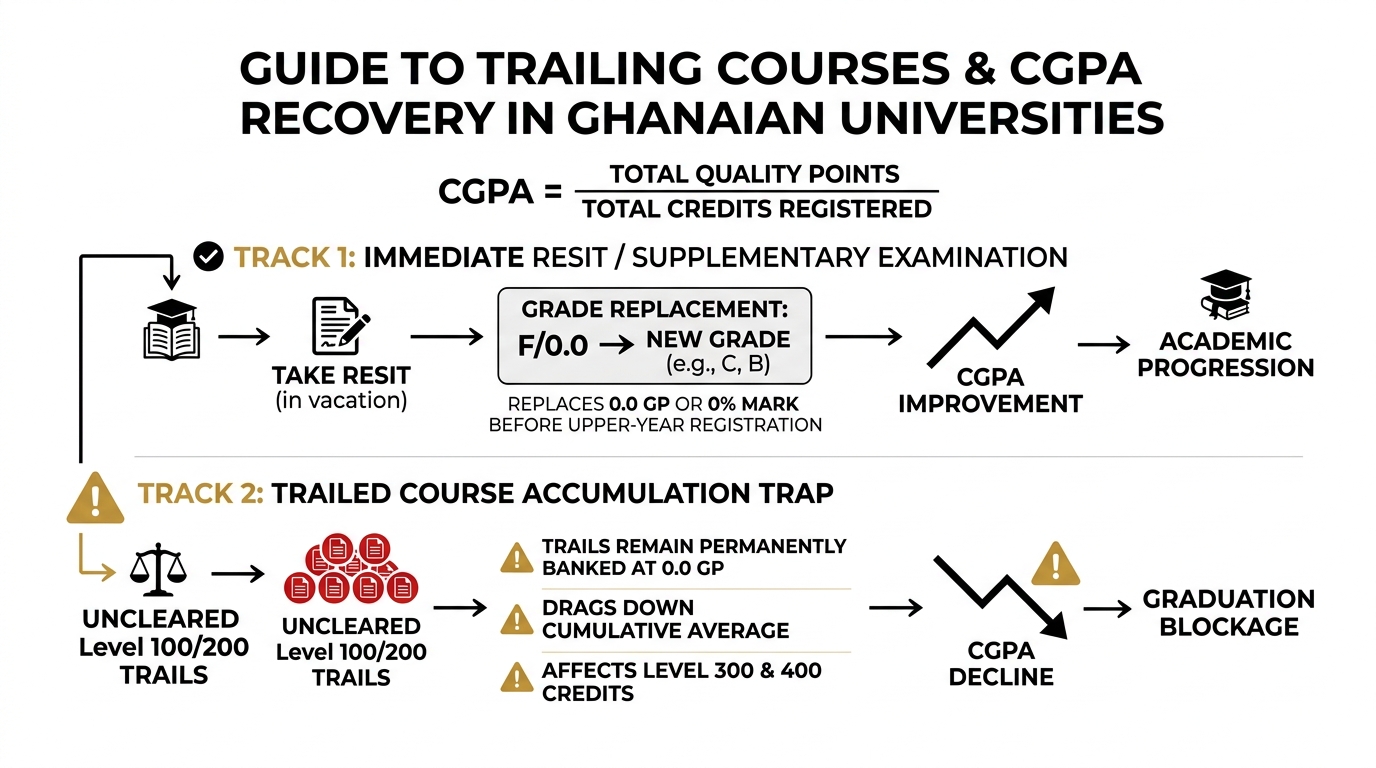
In Ghanaian tertiary education, a failed module is universally termed a trail. Because public universities operate on an accumulative credit framework, understanding how trails are recorded, cleared, and computed is essential for every enrolled student:
1. How Trails Drag Down the Cumulative Figure
When you fail a course at Level 100 or Level 200 (receiving an F at 0.0 GP under the GPA scale or a raw mark under 50% under CWA), the credit hours attached to that course are added to your cumulative credit denominator, while contributing zero (or negligible) quality points to your numerator. For example, trailing a 3-credit course at the University of Ghana adds 3 credits to your denominator while providing 0.0 quality points. That dragging deficit remains permanently on your cumulative ledger until the trail is formally cleared.
2. Vacation Resit Examinations vs Re-Registration
Most universities host an official supplementary or resit examination window during the long vacation (typically in July and August):
- Vacation Resit Sitting: Candidates register for the resit paper upon payment of the approved departmental resit examination fee. If the resit is passed, the newly earned grade replaces the failing mark in the cumulative CGPA or CWA equation, lifting the average before the new academic year commences.
- Grade Capping on Resits: At some institutions (including specific faculties at KNUST and UCC), a trailed course cleared via a supplementary examination may have its recorded grade point capped at Grade C (2.0 GP) or 50% on the transcript, ensuring a second attempt does not unjustly inflate honors standing relative to candidates who passed cleanly on the first sitting.
- Full Course Re-Registration: If a student misses the supplementary window or fails the resit, they must formally re-register the trailed course in a subsequent semester when it is offered. This consumes credit slots from the student's maximum semester credit ceiling (normally capped at 18 to 21 credits per semester).
3. Academic Probation and Dismissal (Withdrawn for Poor Academic Performance)
Universities establish statutory safety floors to identify struggling students:
- Probationary Warning (Level 100 / Level 200): At UG Legon, a student whose cumulative Grade Point Average falls below 1.50 at the end of any academic year is placed on probation. At KNUST, a student whose CWA drops below 45.0% receives a formal probation letter.
- Withdrawal / Discontinuation: If a student on probation fails to elevate their CGPA above 1.50 (or CWA above 45.0%) at the end of the subsequent probationary academic year, university regulations mandate that the student be withdrawn for poor academic performance (withdrawn PAP). Understanding these thresholds allows students to take timely corrective measures with academic counselors before statutory dismissal triggers.
Worked CGPA and CWA recovery modeling across academic years
Many students enter Level 300 with an average lower than desired and wonder: "Can I mathematically still graduate with a Second Class Upper or First Class Honours?" The answer depends entirely on credit accumulation momentum.
Mathematical Model 1: The 4.0 GPA Scale Recovery (UG Legon / UPSA)
Consider an undergraduate student entering Level 300 Semester 1 at the University of Ghana who has completed 64 credit hours across Levels 100 and 200 with a cumulative CGPA of 2.85 (placing them in the Second Class Lower band). Their goal is to graduate with a Second Class Upper Division (requiring a final CGPA of at least 3.00) over a total four-year degree load of 128 credits. The student has 64 credits remaining across Levels 300 and 400.
To determine the exact grade average required across the final two years, we apply the cumulative quality point equation:
- Calculate Banked Quality Points: 64 completed credits multiplied by 2.85 CGPA = 182.40 quality points currently accumulated.
- Calculate Total Quality Points Needed for Graduation: 128 total graduation credits multiplied by target 3.00 CGPA = 384.00 quality points required.
- Determine Quality Point Deficit: 384.00 minus 182.40 = 201.60 quality points required across the remaining 64 credit hours.
- Compute Required Upper-Year GPA: 201.60 divided by 64 = 3.15 GPA.
Strategic conclusion: The student needs to maintain an average of 3.15 GPA across Levels 300 and 400. In practice, this means averaging predominantly B+ (3.5) and B (3.0) grades across all remaining courses. If the student entered Level 400 (with only 32 credits remaining) needing the same recovery, the required final-year GPA would rise to 3.30, demonstrating that earlier interventions yield significantly wider recovery windows.
Mathematical Model 2: The CWA Percentage Recovery (KNUST / UCC)
Now consider an engineering or science undergraduate at KNUST who enters Level 400 (final year) having completed 105 credit hours with a CWA of 66.50% (Second Class Upper Division). Their ambition is to break into First Class Honours (which strictly requires a CWA of 70.00%). The final year carries 35 credits, bringing the total graduation baseline to 140 credit hours.
- Calculate Banked Weighted Product: 105 completed credits multiplied by 66.50% CWA = 6,982.50 weighted marks banked.
- Calculate Required Graduation Weighted Product: 140 total credits multiplied by 70.00% CWA = 9,800.00 weighted marks needed.
- Determine Weighted Deficit: 9,800.00 minus 6,982.50 = 2,817.50 weighted marks needed across the final 35 credits.
- Compute Required Final-Year CWA: 2,817.50 divided by 35 = 80.50% CWA.
To lift their CWA from 66.50% to 70.00%, the student must achieve a staggering 80.50% average across all Level 400 courses. While mathematically possible, scoring an 80.50% average in advanced final-year engineering courses is extraordinarily demanding. This demonstrates why students must target high marks from Level 100 rather than counting on late-stage CWA miracles.
Long essay, industrial attachment, and project credit weighting
A frequent blind spot for Ghanaian undergraduates is failing to anticipate the massive credit weighting attached to senior-year capstone components:
- Final-Year Long Essay / Undergraduate Dissertation: In humanities, social sciences, and business faculties, the Long Essay typically carries 6 credit hours (often distributed as 3 credits for Proposal/Literature Review in Semester 1, and 3 credits for Fieldwork/Final Defense in Semester 2). In engineering and computer science, capstone projects often carry 6 to 8 credits. Earning an A (4.0 GP) in a 6-credit project yields 24 quality points; earning a C (2.0 GP) forfeits 12 potential points.
- Industrial Attachment / Vacation Internship: Many accredited programs mandate structured industrial attachments between Levels 200 and 300, or Levels 300 and 400. In technical and applied science faculties, attachment reports and industry supervisor assessments carry 3 to 6 credit hours. Because attachment grades directly enter the cumulative denominator, treating internships casually can drag down an otherwise solid academic average.
- University Required Courses (UGRC Modules): General African Studies, Critical Thinking, Academic Writing, and Introduction to ICT carry 2 to 3 credits each. Because UGRC courses are compulsory graduation requirements across public universities, failing or underperforming in these non-major modules penalizes your cumulative average with the exact same mathematical weight as your departmental core courses.
International postgraduate conversion: WES, UK, and German standards
Graduating seniors from Ghanaian universities seeking admission to master's programs in the United Kingdom, Canada, the United States, or Europe frequently need to interpret how Ghanaian credentials translate into foreign systems:
| Ghanaian GTEC Classification | Indicative 4.0 GPA (UG/UPSA) | Indicative CWA (KNUST/UCC) | UK Degree Class Equivalent | US GPA / WES Equivalent | German Bavarian Scale |
|---|---|---|---|---|---|
| First Class Honours | 3.60 – 4.00 | 70.0% – 100% | First Class (1st) | 3.75 – 4.00 GPA | 1.0 – 1.6 (Sehr gut) |
| Second Class Upper Division | 3.00 – 3.59 | 60.0% – 69.9% | Upper Second Class (2:1) | 3.25 – 3.74 GPA | 1.7 – 2.5 (Gut) |
| Second Class Lower Division | 2.00 – 2.99 | 50.0% – 59.9% | Lower Second Class (2:2) | 2.50 – 3.24 GPA | 2.6 – 3.3 (Befriedigend) |
| Third Class | 1.50 – 1.99 | 45.0% – 49.9% | Third Class (3rd) | 2.00 – 2.49 GPA | 3.4 – 3.9 (Ausreichend) |
| Pass Degree | 1.00 – 1.49 | 40.0% – 44.9% | Pass Degree | 1.50 – 1.99 GPA | 4.0 (Ausreichend) |
| Fail / Trailed | Below 1.00 | Below 40.0% | Fail | Below 1.50 GPA | 5.0 (Nicht ausreichend) |
World Education Services (WES) Evaluation Note: In evaluation reports for North American institutions, credential agencies like WES evaluate Ghanaian transcripts on a course-by-course basis. Because a Ghanaian mark of 70% is considered First Class / Distinction in the British colonial tradition, evaluators map a 70%+ score to an American 'A' grade (4.0). Consequently, a Ghanaian student with a 72% CWA or 3.65 GPA frequently receives an equivalent 3.80+ US GPA from foreign credential evaluators.
Transcript auditing and student portal troubleshooting
To avoid administrative surprises on university management portals (such as UG's MIS Web, KNUST's AIM App, UCC's Student Portal, or UPSA's USIS), follow this procedural checklist at the close of every semester:
- Check for Incomplete or Missing Marks (IC / INC): If a lecturer fails to submit exam results on time, the portal records an Incomplete (IC) or missing mark. Inquire with your department examination officer immediately. If left unresolved into the next semester, automated algorithms can default unsubmitted courses into an administrative grade of F (0.0 GP), severely distorting your cumulative record.
- Audit Registered Credit Hours Against Transcript Slips: Verify that the credit hours listed on your portal match your approved departmental faculty syllabus. A clerical error entering a 3-credit course as 2 credits reduces your earned quality points when calculating cumulative standing.
- Retain Continuous Assessment (CA) Receipts: In Ghanaian universities, continuous assessment (interim quizzes, assignments, class presentations) accounts for 30% to 40% of your course mark, while the end-of-semester exam accounts for 60% to 70%. Retain marked CA scripts or portal screenshot confirmations to resolve grade discrepancies during the statutory two-week post-results remarking window.
- Track Prerequisite Sequences Early: Avoid registering for advanced modules (e.g. Level 300 Econometrics or Level 300 Structural Analysis) before confirming that you have cleared all prerequisite Level 100 and 200 foundational modules. Failing a prerequisite can invalidate registration for subsequent units, forcing you to extend your degree duration.
Sources
- Ghana Tertiary Education Commission (GTEC). Tertiary Education Policy, Quality Assurance, and National Standards. gtec.edu.gh
- University of Ghana. Handbook for Junior Members and Academic Regulations. ug.edu.gh
- Kwame Nkrumah University of Science and Technology. Academic Regulations and CWA Guidelines. knust.edu.gh
- University of Cape Coast. Directorate of Academic Affairs and Student Handbook. ucc.edu.gh
- University of Professional Studies, Accra (UPSA). Academic Handbook and Grading Regulations. upsa.edu.gh
- Ministry of Education, Ghana. Tertiary Education Policy and Sector Strategy. moe.gov.gh