On this page
- What the KCSE is and what the mean grade measures
- The twelve-point KNEC grade scale and performance bands
- The five subject groups in the Kenyan secondary curriculum
- The seven-subject aggregate calculation formula
- Worked calculation examples across different student profiles
- Tertiary admission pathways and mean grade cutoffs
- TVET academic progression: How KNQA allows laddering to a degree
- The KUCCPS Weighted Cluster Points (WCP) formula explained
- Subject cluster requirements for competitive university degree programmes
- Common mistakes when self-calculating KCSE points
- Key post-exam timeline and KUCCPS application checklist
- Where this calculator stops and how to plan next steps
- Sources and official regulatory bodies
What the KCSE is and what the mean grade measures
The Kenya Certificate of Secondary Education (KCSE) is the national terminal examination administered at the conclusion of Form 4 under the 8-4-4 and emerging competency pathways in Kenya. Set, moderated, marked, and certified exclusively by the Kenya National Examinations Council (KNEC), this examination serves as the single most critical academic filter in the Kenyan educational landscape. Every formal pathway a secondary school graduate pursues—whether direct government-sponsored entry into a university undergraduate degree, enrollment in a diploma programme at a national polytechnic, or admission to a hands-on artisan craft course—is anchored directly in KCSE certification.
When KNEC officially releases results, candidates receive two critical sets of metrics. The first metric consists of individual subject performance grades, evaluated on a twelve-level scale descending from Grade A (the highest distinction) to Grade E (the lowest level). The second metric is the candidate overall mean grade, represented by a single letter grade (such as A, B+, or C) alongside a cumulative aggregate points score calculated out of a maximum possible 84 points. This overall score functions as the primary eligibility threshold for university and tertiary placement under the Kenya Universities and Colleges Central Placement Service (KUCCPS).
A critical point of confusion for many students and parents is that the KCSE mean grade is not a simple arithmetic average of examination percentage scores, nor is it calculated across every subject a candidate sat during the examination period. Secondary candidates in Kenya routinely sit eight or nine subjects across their final two years. However, KNEC evaluates mean grade performance using a rigid, standardized seven-subject formula governed by national curriculum grouping rules. Each of the seven eligible subject grades is translated into a standardized integer point score ranging from 1 to 12. These points are summed to generate an aggregate score out of 84, which is then divided by 7 to determine the candidate mean grade. Understanding how these subjects are selected and how points accumulate is essential for making informed secondary subject selections and executing realistic post-secondary career planning.
The twelve-point KNEC grade scale and performance bands
KNEC operates an established twelve-point standardized grading system. Every registered candidate across all accredited public and private secondary schools in Kenya is assessed against this identical scale. Individual examination papers are marked according to standardized national marking schemes, after which raw percentage scores are scaled into twelve standardized grade categories. Each grade level corresponds to a fixed points weighting utilised across all national academic evaluations.
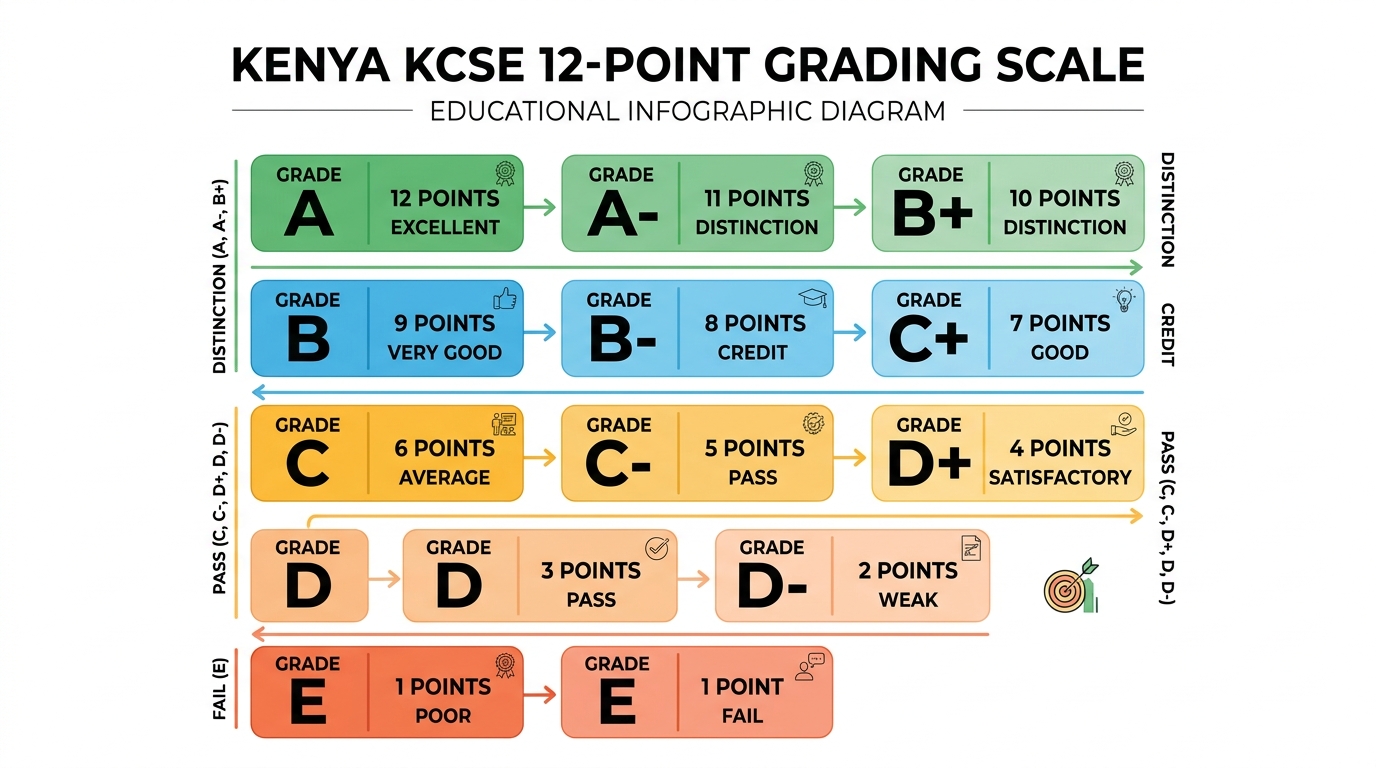
The twelve grades are systematically organized into four broader academic performance tiers: Distinction (grades A, A-, and B+), Credit (grades B, B-, and C+), Pass (grades C, C-, D+, and D), and Weak Pass or Fail (grades D- and E). The following table outlines the complete grade structure, corresponding point weightings, and indicative percentage performance ranges traditionally associated with each grade level.
| Letter Grade | Points Value | Performance Designation | Standard Indicative Raw Score Band |
|---|---|---|---|
| A | 12 | Distinction (Plain) | 80% to 100% |
| A- | 11 | Distinction (Minus) | 75% to 79% |
| B+ | 10 | Distinction / High Credit | 70% to 74% |
| B | 9 | Credit (Plain) | 65% to 69% |
| B- | 8 | Credit (Minus) | 60% to 64% |
| C+ | 7 | Credit (Minimum Degree Baseline) | 55% to 59% |
| C | 6 | Pass (Plain) | 50% to 54% |
| C- | 5 | Pass (Minus / TVET Diploma Entry) | 45% to 49% |
| D+ | 4 | Pass (TVET Craft Certificate Entry) | 40% to 44% |
| D | 3 | Pass | 35% to 39% |
| D- | 2 | Weak Pass (TVET Artisan Entry) | 30% to 34% |
| E | 1 | Fail (Artisan Foundation Entry) | 0% to 29% |
While the point values assigned to each grade letter remain strictly fixed year after year, the exact raw percentage boundaries for individual subjects can fluctuate marginally depending on national cohort performance and standardisation procedures applied by KNEC psychometricians. Nevertheless, once KNEC issues a specific letter grade on a candidate result slip, the point value attached to that grade is legally and administratively absolute.
The five subject groups in the Kenyan secondary curriculum
To ensure national secondary education provides a balanced foundation across literacy, numeracy, scientific inquiry, social sciences, and technical competencies, the Kenya Institute of Curriculum Development (KICD) and KNEC organize secondary curriculum subjects into five distinct categories. Candidates must register for subjects across these groups in compliance with national examination regulations.
Compulsory Core Subjects
Every candidate in Kenya must take English (Subject Code 101), Kiswahili (Subject Code 102), and Mathematics. For Mathematics, schools offer either Mathematics Alternative A (Code 121, tailored for core sciences, engineering, and technical disciplines) or Mathematics Alternative B (Code 122, an applied alternative for non-technical fields). All three core subjects are unconditionally counted in the seven-subject mean grade calculation.
Natural Sciences
Comprising Biology (Code 231), Physics (Code 232), and Chemistry (Code 233), alongside General Science (Code 237) for specialized secondary curricula. Under KNEC regulations, every candidate must sit at least two pure sciences. The scores of the two highest-performing sciences are mandatory components of the seven-subject aggregate formula.
Humanities and Social Sciences
Encompassing History and Government (Code 311), Geography (Code 312), and Religious Education—offered as Christian Religious Education (CRE, Code 313), Islamic Religious Education (IRE, Code 314), or Hindu Religious Education (HRE, Code 315). A candidate must take and count at least one humanity subject in their final aggregate total.
Applied, Technical, and Vocational Subjects
Encompassing practical vocational disciplines including Home Science (Code 441), Art and Design (Code 442), Agriculture (Code 443), Woodwork (Code 444), Metalwork (Code 445), Building Construction (Code 446), Power Mechanics (Code 447), Electricity (Code 448), Drawing and Design (Code 449), Aviation Technology (Code 450), and Computer Studies (Code 451). These subjects develop practical pre-vocational skills and provide candidates with valuable scoring opportunities for their elective slots.
Foreign Languages and Business Studies
Including French (Code 501), German (Code 502), Arabic (Code 503), Kenyan Sign Language (Code 504), Music (Code 511), and Business Studies (Code 565). These subjects provide academic breadth and can be utilized as competitive elective entries to optimize a candidate overall aggregate score.
The seven-subject aggregate calculation formula
KNEC does not determine a candidate mean grade by averaging all subjects taken. If a student sits eight or nine subjects, KNEC algorithmically selects exactly seven subjects according to a strict legal hierarchy designed to guarantee balanced intellectual competence.
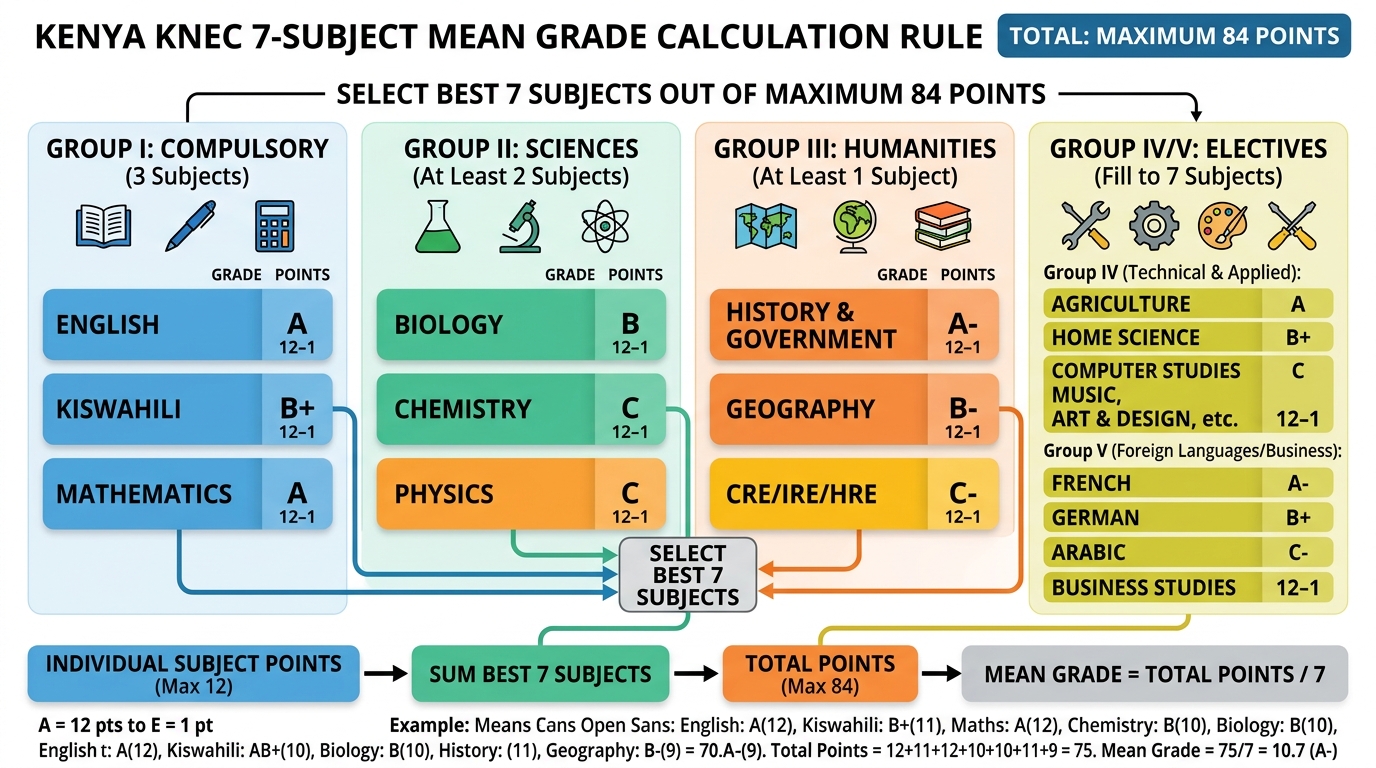
The selection protocol follows a non-negotiable four-step sequence:
- Step 1: All three Group I subjects must be included. English, Kiswahili, and Mathematics are automatically locked into the calculation regardless of the grade scored. Even if a candidate earns an E in Mathematics, that 1 point must be incorporated into the aggregate total.
- Step 2: The best two Group II science subjects are included. Out of Biology, Chemistry, and Physics, the algorithm selects the two subjects where the student achieved the highest points.
- Step 3: The best Group III humanity subject is included. Out of History, Geography, and CRE/IRE/HRE, the subject with the highest point value is incorporated.
- Step 4: The single best remaining subject across any group is selected. The algorithm inspects all leftover subjects—which may include the candidate third science, a second humanity subject, a Group IV technical subject (such as Agriculture or Computer Studies), or a Group V subject (such as Business Studies or French). The leftover subject with the greatest point score is assigned to the seventh slot.
The Maximum 84 Points Rule: Because each subject yields a maximum of 12 points (Grade A), multiplying 7 counted subjects by 12 points gives an absolute maximum score of 84 points. A student who scores straight A grades in all counted subjects achieves an aggregate of 84 points and a mean grade of A (Plain). Conversely, the minimum possible score is 7 points (seven subjects at 1 point each), yielding a mean grade of E.
Worked calculation examples across different student profiles
To understand how the seven-subject selection rule operates in practice, consider three distinct secondary candidates who sat eight examination subjects with differing academic strengths.
STEM / Engineering Aspirant (Strong Sciences)
Candidate Jane sat eight subjects: English B+ (10), Kiswahili B (9), Mathematics Alt A A (12), Chemistry A- (11), Physics B+ (10), Biology B- (8), History & Government A (12), and Computer Studies A (12).
KNEC Selection:
1. Group I (Compulsory): English (10) + Kiswahili (9) + Mathematics (12) = 31 points.
2. Group II (Best 2 Sciences): Chemistry (11) + Physics (10) = 21 points (Biology at 8 is dropped from this tier).
3. Group III (Best Humanity): History & Government (12) = 12 points.
4. Best Remaining Subject: Between Biology (8) and Computer Studies (12), Computer Studies is chosen = 12 points.
Aggregate Score: 31 + 21 + 12 + 12 = 76 points out of 84.
Mean Grade: 76 / 7 = 10.86, which falls squarely into the A- (Minus) mean grade band.
Humanities / Law Aspirant (Elective Rescue Dynamic)
Candidate Kevin sat eight subjects: English A- (11), Kiswahili A- (11), Mathematics Alt A C (6), Chemistry D+ (4), Biology C+ (7), Physics D (3), Geography A (12), and Business Studies A (12).
KNEC Selection:
1. Group I (Compulsory): English (11) + Kiswahili (11) + Mathematics (6) = 28 points.
2. Group II (Best 2 Sciences): Biology (7) + Chemistry (4) = 11 points (Physics at 3 is dropped). Notice that Chemistry must be counted because a minimum of two sciences is required.
3. Group III (Best Humanity): Geography (12) = 12 points.
4. Best Remaining Subject: Between Physics (3) and Business Studies (12), Business Studies is selected = 12 points.
Aggregate Score: 28 + 11 + 12 + 12 = 63 points out of 84.
Mean Grade: 63 / 7 = 9.0, placing Kevin into the B (Plain) mean grade band and qualifying him comfortably for direct university admission.
Vocational / Technical Aspirant (Agriculture Optimization)
Candidate Brian sat eight subjects: English C (6), Kiswahili C+ (7), Mathematics Alt A C- (5), Chemistry D (3), Biology C- (5), History C+ (7), CRE B- (8), and Agriculture A- (11).
KNEC Selection:
1. Group I (Compulsory): English (6) + Kiswahili (7) + Mathematics (5) = 18 points.
2. Group II (Best 2 Sciences): Biology (5) + Chemistry (3) = 8 points.
3. Group III (Best Humanity): CRE (8) = 8 points.
4. Best Remaining Subject: Between History (7) and Agriculture (11), Agriculture is selected = 11 points.
Aggregate Score: 18 + 8 + 8 + 11 = 45 points out of 84.
Mean Grade: 45 / 7 = 6.43, placing Brian into the C (Plain) band, which guarantees entry into competitive national TVET diploma programmes.
Tertiary admission pathways and mean grade cutoffs
In Kenya, tertiary admissions are coordinated centrally by KUCCPS for government-subsidized placement across universities, national polytechnics, technical vocational colleges, and vocational training centres. Your aggregate points and mean grade dictate which tier of higher education you can immediately access.
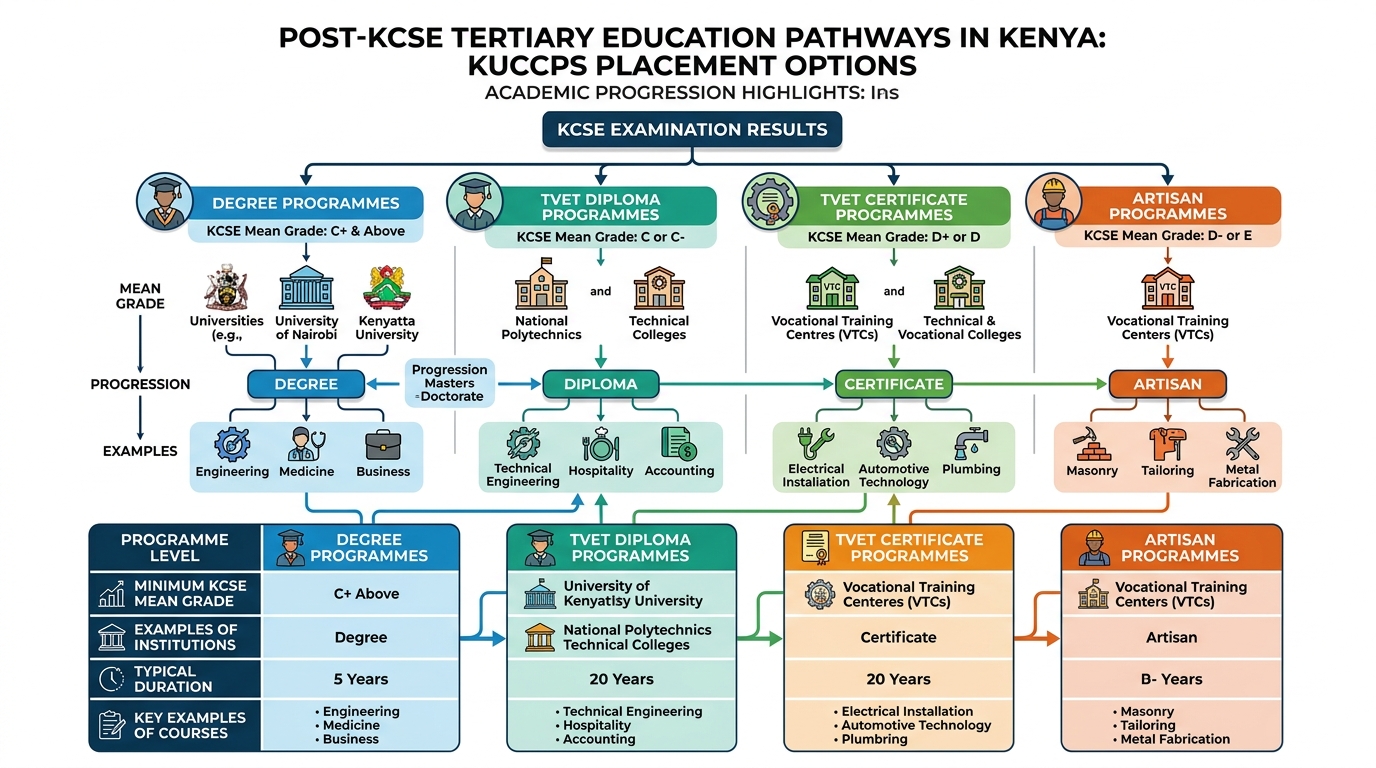
The national placement thresholds set by the Ministry of Education and KUCCPS establish the following academic pathways:
| Mean Grade | Aggregate Points Range | Primary Placement Eligibility | Example Institutions and Qualifications |
|---|---|---|---|
| A to A- | 74 to 84 points | Competitive University Degrees (High Demand) | Medicine (MBChB), Dental Surgery, Civil/Electrical Engineering, Law, Computer Science |
| B+ to B- | 53 to 73 points | Direct University Degrees (Broad Disciplines) | Nursing, Commerce, Economics, Agriculture, Architecture, Software Engineering, Education |
| C+ | 46 to 52 points | National Minimum Degree Baseline | General Bachelor of Arts, Bachelor of Science, Education (Arts), Business Administration |
| C to C- | 32 to 45 points | TVET Diploma Programmes (Level 6) | National Polytechnics, Technical Colleges (Diploma in Electrical Engineering, ICT, Accountancy) |
| D+ to D | 18 to 31 points | TVET Craft Certificate Programmes (Level 5) | Vocational Technical Colleges (Certificate in Automotive Mechanics, Plumbing, Electrical Installation) |
| D- to E | 7 to 17 points | TVET Artisan Programmes (Level 4) | Vocational Training Centres (Artisan in Masonry, Welding and Fabrication, Garment Making) |
The New Higher Education Financing (HEF) Model: In Kenya, securing university or college placement through KUCCPS is now decoupled from automatic financial aid. Under the Student-Centred Higher Education Financing model launched by the Ministry of Education, placed students must apply separately via the HEF portal (hef.co.ke) for government scholarships and Higher Education Loans Board (HELB) loans. Funding is allocated according to means testing across five vulnerability bands (Band 1 to Band 5), where Band 1 covers vulnerable and extremely needy students with up to 95% combined scholarship and loan funding.
TVET academic progression: How KNQA allows laddering to a degree
A widespread misconception among secondary school leavers is that falling below the C+ university threshold terminates a student degree aspirations. Under the Kenya National Qualifications Framework (KNQF) administered by the Kenya National Qualifications Authority (KNQA), Kenya maintains an open, articulated educational ladder that allows any motivated student to advance progressively from an artisan certificate to a master or doctorate degree.
The progression pathway follows a structured sequence of accredited qualifications:
- Level 4 (Artisan Certificate): Candidates with KCSE mean grades of D-, E, or non-formal secondary completion enroll in artisan programmes at local Vocational Training Centres (VTCs). These courses typically last 6 to 12 months and emphasize practical, competency-based trade skills.
- Level 5 (Craft Certificate): Passing an artisan qualification (or scoring a direct KCSE mean grade of D or D+) allows admission to a two-year craft certificate course at a technical college or national polytechnic certified by TVET CDACC or KNEC.
- Level 6 (National Diploma): Candidates who graduate with a credit or distinction in their craft certificate—or who achieved a direct KCSE mean grade of C- or C—advance to a national diploma programme lasting two to three years.
- Level 7 (Bachelor Degree Direct Transfer): A student holding an accredited TVET Diploma with good academic standing is legally eligible under KNQA regulations for direct entry into the second or third year of a relevant university bachelor degree through credit transfers (credit waivers). Many practicing Kenyan engineers, accountants, and IT directors started their post-secondary education in TVET diploma programmes before graduating from top universities.
The KUCCPS Weighted Cluster Points (WCP) formula explained
While the KCSE mean grade determines baseline eligibility for degree programmes (a minimum of C+), actual competitive selection for government-sponsored university slots is governed by a separate metric: Weighted Cluster Points (WCP), commonly referred to as cluster points.
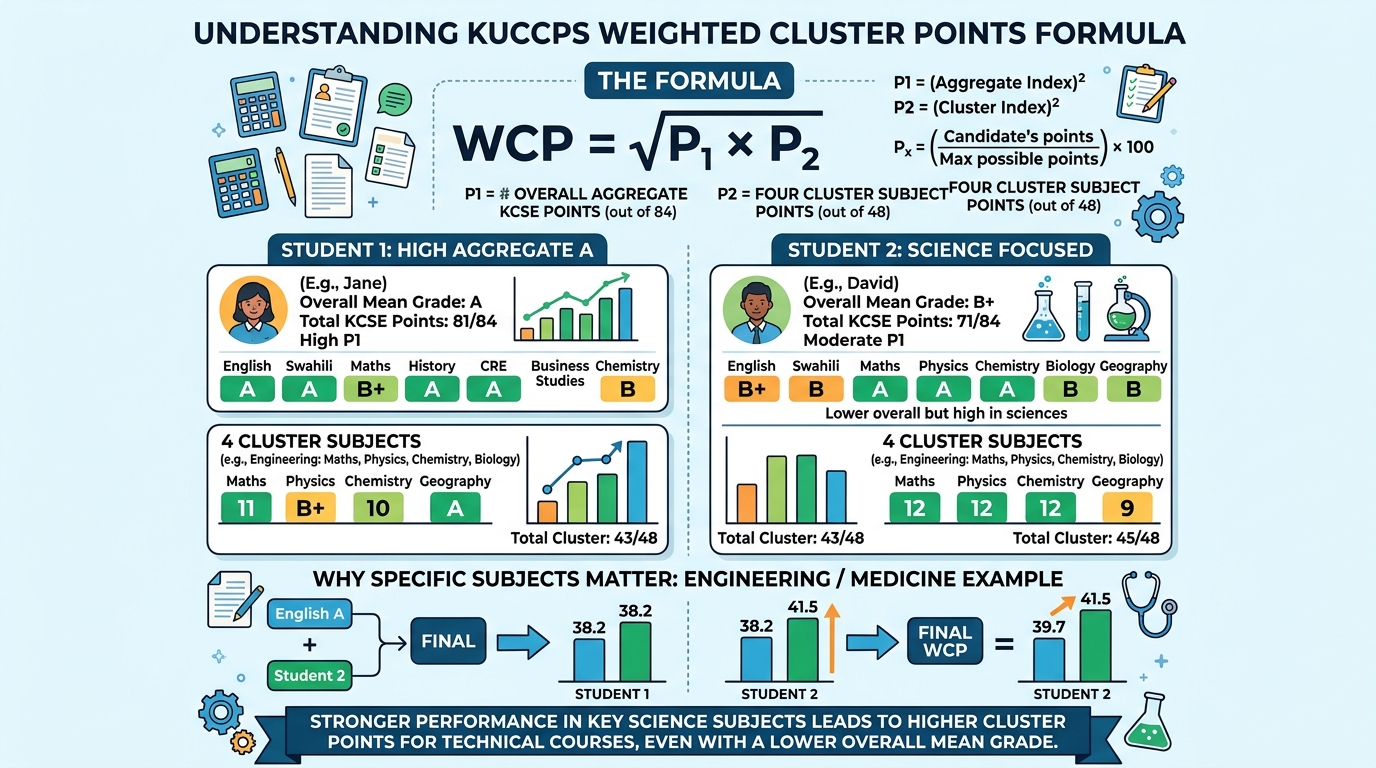
KUCCPS computes cluster points using a geometric mean formula that harmonizes two distinct components: a candidate raw performance in four course-specific subjects against their overall seven-subject aggregate performance. The official formula is expressed as:
WCP = Square_Root( (r / m) * (t / j) ) * 48
Where:
r = The sum of points scored by the candidate in the four mandatory cluster subjects specific to the degree course (maximum 48 points, since 4 subjects * 12 points = 48).
m = The maximum possible points for the four cluster subjects, which is always fixed at 48.
t = The candidate total KCSE aggregate points across all seven counted subjects (maximum 84).
j = The maximum possible KCSE aggregate points, which is always fixed at 84.
48 = The overall scaling factor that calibrates the final weighted score onto a 48-point scale.
This mathematical formulation has a profound practical implication: a candidate cannot gain admission into a high-demand STEM programme purely on the strength of high grades in humanities or languages. If two candidates both score an aggregate of 76 points (Grade A-), the candidate with Grade A in Mathematics and Physics will achieve a dramatically higher WCP for Mechanical Engineering than the candidate who scored Grade A in History and Christian Religious Education but Grade C in Physics.
Subject cluster requirements for competitive university degree programmes
Every accredited degree programme in Kenya belongs to one of approximately 20 distinct academic clusters defined by KUCCPS. Each cluster designates four mandatory subjects that form the basis of the raw cluster score (r). The following reference table outlines cluster subject configurations and minimum subject-level requirements for leading career disciplines in Kenya.
| Degree Programme | Mandatory Cluster Subjects (4 Subjects) | Minimum Subject Grade Thresholds | Key Institutions Offering Programme |
|---|---|---|---|
| Medicine and Surgery (MBChB) / Dental Surgery | 1. Biology 2. Chemistry 3. Mathematics Alt A or Physics 4. English or Kiswahili | Minimum B (Plain) in Biology, Chemistry, Maths/Physics, and English/Kiswahili | University of Nairobi (UoN), Moi University, Kenyatta University (KU), JKUAT |
| Civil / Electrical / Mechanical Engineering | 1. Mathematics Alt A 2. Physics 3. Chemistry 4. Any Group III, IV, or V subject (or Biology) | Minimum C+ in Mathematics Alt A, Physics, and Chemistry | UoN, JKUAT, Technical University of Kenya (TUK), Moi University |
| Computer Science / Software Engineering | 1. Mathematics Alt A 2. Physics 3. Chemistry or Biology 4. Any Group III, IV, or V subject | Minimum C+ in Mathematics Alt A and Physics | JKUAT, UoN, Strathmore University, KU, Dedan Kimathi University (DeKUT) |
| Bachelor of Laws (LLB) | 1. English or Kiswahili (Highest) 2. Mathematics or any Science 3. Any Group III Humanity 4. Any remaining subject | Minimum B (Plain) in English or Kiswahili | UoN (Parklands), KU, Moi University, Riara University, Strathmore |
| Bachelor of Science in Nursing (BScN) | 1. Biology 2. Chemistry 3. Mathematics Alt A or Physics 4. English or Kiswahili | Minimum C+ in Biology, Chemistry, Maths/Physics, and English/Kiswahili | KU, UoN, Moi University, Egerton University, Chuka University |
| Bachelor of Commerce / Economics / Finance | 1. Mathematics Alt A or Alt B 2. English or Kiswahili 3. Any Group III Humanity 4. Any Group IV or V subject (or Science) | Minimum C+ in Mathematics and English/Kiswahili | UoN, KU, Strathmore, JKUAT, Maseno University |
| Bachelor of Pharmacy (BPharm) | 1. Chemistry 2. Biology 3. Mathematics Alt A or Physics 4. English or Kiswahili | Minimum C+ in Chemistry, Biology, Maths/Physics, and English/Kiswahili | UoN, KU, JKUAT, Mount Kenya University (MKU) |
Common mistakes when self-calculating KCSE points
Every year when examination results are published, thousands of candidates miscalculate their points or misjudge their admission chances due to preventable calculation errors. Being aware of these pitfalls prevents costly application missteps during KUCCPS placement revisions.
- Mistake 1: Summing all eight or nine subjects. Adding up points across every paper sat produces an inflated aggregate score far exceeding 84 points. KNEC strictly bounds calculations to exactly seven subjects governed by curriculum grouping rules.
- Mistake 2: Violating the two-science rule. Students with strong humanities often attempt to drop two sciences and count only one. Even if you score Grade A in History, Geography, and CRE, KNEC will only count one humanity toward the core cluster, forcing the inclusion of your second-best science, regardless of how low that science grade is.
- Mistake 3: Overlooking Mathematics Alternative differences. While Mathematics Alternative A and Alternative B award identical point values on the 12-point scale, nearly all engineering, architecture, computer science, and actuarial degree programmes in Kenya strictly require Mathematics Alternative A. A student with an A in Mathematics Alt B cannot qualify for BSc Electrical Engineering.
- Mistake 4: Confusing mean grade eligibility with cluster point competitiveness. Scoring a B+ mean grade does not guarantee admission into competitive degree courses like Medicine or Law if your specific cluster subjects are weak or if national competition drives the university cutoff points above your calculated WCP.
- Mistake 5: Neglecting subject-level minimum prerequisites. Certain professional regulatory boards (such as the Engineers Board of Kenya - EBK, Kenya Medical Practitioners and Dentists Council - KMPDC, and Council of Legal Education - CLE) enforce strict subject prerequisites that supersede overall university mean grade cutoffs. Failing to meet a single prerequisite grade invalidates an application even if the candidate overall points are exceptionally high.
Key post-exam timeline and KUCCPS application checklist
Transitioning successfully from secondary school to tertiary education requires vigilant adherence to official procedural milestones. The following sequential roadmap guides candidates through each phase following examination completion.
KNEC Results Release and Official Verification
Results are officially announced by the Cabinet Secretary for Education. Candidates verify their preliminary scores via the official KNEC SMS shortcode or the online KNEC results portal. Within two weeks of the announcement, candidates must collect their physical, certified KNEC Result Slip from their secondary school principal to confirm stamped subject grades and check for any discrepancy before the KUCCPS revision window opens.
KUCCPS First Online Revision Window
KUCCPS opens its online student portal (students.kuccps.net) for the national First Revision of course choices. Candidates log in using their KCSE Index Number, KCSE Year, and KCPE Index Number or Birth Certificate Number as their initial password. Candidates can revise or confirm their six degree choices (divided into 1a, 1b, 1c for same course at different institutions, plus choices 2, 3, and 4), four diploma choices, four craft certificate choices, and four artisan choices based on their actual confirmed results.
KUCCPS Second Revision (Mop-Up Selection)
Candidates who missed placement during the first cycle due to selecting hyper-competitive programmes with cutoff points exceeding their weighted scores are notified through the portal. A dedicated Second Revision window opens, allowing unplaced students to pick from remaining unfilled academic programmes across public and private universities and TVET colleges.
Inter-Institutional Transfer Window
After final placement announcements, KUCCPS provides an official inter-institutional transfer window lasting approximately one month. Candidates who wish to transfer from their allocated institution to another university or college may submit an online transfer request, provided they meet the receiving institution published cutoff points and the receiving institution endorses the transfer through the portal.
Higher Education Financing (HEF) Application
Once placed in an institution, candidates immediately register on the official Higher Education Financing portal (hef.co.ke) with a valid national ID card (or guardian details if under 18), valid email address, and personal phone number registered under their name. Students apply simultaneously for the government scholarship and HELB student loan to ensure financial allocations are disbursed before semester reporting dates.
Where this calculator stops and how to plan next steps
This AfriWidget calculator faithfully executes the standardized KNEC seven-subject algorithm, grouping requirements, and twelve-point scale to compute your official mean grade and aggregate score out of 84. However, to maximize its utility, keep the following operational boundaries in mind:
First, this tool evaluates standard academic eligibility; it does not replace the individual programme formulas applied during institutional selection. Specific universities maintain institutional cutoffs that vary each academic year based on applicant volume and bed capacity.
Second, this calculator is an essential planning instrument. When preparing for national examinations, candidates can model different grade scenarios across their subjects to identify high-leverage areas. For instance, raising an elective score from a C to an A can lift a student across the 46-point threshold into direct university eligibility, while securing strong grades in Mathematics Alt A and Physics protects eligibility for high-demand engineering careers.
Third, once official KNEC results are announced, always cross-reference your calculated score with the physical result slip provided by your secondary institution and utilize official KUCCPS portal diagnostic tools to assess your real-time cluster point competitiveness.
Sources and official regulatory bodies
- Kenya National Examinations Council (KNEC). KCSE Examination Regulations, Subject Grouping Rules, and Grading Directives. knec.ac.ke
- Kenya Universities and Colleges Central Placement Service (KUCCPS). Placement Policy, Degree Cluster Criteria, and Cut-off Points Framework. kuccps.net
- Ministry of Education, Kenya. Higher Education Policy, University Entry Standards, and TVET Reforms. education.go.ke
- Kenya National Qualifications Authority (KNQA). Kenya National Qualifications Framework (KNQF) Progression Pathways and Articulation Policy. knqa.go.ke
- Higher Education Financing (HEF) Secretariat. Student-Centred Higher Education Financing Model Guidelines and Categorization. hef.co.ke
- Higher Education Loans Board (HELB). Tertiary Education Student Financing and Loan Disbursement Framework. helb.co.ke