On this page
- What this calculator does
- How NC(V) assessment works
- Fundamental subjects and the 50:50 split
- Vocational subjects and the 25:25:50 split
- Pass thresholds and why they differ
- A worked example
- The rewrite and supplementary route
- Common mistakes that delay certification
- Where this calculator stops
- ICASS sub-minimums, portfolio verification, and Umalusi moderation
- NC(V) Level 4 higher education endorsement criteria
- Exam mark target modeling: Back-calculating from term marks
- Condonation rules and single-subject carry-over policies
- Artisan apprenticeship and red seal trade test pathways
- Sources
What this calculator does
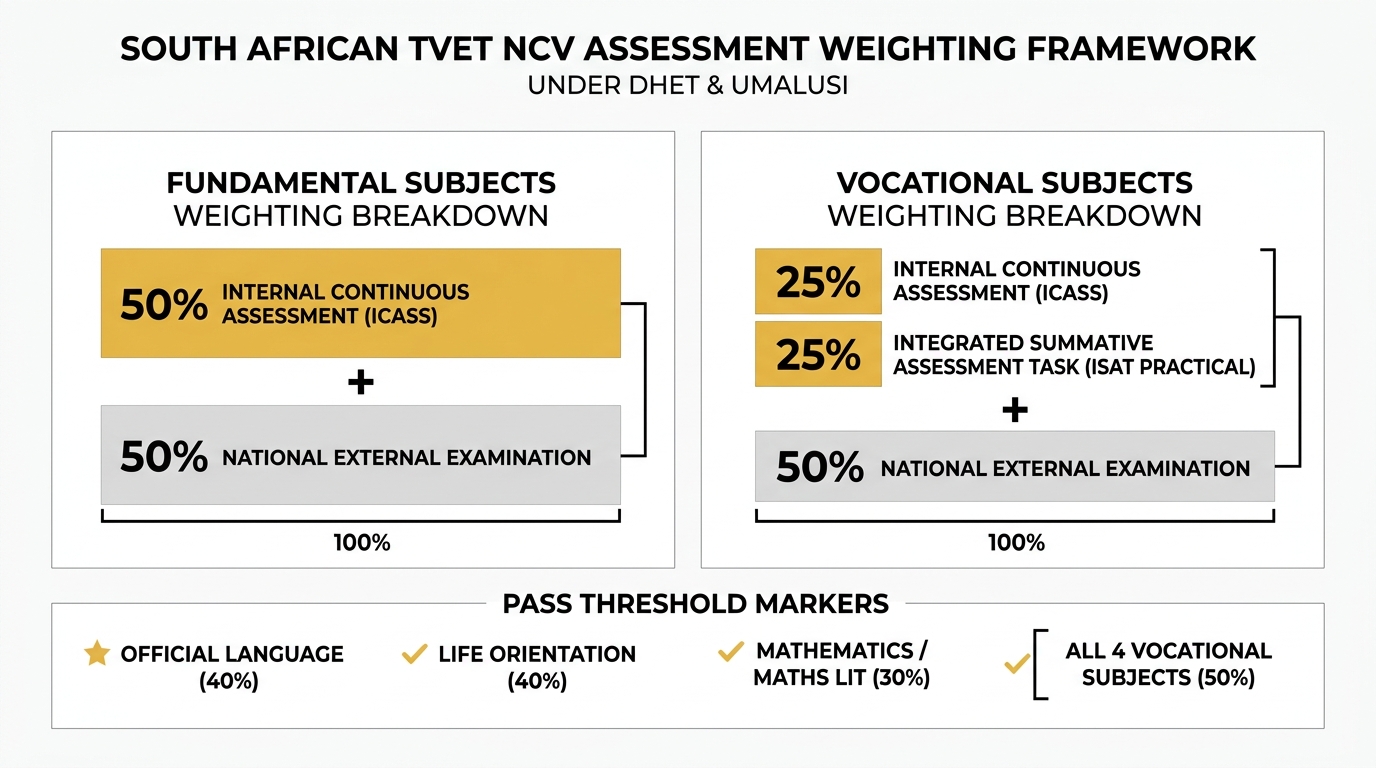
This tool takes the marks from your NC(V) trimester or year, combines them using the DHET weighting rules, and returns the outcome for every subject you entered. It handles the two different weightings that the framework applies: fundamental subjects use a 50:50 split between ICASS and the national examination, while vocational subjects use a 25:25:50 split between ICASS, the ISAT practical assessment, and the national examination. It also audits each subject against its own minimum pass threshold, since the threshold differs by subject type.
The arithmetic itself is straightforward once the weighting is known. What makes the tool worth using is the fact that NC(V) assessment runs on two different rules side by side, and candidates mix them up regularly. The vocational subject weighting carries a practical component that the fundamental subjects do not, and the pass thresholds are not the same across all seven subjects. Getting the weighting or the threshold wrong leads to a wrong picture of whether the certificate is actually cleared.
Every calculation runs inside your browser. No mark, no subject name, and no personal detail is uploaded. If you press the AI insight button, only an anonymous summary of the level, the number of subjects, the aggregate performance band, and the count of subjects that passed or failed is sent to a small serverless function that runs once and then stops.
How NC(V) assessment works
The National Certificate (Vocational) is a three-year qualification offered at public TVET colleges and accredited private colleges across South Africa. It runs at NQF Levels 2, 3, and 4, and each level is a full year of study in its own right. To be awarded the certificate for a level, a candidate must pass seven subjects: three fundamental subjects that every NC(V) student takes, and four vocational subjects that are chosen from the specialisation the candidate is enrolled in.
The assessment framework separates the internal work from the external work. Internal work is captured through ICASS, the Internal Continuous Assessment mark, which is built from class tests, assignments, projects, and internal trial examinations run by the college during the year. For vocational subjects there is a second internal component called ISAT, the Integrated Summative Assessment Task, which is a practical assessment of occupational competence in the chosen trade. The external component is the national examination set by DHET and quality-assured by Umalusi, written on the same date at every college in the country.
The three components are combined using the weighting that applies to the subject type, and the result is the final mark that appears on the statement of results issued by DHET. Each subject then has its own pass threshold, and a candidate who fails even one of the seven subjects does not receive the certificate for that level until the failed subject is cleared through a supplementary or rewrite examination.
Fundamental subjects and the 50:50 split
The three fundamental subjects sit at the base of the qualification and are taken by every NC(V) candidate regardless of the vocational specialisation. The official language is usually English First Additional Language, though the specific language offered depends on the college. Life Orientation covers citizenship, personal development, and health topics. Mathematics or Mathematical Literacy covers the numeracy requirement for the level.
The final mark for each fundamental subject uses a 50:50 split between ICASS and the national examination. That means the internal work carried the same mathematical weight as the external paper, which is a higher internal weighting than vocational subjects use. A candidate who performs well across the classroom year enters the national examination with a substantial buffer, and a candidate who underperforms internally has to compensate with a stronger examination performance to reach the same final mark.
Thresholds: Language ≥ 40 | Life Orientation ≥ 40 | Maths or Maths Literacy ≥ 30
Vocational subjects and the 25:25:50 split
The four vocational subjects are the specialisation of the qualification. They differ by programme: a Civil Engineering and Building Construction candidate takes vocational subjects in construction planning, construction supervision, materials, and one more technical subject; a Tourism candidate takes vocational subjects in tourism operations, tourism planning, and related topics; and so on across the different NC(V) programmes. Regardless of the specific subject, the assessment weighting is the same.
The final mark uses a 25:25:50 split between three components. ICASS carries 25 per cent, the ISAT practical assessment carries 25 per cent, and the national examination carries 50 per cent. This is the crucial difference from the fundamental subjects: half of the vocational mark comes from the external examination paper, and half comes from the internal assessment work split between the ongoing ICASS record and the ISAT practical.
The ISAT is not a written test. It is a practical demonstration of occupational competence, assessed against a national ISAT instrument, and it is what makes the vocational subjects genuinely vocational rather than just a written exam with a practical flavour. A candidate who is strong in the workshop but weaker in the examination room still has a pathway to a passing final mark because the practical carries 25 per cent of the weight and ICASS carries another 25 per cent.
Threshold: every vocational subject ≥ 50
Pass thresholds and why they differ
The pass thresholds across the seven subjects are not uniform. The two language and orientation subjects sit at 40 per cent. Mathematics or Mathematical Literacy sits at 30 per cent, matching the general numeracy threshold used at the secondary school level. The four vocational subjects sit at 50 per cent each, which is the highest threshold in the qualification.
| Subject type | Weighting | Pass threshold |
|---|---|---|
| Official Language | ICASS 50% + Exam 50% | 40% |
| Life Orientation | ICASS 50% + Exam 50% | 40% |
| Mathematics / Maths Literacy | ICASS 50% + Exam 50% | 30% |
| Vocational subject (each of four) | ICASS 25% + ISAT 25% + Exam 50% | 50% |
The higher threshold on vocational subjects reflects the industry-facing purpose of the qualification. A candidate who passes a vocational subject at 50 per cent has demonstrated both theoretical and practical competence at a level the trade accepts as a minimum for entering the workplace or progressing to further study in the field. The lower threshold on Mathematics or Mathematical Literacy reflects its role as a general numeracy requirement that runs alongside the specialisation rather than as the specialisation itself.
The two language and orientation subjects sit in between. Forty per cent is the level at which the candidate demonstrates sufficient written and functional literacy to read occupational documentation, communicate professionally, and continue learning in the field. It is the same threshold that applies to language subjects across the NQF framework.
A worked example
Take a candidate enrolled in NC(V) Level 4 Civil Engineering and Building Construction. The candidate's marks across the seven subjects are as follows.
| Subject | ICASS | ISAT | Exam | Final | Outcome |
|---|---|---|---|---|---|
| English FAL | 56 | — | 48 | 52.00 | Pass |
| Life Orientation | 64 | — | 58 | 61.00 | Pass |
| Mathematics | 42 | — | 36 | 39.00 | Pass (≥ 30) |
| Construction Planning | 60 | 70 | 52 | 58.50 | Pass |
| Construction Supervision | 55 | 65 | 50 | 55.00 | Pass |
| Materials | 62 | 68 | 54 | 59.50 | Pass |
| Carpentry and Roof Work | 58 | 74 | 48 | 57.00 | Pass |
The English mark is 56 multiplied by 0.50 plus 48 multiplied by 0.50, which is 52.00, above the 40 per cent threshold. Life Orientation is 64 plus 58 divided by two, which is 61.00, also above 40. Mathematics is 42 plus 36 divided by two, which is 39.00, above the 30 per cent threshold. The four vocational subjects use the 25:25:50 weighting. Construction Planning is 60 times 0.25 plus 70 times 0.25 plus 52 times 0.50, which is 15 plus 17.5 plus 26, or 58.50, above the 50 per cent threshold. The other three vocational subjects follow the same pattern, and all four clear 50 per cent.
The candidate passes all seven subjects and is awarded the NC(V) Level 4 certificate for the Civil Engineering and Building Construction programme. The vocational aggregate, which is the average of the four vocational subject finals, is 57.50. The fundamental aggregate, which is the average of the three fundamental subject finals, is 50.67.
Now suppose the same candidate had scored only 46 on the exam paper in one of the vocational subjects, with the ICASS and ISAT marks unchanged. The final for that subject would drop below 50, and the certificate would be withheld until that subject alone was rewritten and passed. The other six subjects stay on the record permanently. That is the practical reality of the NC(V) certificate: it is issued for the level only when all seven subjects are cleared, but the individual subject credits do not expire or need repeating.
The rewrite and supplementary route
A candidate who fails one or more NC(V) subjects has two routes to clear the outstanding work. The first is the mid-year supplementary examination, which is written in the first half of the following academic year. The second is the end-of-year national examination, taken alongside the next cohort. Both routes give the candidate a chance to rewrite only the subjects that were not passed, and the passing of a subject via either route counts towards the certificate for that level.
What differs between the two routes is timing rather than substance. The supplementary is usually taken by candidates who want to clear a subject as quickly as possible, typically because they need the certificate to enter a university or to start a workplace programme. The end-of-year route is taken by candidates who need more preparation time or who are already working and studying part-time.
In most cases the ICASS mark and, where the subject uses one, the ISAT practical mark are carried over into the rewrite, provided the rewrite is taken inside the validity window that the college applies. This matters because it means a candidate who performed well on the practical and internal work but underperformed on the examination does not have to rebuild the internal record from scratch. The examination is the only component that is rewritten, and the composite is recalculated with the new examination mark. Always confirm the exact carry-over rule with your college examination office before registering for the rewrite.
Common mistakes that delay certification
A handful of recurring errors delay NC(V) certification by a term or a full year. Understanding them in advance is worth the read.
Assuming all subjects use the same weighting. The fundamental subjects use 50:50 and the vocational subjects use 25:25:50. A candidate who applies the wrong weighting to the wrong subject will misjudge their own standing and may not realise a subject is at risk until the final mark is published.
Neglecting the ISAT practical. The ISAT carries 25 per cent of the vocational subject mark. Candidates sometimes treat the practical as a formality, only to discover that a weaker ISAT mark caps the achievable final. The practical is a genuine component with a national assessment instrument behind it, and it deserves the same preparation as the examination paper.
Ignoring the Mathematics threshold. Mathematics or Mathematical Literacy passes at 30 per cent, which is lower than the other thresholds, and some candidates assume that a fail in a fundamental subject means the whole qualification is lost. A near miss on Mathematics is the easiest of the seven thresholds to clear in a rewrite, and it should be prioritised accordingly.
Letting a single vocational subject block the certificate. A candidate who passes six subjects and fails one vocational subject does not receive the certificate. The subject credits for the six passes are retained, so the only work outstanding is the one failed subject, but the certificate is only issued once every subject is cleared. Candidates who delay the rewrite past the validity window can lose the ICASS and ISAT credit and be required to re-register the subject in full.
Assuming NC(V) Level 4 is the same as a National Senior Certificate. The two qualifications are different, and the university admission requirements that apply to the NSC do not map directly onto NC(V). An NC(V) Level 4 graduate can apply to a university or University of Technology, but the specific subject combinations and minimum marks required differ by programme, and the faculty prospectus for the year of application is the definitive source.
Missing the rewrite registration deadline. The supplementary and end-of-year examination windows are published on a fixed calendar, and registration deadlines fall well before the examination dates. Candidates who miss the registration deadline for the supplementary window have to wait for the next end-of-year cycle.
Where this calculator stops
This tool estimates the final mark for every NC(V) subject you enter, applies the DHET weighting rules and pass thresholds, and reports whether each subject clears and whether the certificate for the level is on track. It does not know your college's exact ICASS composition, does not know whether the ISAT instrument for your subject includes a specific sub-minimum requirement that the college applies in addition to the 25 per cent weighting, and does not know the validity window your college applies to a rewrite. It also does not know the specific university admission requirements for your programme of interest, or the specific subject combination required for the qualification you are applying to.
The pass thresholds used here match the published DHET NC(V) framework. The final, official outcome is the one recorded on the statement of results issued by DHET after the examination scripts have been marked and moderated. Use this calculator to see where you stand, to plan the exam strategy that gets each subject over its threshold, and to understand what a rewrite would need to achieve to clear an outstanding subject.
ICASS sub-minimums, portfolio verification, and Umalusi moderation
One of the most frequent reasons students are barred from writing final national examinations at South African TVET colleges is failing to satisfy the statutory ICASS sub-minimum and portfolio compliance requirements enforced by the Department of Higher Education and Training (DHET) and quality-assured by Umalusi:
- The 80% Attendance Threshold: College regulations mandate that students attend at least 80% of all scheduled contact periods in each enrolled subject. Students falling below this threshold can be disqualified from exam registration regardless of test marks.
- The 40% ICASS Prerequisite Gate: To qualify for admission to the national examination in any subject, a candidate must achieve an ICASS term mark of at least 40% (or 50% in select technical disciplines). If a student scores below 40% on internal continuous assessment, DHET regulations automatically disqualify the candidate from sitting the national exam, resulting in an administrative fail (coded as "999" or "INC") for that subject.
- Portfolio of Evidence (PoE) Verification: Every student must compile a physical or digital Portfolio of Evidence containing all standardized class tests, practical task rubrics, and formal assignments. Provincial and national Umalusi moderators sample student portfolios every October. If a student's portfolio lacks verified lecturer signatures, authenticated marks, or required test scripts, their ICASS mark can be nullified or downgraded during moderation.
Strategic takeaway for students: Your ICASS mark is locked before you sit the national examination paper. Because ICASS represents 50% of fundamental subjects and 25% of vocational modules, banking a high internal mark (65%+) dramatically reduces the examination mark required to pass, whereas entering the exam with a borderline 40% ICASS leaves virtually zero room for error on the national paper.
NC(V) Level 4 higher education endorsement criteria
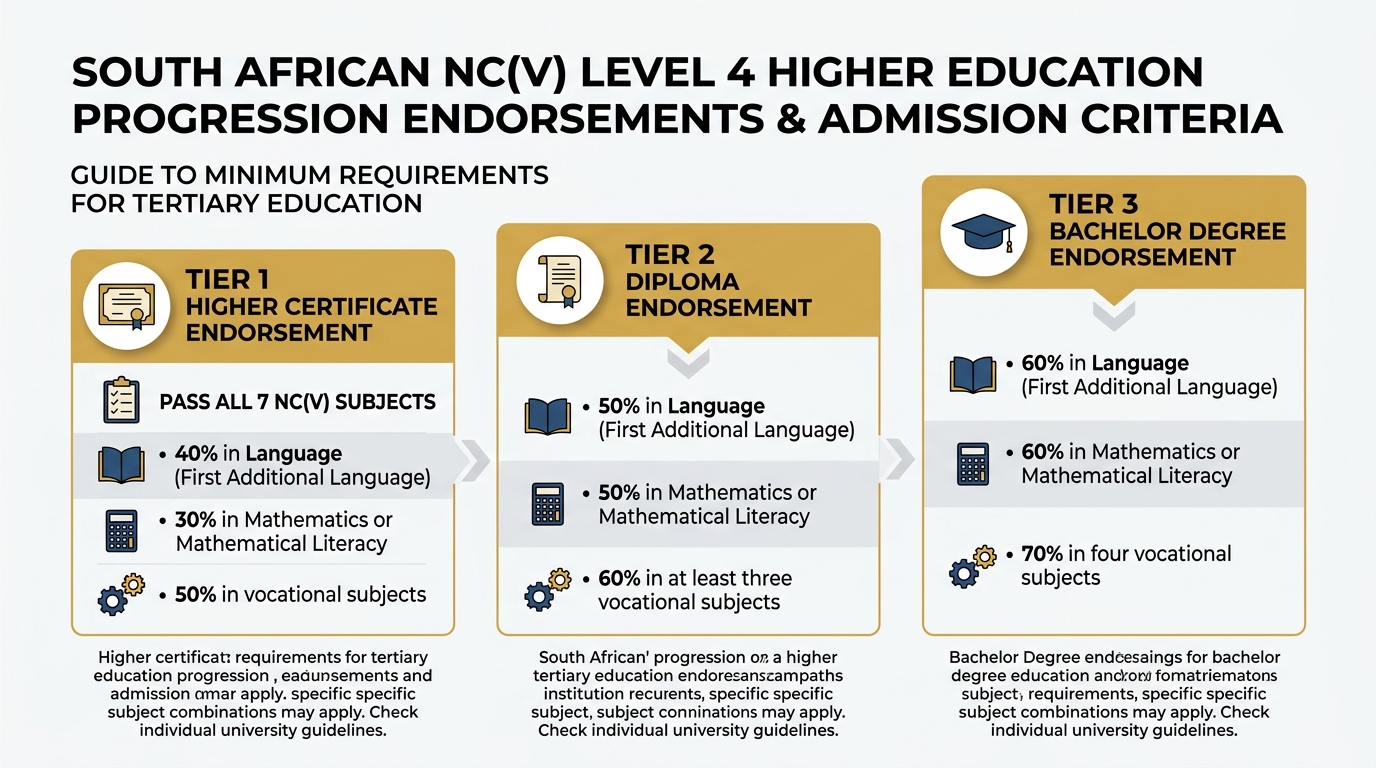
Unlike the traditional National Senior Certificate (NSC / Matric) which uses Admission Point Scores (APS) derived from seven high school subjects, the National Certificate (Vocational) Level 4 carries its own statutory statutory Gazetted admission minimums for entry into South African universities, Universities of Technology (UoTs), and comprehensive institutions:
| Higher Education Admission Tier | Official Language Requirement | Mathematics / Maths Lit Requirement | Vocational Subjects Requirement | Typical Tertiary Study Destination |
|---|---|---|---|---|
| Higher Certificate Endorsement | At least 40% in Official Language | At least 30% in Maths or Maths Lit | At least 50% in all four vocational subjects | TVET advanced certificates, university bridging programs, Level 5 higher certificates. |
| Diploma Endorsement | At least 50% in Official Language | At least 50% in Maths or Maths Lit | At least 60% in at least three vocational subjects | National Diplomas at Universities of Technology (TUT, VUT, CPUT, DUT, CUT) in engineering, IT, management. |
| Bachelor Degree Endorsement | At least 60% in Official Language | At least 60% in Mathematics (or Maths Lit for humanities) | At least 70% in all four vocational subjects | Bachelor of Technology (BTech), Bachelor of Science (BSc), or BCom degree programs at public universities. |
Important faculty-specific criteria: Clearing the statutory national endorsement does not guarantee automatic university admission. Faculties of Engineering and Information Technology at institutions such as TUT, CPUT, and the University of Johannesburg (UJ) frequently stipulate that candidates must have taken pure Mathematics (rather than Mathematical Literacy) with a minimum score of 60% or 70%, accompanied by specific physical or technical vocational subjects.
Exam mark target modeling: Back-calculating from term marks
Students preparing for the October/November national examinations can use the DHET weighting formulas to calculate the exact minimum mark required on the final written paper to pass or achieve an endorsement:
Worked Scenario 1: Fundamental Subject (Life Orientation or English FAL)
Suppose a candidate enters the examination with an ICASS mark of 48.0% in Official Language (Pass mark = 40.0%). Because fundamentals are weighted 50% ICASS and 50% Examination:
- Determine target final total: Target = 40.0%.
- Calculate ICASS contribution: 48.0% multiplied by 0.50 = 24.0 points already banked.
- Calculate examination points needed: 40.0 minus 24.0 = 16.0 points required from the exam.
- Solve for required exam mark: 16.0 divided by 0.50 = 32.0% minimum exam score needed to clear the subject.
Worked Scenario 2: Vocational Subject (e.g. Electrical Principles and Practice)
Suppose a candidate achieves an ICASS mark of 52.0% and an ISAT practical score of 64.0% in a vocational module (Pass mark = 50.0%). The weighting is 25% ICASS, 25% ISAT, and 50% Examination:
- Determine target final total: Target = 50.0%.
- Calculate banked internal contributions: (52.0% multiplied by 0.25) + (64.0% multiplied by 0.25) = 13.0 + 16.0 = 29.0 points already banked.
- Calculate remaining points required from national paper: 50.0 minus 29.0 = 21.0 points.
- Solve for required exam mark: 21.0 divided by 0.50 = 42.0% minimum score required on the national written paper.
Condonation rules and single-subject carry-over policies
DHET policy governs what happens when a student falls marginally short of clearing all seven subjects during an examination cycle:
- Single-Subject Condonation (The 2% Rule): In specific certification cycles, Umalusi and DHET allow a condonation of up to 2% in one subject if that subject is the sole impediment preventing full certificate conferral, provided the candidate achieved an overall aggregate above statutory thresholds and passed all other six modules cleanly.
- Subject Credit Carry-Over (Retention of Credits): NC(V) is an accumulative qualification. A student who passes five or six subjects retains those subject credits indefinitely on the national database. When re-registering for the failed subject in the March supplementary series or November cycle, the student only sits the examination for the outstanding subject.
- ICASS and ISAT Validity Period: Internal assessment marks (ICASS and ISAT) remain valid for one subsequent examination cycle (typically the March supplementary exam). If a candidate delays rewriting the failed subject beyond the statutory 12-month window, they must re-register for the entire subject at the TVET college, attend contact classes, and compile a brand-new Portfolio of Evidence.
Artisan apprenticeship and red seal trade test pathways
Beyond university degree pathways, the primary vocational mandate of the National Certificate (Vocational) is equipping candidates for entry into accredited artisan trades under the National Artisan Moderation Body (NAMB) and the Quality Council for Trades and Occupations (QCTO):
| NC(V) Exit Level | Apprenticeship & Work-Based Learning Status | Qualifying Artisan Trades |
|---|---|---|
| NC(V) Level 3 | Qualifies candidates for entry into Sector Education and Training Authority (SETA) learnerships and contracted apprentice programs with approved employers. | Boilermaking, Welding, Automotive Body Repair, Bricklaying. |
| NC(V) Level 4 (Trade Endorsement) | Direct exemption from institutional theoretical apprentice training; qualifies for immediate 18-to-24 month workplace experiential learning contract. | Electrician, Millwright, Fitter and Turner, Plumber, Heavy Equipment Mechanic. |
| Section 26D Trade Test (Red Seal) | Candidates who hold NC(V) Level 4 plus verified workplace logbook hours qualify to sit the national trade test to become a certified Red Seal Artisan. | All designated mechanical, electrical, and civil trades nationally recognised across SADC. |
Sources
- Department of Higher Education and Training (DHET). NC(V) Assessment and Examination Guidelines. dhet.gov.za
- Umalusi. Quality Assurance of the National Certificate (Vocational). umalusi.org.za
- South African Qualifications Authority (SAQA). NC(V) Qualification Registrations on the National Qualifications Framework. saqa.org.za
- Department of Higher Education and Training (DHET). TVET Colleges Programme and Examination Information. dhet.gov.za/SitePages/TVETColleges.aspx
- Republic of South Africa. National Qualifications Framework Act 67 of 2008. gov.za/documents/national-qualifications-framework-act