On this page
- What this calculator does
- The two grading scales
- How GPA is calculated
- How cumulative CGPA is calculated
- Degree classification bands
- Credit inertia and CGPA trajectory
- Retakes, carryover units, and repeat policies
- Polytechnic vs. university grading (ND, HND & Degree)
- Target CGPA reversal formula
- International credential crosswalk (WES, ECE & UK ENIC)
- A worked example
- Common mistakes
- Who this calculator is for
- Where the calculator stops
- Sources
What this calculator does
This tool takes the courses you registered for a term, the credit units attached to each one, and the letter grade you earned, and returns three figures: your semester GPA, your cumulative CGPA if you enter a prior record, and the degree class your current record sits in. It handles both of the two grading scales that dominate African tertiary education, so the same tool works whether you are at a Nigerian university on the 5.0 scale, a Ghanaian university on the 4.0 scale, or an international university that uses one of the two.
The arithmetic itself is short. What makes it worth a dedicated page is the split between the two scales. A student in Lagos works with a 5.0 maximum, a student in Accra works with a 4.0 maximum, and the same letter grade can land on very different numbers depending on which scale the institution uses. Confusing the two is the single most common mistake new students make when reading their own transcript for the first time. This calculator keeps the scales separate and labels every figure with the correct maximum, so no one mixes up a 5.0 GPA with a 4.0 GPA.
Everything runs inside the browser. The tool does not upload course codes, grades, or cumulative records to any server. If the AI insight button is pressed, only an anonymous summary of the grading scale, the number of courses, the semester GPA, the cumulative CGPA, and the classification band is sent to a small serverless function that runs once and then stops.
The two grading scales
African universities run on two widely used grade point scales, and the difference between them is not just the maximum value. The letter grades and the credit weighting look identical on the surface, but the point values attached to each letter are different, and that difference compounds across a degree.
The 5.0 scale is used across Nigerian universities under the National Universities Commission framework and by most West African institutions. Under this scale, an A earns 5 grade points, a B earns 4, a C earns 3, a D earns 2, an E earns 1, and an F earns 0. A perfect record produces a CGPA of 5.00, and First Class Honours typically starts at 4.50.
The 4.0 scale is used in Ghana, Kenya, South Africa, and by most international universities. Some institutions use a simple mapping where A is 4, B is 3, C is 2, D is 1, and F is 0, while others use a finer split with B+ at 3.5 and C+ at 2.5. This calculator uses the simple mapping for clarity. A perfect record produces a CGPA of 4.00, and First Class Honours typically starts at 3.60.
| Letter grade | 5.0 scale points | 4.0 scale points |
|---|---|---|
| A | 5.00 | 4.00 |
| B | 4.00 | 3.00 |
| C | 3.00 | 2.00 |
| D | 2.00 | 1.00 |
| E | 1.00 | 0.00 |
| F | 0.00 | 0.00 |
Notice that the E grade exists on the 5.0 scale as a narrow pass but does not appear on the simpler 4.0 mapping used here. Some 4.0 institutions handle the E band as a D and reserve F for a straight fail. Always check your specific institution's academic handbook for the exact mapping your programme uses.
How GPA is calculated
The grade point average is a weighted arithmetic mean where the credit units of each course are the weights. Every course produces a quality point value equal to its credit units multiplied by the grade point of the letter grade earned, and the semester GPA is the sum of quality points divided by the sum of credit units.
Semester GPA = (Sum of all quality points) ÷ (Sum of all credit units)
The weighting is the whole point of the system. A three-credit course carries three times the mathematical influence of a one-credit course. Under the 5.0 scale, an A in a three-credit course contributes 15 quality points, while the same A in a one-credit course contributes only 5. Under the 4.0 scale, the same A produces 12 quality points in a three-credit course and 4 in a one-credit course. A student who spends equal study time on all courses is spreading effort evenly across wildly unequal mathematical weights.
How cumulative CGPA is calculated
The cumulative grade point average extends the same calculation across every graded course a student has completed at the institution. Instead of a single term, the numerator is the total quality points from every semester completed so far, and the denominator is the total credit units from every semester.
One consequence of this weighting catches many students out. You cannot simply average your semester GPAs to get your CGPA unless every semester carried exactly the same credit load, which almost never happens in practice. A semester with 21 credit units carries more weight in the cumulative figure than a semester with 15 credit units, so a plain average of the two GPAs will give a slightly wrong answer. The correct method is always total quality points divided by total credits.
There is a second consequence that shapes how the CGPA moves over time. Once a student has completed sixty or ninety credit units, a single new semester of fifteen credits carries only a small fraction of the total weight. That is why the CGPA moves slowly in the later years, and it is also why a weak first year is very hard to recover from. The arithmetic rewards early effort disproportionately, even though the immediate stakes feel lower at the start.
Degree classification bands
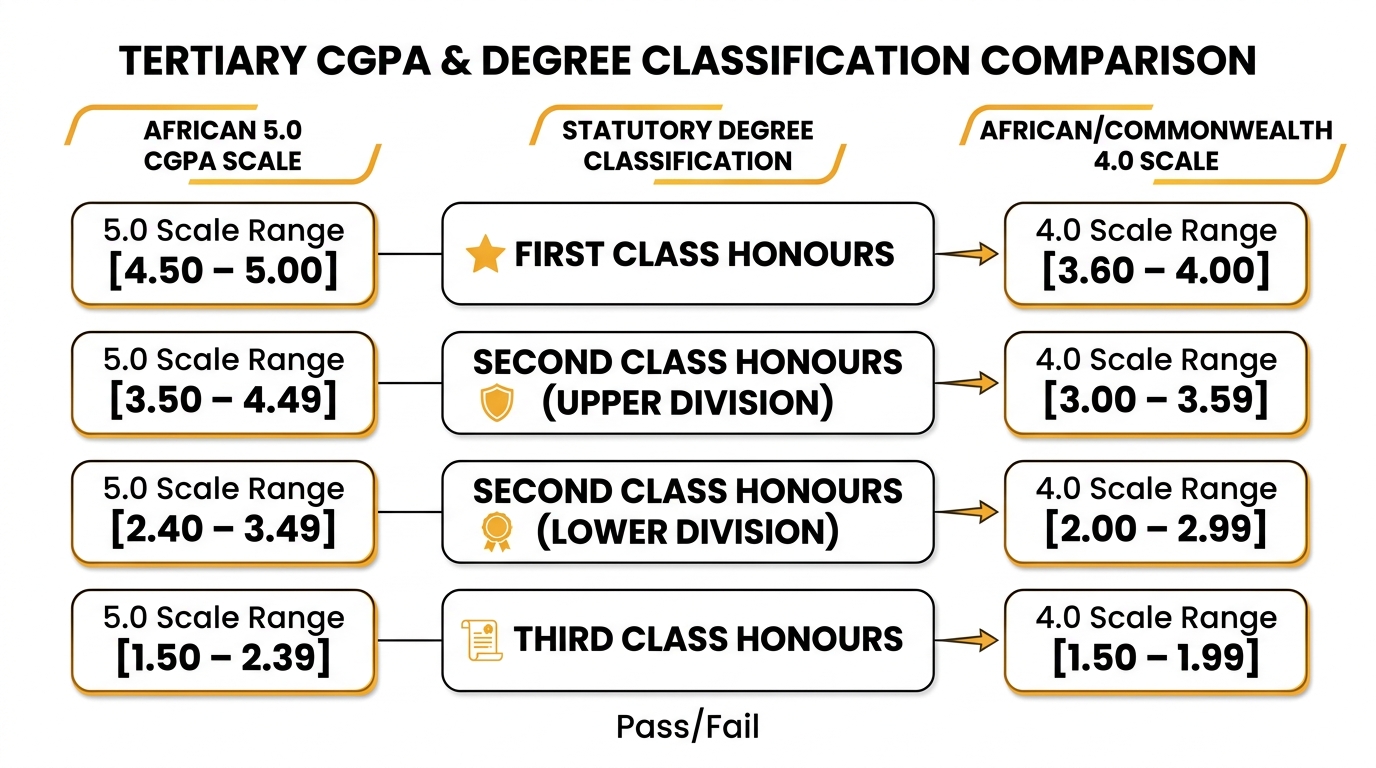
The degree classification is decided on the final cumulative CGPA at graduation, not on any single semester. Each country's regulator publishes the standard bands, and individual universities apply them within their own framework. The two most common sets in African tertiary education are shown below.
| Classification | 5.0 scale (Nigeria, NUC) | 4.0 scale (Ghana, Kenya, international) |
|---|---|---|
| First Class Honours | 4.50 to 5.00 | 3.60 to 4.00 |
| Second Class Upper | 3.50 to 4.49 | 3.00 to 3.59 |
| Second Class Lower | 2.40 to 3.49 | 2.00 to 2.99 |
| Third Class | 1.50 to 2.39 | 1.50 to 1.99 |
| Pass | 1.00 to 1.49 | 1.00 to 1.49 |
The bands are broad national standards, and a specific university can adjust them slightly. In practice, the thresholds that matter most for a student are the two boundaries that decide honours: the 4.50 or 3.60 threshold for First Class, and the 3.50 or 3.00 threshold for Second Class Upper. Those two bands drive the most career and graduate school outcomes.
Credit inertia and CGPA mathematical trajectory across academic years
One of the least understood mathematical realities of tertiary education is the principle of cumulative credit inertia. In the first year of an undergraduate programme, a student's Cumulative Grade Point Average is highly sensitive to every individual course grade. Because the cumulative credit denominator is small, a single four-credit course with an outstanding or disastrous grade can swing the entire cumulative profile by half a letter grade. By the fourth or fifth academic year, however, this sensitivity decays substantially. Once a student has accumulated over one hundred credit units, the cumulative record behaves like an ocean liner: enormous mathematical energy is required to alter its course even slightly.
To understand this decay quantitatively, consider the mathematical formula that governs how a single semester shifts an existing CGPA. If a student enters a semester with prior cumulative credits Cprior and a prior cumulative average CGPAprior, and completes an additional semester of credit load Csem with a semester performance GPAsem, the net change in cumulative standing (ΔCGPA) is given by:
The term Csem / (Cprior + Csem) represents the semester weighting coefficient. In Year 1 Semester 2, where Cprior is perhaps 18 credits and Csem is 18 credits, this coefficient is 18 / 36 = 0.50. In other words, the student's second-semester performance carries a full 50% mathematical influence on their updated cumulative standing. By the final semester of a four-year degree, where Cprior might be 126 credits and Csem is 14 credits, the coefficient drops to 14 / 140 = 0.10. The exact same academic effort that produced a massive surge in Year 1 now moves the needle by only one-tenth of the differential.
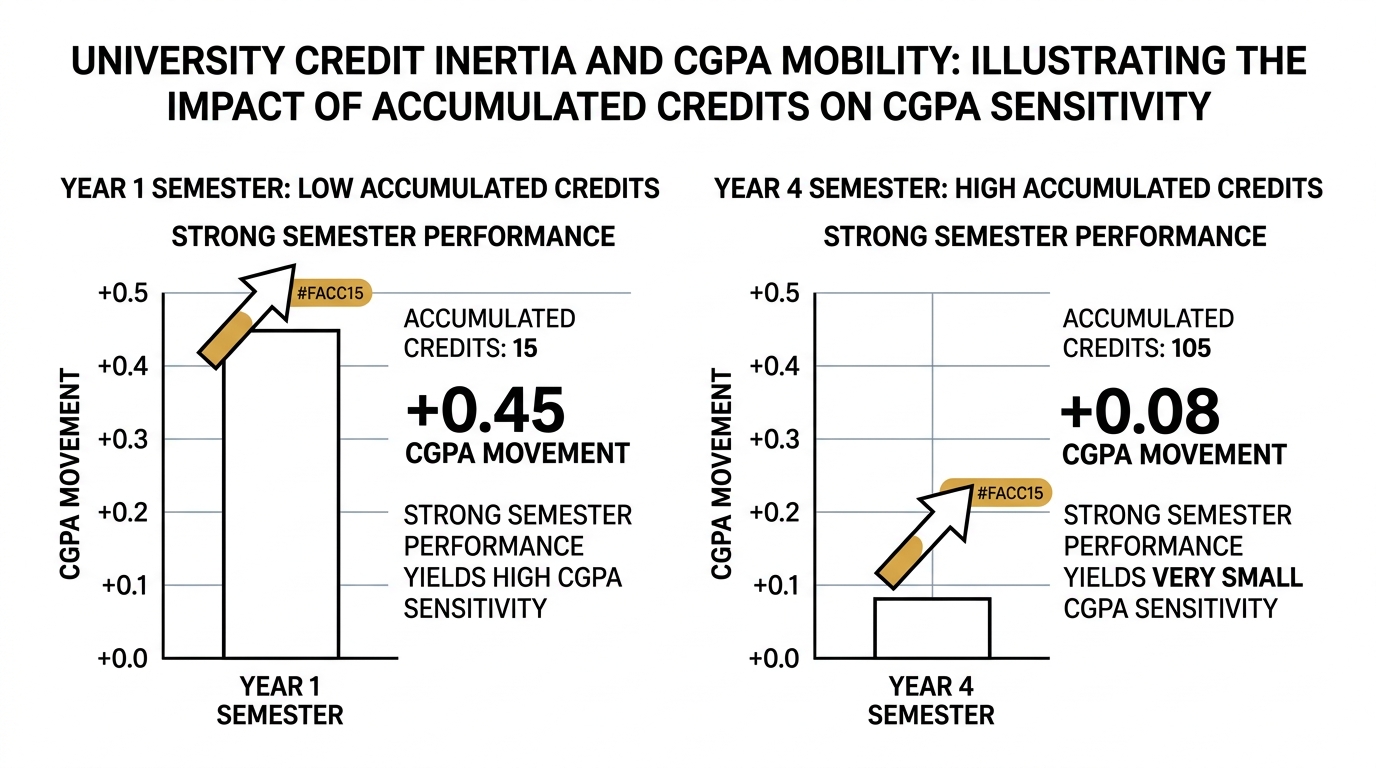
The practical implication of this law is illustrated in the table below. Suppose a student across five consecutive academic milestones maintains a baseline prior CGPA of 3.20 on a 5.0 scale, and then achieves a flawless semester of 15 credit units with straight 'A' grades (5.00 GPA). Notice how the resulting cumulative gain steadily shrinks as total accumulated credits increase:
| Academic Milestone | Prior Credits | Prior CGPA | Semester Credits & GPA | Updated CGPA | Net Gain (Δ) |
|---|---|---|---|---|---|
| Year 1, Semester 2 | 15 | 3.20 | 15 CU · 5.00 GPA | 4.10 | +0.90 |
| Year 2, Semester 2 | 50 | 3.20 | 15 CU · 5.00 GPA | 3.62 | +0.42 |
| Year 3, Semester 2 | 85 | 3.20 | 15 CU · 5.00 GPA | 3.47 | +0.27 |
| Year 4, Semester 2 (Finals) | 120 | 3.20 | 15 CU · 5.00 GPA | 3.40 | +0.20 |
| Year 5, Semester 2 (Engineering/Law) | 155 | 3.20 | 15 CU · 5.00 GPA | 3.36 | +0.16 |
This table demonstrates why early intervention is essential in tertiary education. Students who falter in Year 1 frequently assume they can make up ground in Year 3 or 4. While improvement is always possible, the mathematical effort required to leap across a classification boundary (such as moving from Second Class Lower into Second Class Upper) increases exponentially with each semester that passes. Building a strong cushion in the first three semesters remains the most mathematically reliable strategy for graduating with honors.
The anatomy of transcript retakes, carryover units, and repeat policies
When a tertiary student fails an examination or earns an unacceptable grade, the institutional procedure for handling the subsequent repeat attempt has an enormous impact on the cumulative record. Students frequently ask whether repeating a course replaces the original failing grade entirely or whether both attempts are averaged together. The answer depends strictly on the academic regulations of the governing council or university senate. Across African and Commonwealth tertiary institutions, three primary regulatory models exist:
-
Full Accumulation and Cumulative Averaging (The Statutory NUC and West African Model): Under this framework—mandated by the National Universities Commission (NUC) in Nigeria and widely practiced across public universities in Anglophone Africa—every registered course attempt permanently remains on the official academic record. If a student registers for a 3-credit unit course in Year 1 and earns an 'F' (0 grade points), that attempt contributes 3 credits to the cumulative denominator and 0 quality points to the numerator. When the student registers for the carryover unit in Year 2 and earns an 'A' (5 grade points), that second attempt contributes another 3 credits to the denominator and 15 quality points to the numerator. Across both attempts, the student has accumulated 6 total credit units and 15 quality points, resulting in an effective career grade point of
15 / 6 = 2.50(a C-equivalent). The 'F' is never erased; its drag on the denominator remains permanent. - Grade Replacement with Transcript Notation (The North American and Private University Model): In this model, adopted by select private universities (such as Covenant University, Strathmore, and American University of Nigeria), when a course is repeated, the highest or most recent grade replaces the original failing grade point in the cumulative CGPA numerator and denominator calculation. However, the original attempt is not expunged from the physical transcript; instead, it is marked with an institutional footnote such as 'R' (Repeated) or 'E' (Excluded from CGPA). This policy enables rapid GPA recovery, as the original 0 quality points and its associated credit load are removed from the active denominator.
- Capped Pass Policy (The UK and Commonwealth Honours Model): In this framework, common in UK-affiliated universities and select southern African tertiary institutions, students who fail a module are allowed a resit or repeat attempt to clear the academic deficiency and meet graduation prerequisites. However, the university senate caps the grade point awarded for the second attempt at the bare pass mark (typically a C, D, or 40–50% equivalent). Regardless of whether the student scores 85% on the retake examination, the recorded grade point is capped at 2.0 (or 1.0 depending on the scale). This policy ensures that a student who required two attempts to master a subject cannot gain an honours advantage over a peer who passed on the first attempt.
Understanding which policy applies to your institution is critical when deciding whether to retake an optional elective or focus your revision on upcoming core courses. Furthermore, carryover units impose severe indirect penalties: they consume allowable credit loads per semester (which typically cap at 24 credits per semester under statutory university guidelines), causing timetable clashes, lecture overlaps, and potential academic overload that can trigger secondary failures.
Polytechnic vs. university grading architecture: ND, HND, and degree divergences
In many tertiary education systems, particularly in Nigeria and Ghana, tertiary education is divided into two distinct tracks: the collegiate university system awarding Bachelor's degrees (B.Sc, B.A, B.Eng) and the polytechnic / technical college system awarding the National Diploma (ND) and Higher National Diploma (HND) supervised by the National Board for Technical Education (NBTE) or equivalent technical accreditation bodies.
While both systems use quality points and credit unit weighting, their classification nomenclature and institutional transition rules diverge in fundamental ways:
| Classification Tier | University Honours Title (5.0 Scale) | Polytechnic Diploma Title (NBTE 4.0 / 5.0) | Qualifying CGPA Cutoff |
|---|---|---|---|
| Tier 1 (Top Band) | First Class Honours | Distinction | 3.50+ (4.0) or 4.50+ (5.0) |
| Tier 2 (Upper Mid) | Second Class Honours (Upper Division) | Upper Credit | 3.00 – 3.49 (4.0) or 3.50 – 4.49 (5.0) |
| Tier 3 (Lower Mid) | Second Class Honours (Lower Division) | Lower Credit | 2.50 – 2.99 (4.0) or 2.40 – 3.49 (5.0) |
| Tier 4 (Minimum Pass) | Third Class Honours | Pass | 2.00 – 2.49 (4.0) or 1.50 – 2.39 (5.0) |
| Tier 5 (Conceded Pass) | Pass Degree (where retained) | Not Applicable (Fail below 2.00) | 1.00 – 1.49 |
A crucial structural difference between university degrees and polytechnic diplomas is the Clean Slate Transition between the National Diploma and Higher National Diploma programmes. An undergraduate student at a university completes a single four- or five-year continuous transcript where every semester from Year 1 to Year 5 compounds into one final cumulative CGPA. In contrast, an ND graduate completes a self-contained two-year programme resulting in a final National Diploma CGPA. Following the mandatory one-year or two-year Industrial Training (IT) attachment, the student enrolls in the Higher National Diploma (HND) programme. At this point, the clock resets completely to zero. The HND is evaluated strictly on its own two-year coursework: quality points earned during the ND do not carry forward into the HND CGPA calculation.
Similarly, when polytechnic graduates seek Direct Entry (DE) admission into university degree programmes (entering into 200 Level / Year 2), university senates award course waivers and exemptions for accredited ND courses, but the university transcript starts fresh at 0.00 CGPA. The university degree classification is derived solely from the credits completed within the university walls.
Target CGPA reversal: mathematical formula and strategic semester planning
Rather than merely calculating existing records retrospectively, tertiary students often need to plan forward: "What exact semester GPA do I need across my remaining credits to graduate with a First Class or Second Class Upper?" By applying algebraic reversal to the standard cumulative CGPA equation, you can solve directly for the required academic performance.
Let CGPAtarget be your desired graduating cumulative standing, Cprior be your completed credits, QPprior be your existing accumulated quality points (calculated as Cprior × CGPAprior), and Cremaining be the total credits left before graduation. The required average GPA across all remaining credits (GPAreq) is given by:
This equation yields immediate clarity on whether a target is mathematically achievable or impossible. Let us evaluate two realistic case studies on the standard 5.0 scale:
Case Study 1: The Realistic Comeback (Second Class Lower to Second Class Upper)
A third-year university student has completed 72 credit units with a cumulative CGPA of 3.32 (Second Class Lower). The student has 36 credit units remaining across Year 4. The student wishes to know if graduating with Second Class Upper (minimum CGPA of 3.50) is mathematically feasible.
- Current Quality Points:
QPprior = 72 × 3.32 = 239.04 QP - Total Career Credits:
72 + 36 = 108 credits - Target Total Quality Points:
108 × 3.50 = 378.00 QP - Deficit Quality Points Needed:
378.00 − 239.04 = 138.96 QP - Required Remaining GPA:
138.96 / 36 = 3.86 GPA
A target GPA of 3.86 requires an average distribution of mostly 'B' grades (4.0 pts) and occasional 'A' grades (5.0 pts). Because 3.86 is well below the 5.00 ceiling, the goal is fully attainable with disciplined academic execution.
Case Study 2: The Mathematically Impossible Ambition
Another student enters their final semester having completed 110 credits with a cumulative CGPA of 3.80. They have 16 credits remaining and hope to graduate with First Class Honours (minimum 4.50 CGPA).
- Current Quality Points:
QPprior = 110 × 3.80 = 418.00 QP - Total Career Credits:
110 + 16 = 126 credits - Target Total Quality Points:
126 × 4.50 = 567.00 QP - Deficit Quality Points Needed:
567.00 − 418.00 = 149.00 QP - Required Remaining GPA:
149.00 / 16 = 9.31 GPA
Because the maximum achievable GPA on the 5.0 scale is 5.00, achieving a 9.31 is a mathematical impossibility. Even if the student scores 100% in every single course in their final semester (16 × 5.0 = 80 QP), their maximum graduating CGPA will be (418 + 80) / 126 = 3.95. Understanding this boundary condition prevents students from developing unrealistic expectations and helps them channel their energy toward securing their position at the top of their achievable classification band.
International credential crosswalk: evaluating tertiary transcripts (WES, ECE & UK ENIC)
Graduating students applying for master's programmes, doctoral fellowships, or employment abroad frequently encounter credential evaluation requirements from agencies such as World Education Services (WES), Educational Credential Evaluators (ECE), or the UK National Information Centre (UK ENIC). A common error made by international applicants is attempting to convert a 5.0 CGPA to a 4.0 scale by multiplying by 0.8 (e.g., assuming a 4.00 on a 5.0 scale equals 4.00 × 0.8 = 3.20 on a US 4.0 scale).
This linear conversion is fundamentally flawed. In the Nigerian 5.0 system, an 'A' grade represents marks of 70% and above. In contrast, in the United States collegiate 4.0 system, an 'A' typically requires 90% or 93% and above. Evaluating agencies do not compress scales linearly; instead, they conduct course-by-course evaluations that translate individual raw percentage marks or letter grades into host-country equivalents based on institutional accreditation and national benchmarking standards.
| Degree Standing | African 5.0 Scale (Nigeria / NUC) | West African 4.0 Scale (Ghana / GTEC) | US Collegiate 4.0 Equivalent (WES Benchmark) | UK Degree Equivalent | ECTS European Equivalent |
|---|---|---|---|---|---|
| First Class Honours | 4.50 – 5.00 | 3.60 – 4.00 | 3.70 – 4.00 (A / A+) | First Class (1st) | A (Excellent - top 10%) |
| Second Class Upper | 3.50 – 4.49 | 3.00 – 3.59 | 3.30 – 3.69 (B+ / A-) | Upper Second (2:1) | B (Very Good - next 25%) |
| Second Class Lower | 2.40 – 3.49 | 2.00 – 2.99 | 2.70 – 3.29 (B- / B) | Lower Second (2:2) | C (Good - next 30%) |
| Third Class Honours | 1.50 – 2.39 | 1.50 – 1.99 | 2.00 – 2.69 (C / C+) | Third Class (3rd) | D (Satisfactory - next 25%) |
| Pass Degree | 1.00 – 1.49 | 1.00 – 1.49 | 1.00 – 1.99 (D) | Ordinary / Pass | E (Sufficient - final 10%) |
When preparing transcripts for evaluation abroad, always ensure that your academic registrar attaches the official transcript legend printed on the reverse side of the transcript sheet. Evaluation officers rely on this key to confirm the minimum pass percentage (40% vs 50%) and verify that your institution holds full national charter status with its respective tertiary commission.
A worked example
Take a first-year engineering student at a Nigerian university on the 5.0 scale, registered for six courses in the first semester.
| Course | Credits | Grade | Points | Quality points |
|---|---|---|---|---|
| MTH 101 Elementary Mathematics I | 4 | A | 5.0 | 20.0 |
| PHY 101 General Physics I | 3 | A | 5.0 | 15.0 |
| CHM 101 General Chemistry I | 3 | B | 4.0 | 12.0 |
| ENG 101 Engineering Drawing | 2 | A | 5.0 | 10.0 |
| GST 101 Use of English | 2 | B | 4.0 | 8.0 |
| PHY 107 Physics Practical | 1 | A | 5.0 | 5.0 |
The total quality points are 20 plus 15 plus 12 plus 10 plus 8 plus 5, which is 70. The total credits are 15. The semester GPA is 70 divided by 15, which is 4.67 on the 5.0 scale. That places the student well inside First Class standing for the term.
Now suppose the same student completes a second semester with 18 credits and 75 quality points, giving a semester GPA of 4.17. The cumulative quality points across both semesters are 70 plus 75, which is 145. The cumulative credits are 15 plus 18, which is 33. The Year 1 CGPA is 145 divided by 33, which is 4.39 on the 5.0 scale. That is Second Class Upper, just below the 4.50 First Class threshold.
Notice what a plain average of the two GPAs would have produced. Averaging 4.67 and 4.17 gives 4.42, which is slightly higher than the true 4.39. The difference comes from the second semester carrying three more credits than the first. In this case the error is small, but over a full degree with widely varying term loads the error can push a student's estimate across a classification boundary. The correct method is always the weighted one.
If the same student had earned a B instead of an A in the four-credit Mathematics course, the semester quality points would have dropped from 20 to 16, the term GPA would have been 66 divided by 15, which is 4.40, and the cumulative would have landed near 4.27. That single letter grade in a high-credit course moved the cumulative figure by more than a tenth of a point. A similar slip in a one-credit practical would barely have registered.
Common mistakes
Averaging semester GPAs to get a CGPA. This is the most common error. Two semesters with different credit loads cannot be averaged directly. The cumulative figure has to be built from total quality points and total credits.
Forgetting the credit weighting. A one-credit course and a four-credit course do not matter the same amount. Students who spend equal time on both are effectively gambling their CGPA on the arithmetic working out, and it usually does not.
Treating a D as a safe pass. A D is technically a pass on most scales, but many programmes require a C or above in prerequisite courses before allowing the student to progress. A D in a foundational course can block registration for everything that follows, which is a bigger problem than the CGPA hit on its own.
Ignoring the E grade on the 5.0 scale. An E earns 1 grade point and is technically a narrow pass on the 5.0 scale, but it drags the GPA down and does not satisfy most progression rules. Treat E as a warning sign and plan a recovery.
Carrying a fail without checking the repeat policy. When a failed course is repeated, some universities replace the failed grade with the new one in the cumulative record, while others average both attempts. The difference matters enormously for how much a fail actually costs. Check the faculty handbook.
Assuming 5.0 to 4.0 conversion is a simple multiplication. Multiplying a 5.0 CGPA by 0.8 is not an accurate conversion because the underlying marks that produce each letter grade are different on the two scales. Official conversions for graduate school or credential evaluation use course-by-course transcript review.
Not checking the handbook for the current year. Classification bands and grade point mappings occasionally shift when academic boards revise the curriculum. A student who assumes the same thresholds apply throughout a four-year degree can be caught out in final year.
Who this calculator is for
The tool is built for undergraduate and postgraduate students at universities, polytechnics, and colleges of education across Africa and internationally. It works on both the 5.0 and 4.0 scales, so the same page serves students at the University of Lagos, the University of Ghana, the University of Nairobi, the University of Cape Town, and any international institution that uses either system.
It is also useful for the people around those students. An academic adviser helping a student plan a recovery from a weak first year can use it to simulate how different grades in the remaining credits would move the CGPA. A parent trying to understand what their child's progress report actually means can enter the courses and see the classification band. A student preparing a graduate school application can estimate their CGPA on the scale the receiving institution uses, so the self-reported figure is close to the official one.
The calculator is also a teaching tool. New students who have never seen a transcript often assume the GPA is a plain average of their marks. Walking through the calculator once makes the credit weighting obvious in a way that a page of explanation cannot.
Where the calculator stops
This tool estimates semester GPA, cumulative CGPA, and degree classification from the courses and grades you enter, applying the standard weighted formula and the published national bands. It does not know your institution's specific rules on trails, course substitutions, transfer credits, supplementary exams, or special programmes, and it does not know any individual circumstances that might apply to your record. If your institution publishes a different grade mapping or applies a rule that changes the calculation, the official transcript will differ from the estimate here.
It also does not model repeated courses with full detail. Some universities replace the failed attempt entirely, others average the two attempts, and a few apply a cap on the improved grade. The tool treats each course entry as a single attempt, which is a reasonable simplification for planning but not for reproducing an official record. For a specific case, the records office is the authority.
What the tool does give you is a fast, transparent, private estimate, so you can see where you stand, test how much a change in one course grade would move the cumulative figure, and plan your next semester realistically. The classification band and the projected cumulative score are useful reference points for conversations with your academic adviser, and they are a reasonable starting point for any application that asks you to self-report your GPA or CGPA.
Sources
The grading scales, weighting rules, and classification bands described on this page come from the sources listed below. Every source is public and can be checked directly.
Sources
- National Universities Commission (NUC) Nigeria. Core Curriculum Minimum Academic Standards and University Regulations. nuc.edu.ng
- Ghana Tertiary Education Commission (GTEC). Tertiary Education Policy and National Standards. gtec.edu.gh
- Commission for University Education (CUE) Kenya. University Standards and Guidelines for Academic Programmes. cue.or.ke
- Council on Higher Education (CHE) South Africa. Higher Education Quality Framework and Programme Standards. che.ac.za
- AACRAO. International Grade Conversion and Credential Evaluation Resources. aacrao.org