On this page
- What the UCAS Tariff actually is and how Size and Grade Bands work
- Official UCAS Tariff point tables (2026 and 2027 entry)
- How totals are added up: non-duplication and qualification caps
- Five worked student profiles across qualification routes
- Tariff offers versus grade offers: how UK universities screen
- Comparing qualification routes and compulsory subject traps
- International and African qualifications in UCAS admissions
- Clearing flexibility, contextual offers, and revision trade-offs
- Common mistakes students make with UCAS points
- Where this calculator stops and privacy notes
- Sources and official references
What the UCAS Tariff actually is and how Size and Grade Bands work
The UCAS Tariff is a numerical translation scale managed by the Universities and Colleges Admissions Service (UCAS) to convert regulated Level 3 post-16 qualifications into a single comparable score. Instead of writing separate admissions thresholds for dozens of academic, applied, and technical certificates, a UK university department that wants roughly the attainment of an A and two Bs at A-Level can publish an entry requirement of 128 UCAS Tariff points. That single benchmark allows an admissions tutor to evaluate a three A-Level sixth-former, a BTEC National Extended Diploma college student, a T-Level technical learner, and an Access to Higher Education adult returner on a unified arithmetic scale.
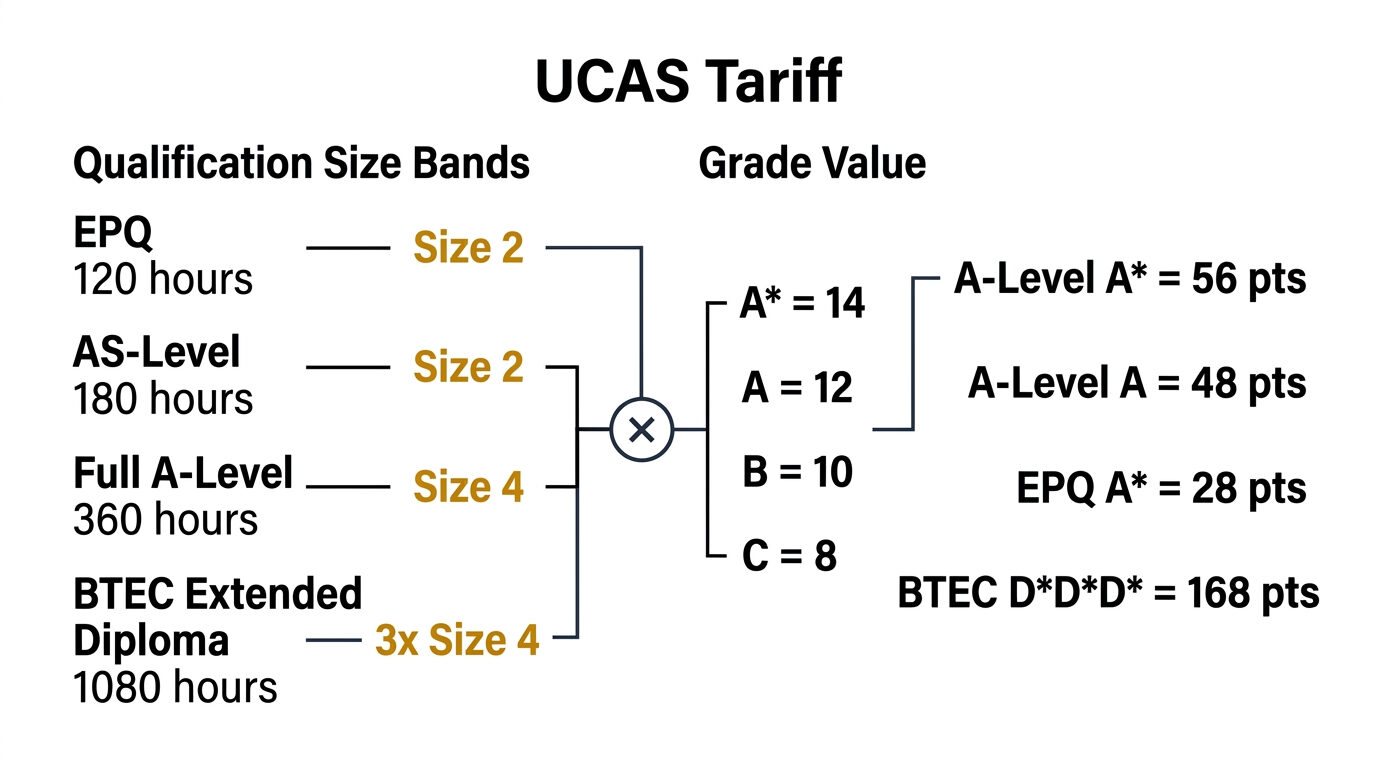
The numbers inside the Tariff tables are not arbitrary integers chosen by committee guesswork. Every regulated qualification admitted onto the post-2017 UCAS Tariff framework is scored by multiplying two structural components:
- Size Band (1 to 4): Assigned from the qualification's notional study hours or Guided Learning Hours (GLH). Small ancillary awards under 100 hours sit in Size Band 1; half-size awards such as the Extended Project Qualification (120 GLH) and decoupled AS-Levels (180 GLH) sit in Size Band 2; intermediate certificates sit in Size Band 3; and a full two-year GCE A-Level or BTEC Extended Certificate (360 GLH) sits in Size Band 4. Double awards (720 GLH) and triple awards such as a BTEC National Extended Diploma (1,080 GLH) are treated as two or three Size Band 4 blocks respectively.
- Grade Band (3 to 14): Assigned by mapping the academic demand of each passing grade across awarding bodies. At A-Level, grade E sits at Grade Band 4, D at 6, C at 8, B at 10, A at 12, and A* at the maximum Grade Band 14.
Multiplying Size Band by Grade Band produces the exact figures you see on university prospectuses. A full A-Level (Size Band 4) at grade A* (Grade Band 14) yields 4 multiplied by 14, or 56 points; grade A (Grade Band 12) yields 4 multiplied by 12, or 48 points; and each letter drop removes 8 points. An Extended Project Qualification (Size Band 2) at grade A* yields 2 multiplied by 14, or 28 points—exactly half an A-Level. One deliberate exception in the modern framework is the standalone AS-Level: when AS examinations were decoupled from full A-Levels in England, UCAS calibrated AS-Levels at 40 per cent of an A-Level rather than 50 per cent to reflect first-year syllabus depth, giving an AS grade A 20 points rather than 24.
Crucially, the Tariff is an administrative currency rather than a statement that two qualifications teach identical content. A BTEC National Extended Diploma at DDM carries the exact same 128 points as A-Level grades ABB (whereas DMM carries 112 points, matching BBC), yet admissions tutors know that a continuous-assessment vocational diploma develops practical studio or laboratory fluency while linear A-Levels test unseen terminal examination synthesis. Many undergraduate degrees welcome both profiles; heavily mathematical or clinical degrees insist on specific syllabus content regardless of how high your point total climbs.
Official UCAS Tariff point tables (2026 and 2027 entry)
The reference tables below cover the Level 3 qualifications most frequently entered by domestic and international applicants for the 2026 and 2027 UCAS admission cycles. Every figure matches the official UCAS Tariff database and the calculation engine at the top of this page.
GCE A-Levels and International A-Levels (CAIE, Edexcel IAL, OxfordAQA)
| Grade | Grade Band | Guided Learning Hours | UCAS Points |
|---|---|---|---|
| A* | 14 | 360 GLH (Size Band 4) | 56 |
| A | 12 | 360 GLH (Size Band 4) | 48 |
| B | 10 | 360 GLH (Size Band 4) | 40 |
| C | 8 | 360 GLH (Size Band 4) | 32 |
| D | 6 | 360 GLH (Size Band 4) | 24 |
| E | 4 | 360 GLH (Size Band 4) | 16 |
GCE AS-Levels and Level 3 Core Maths
| Grade | Qualification Scope | Relative Weighting | UCAS Points |
|---|---|---|---|
| A | AS-Level / Level 3 Core Maths | 40% of full A-Level | 20 |
| B | AS-Level / Level 3 Core Maths | 40% of full A-Level | 16 |
| C | AS-Level / Level 3 Core Maths | 40% of full A-Level | 12 |
| D | AS-Level / Level 3 Core Maths | 41.7% of A-Level D | 10 |
| E | AS-Level / Level 3 Core Maths | 37.5% of A-Level E | 6 |
T-Levels (Technical Level Qualifications)
| Overall T-Level Grade | A-Level Equivalent | UCAS Points |
|---|---|---|
| Distinction* | A*A*A* | 168 |
| Distinction | AAA | 144 |
| Merit | BBB | 120 |
| Pass (grade C or above on core component) | CCC | 96 |
| Pass (grade D or E on core component) | DDD | 72 |
BTEC Level 3 National Extended Diploma (1,080 GLH)
| Grade Profile | Equivalent Three A-Level Profile | UCAS Points |
|---|---|---|
| D*D*D* | A*A*A* | 168 |
| D*D*D | A*A*A | 160 |
| D*DD | A*AA | 152 |
| DDD | AAA | 144 |
| DDM | ABB | 128 |
| DMM | BBC | 112 |
| MMM | CCC | 96 |
| MMP | CDD | 80 |
| MPP | DDE | 64 |
| PPP | EEE | 48 |
BTEC National Diploma (720 GLH) and Extended Certificate (360 GLH)
| Qualification Size | Official Grades and UCAS Points |
|---|---|
| BTEC National Diploma (720 GLH, 2 A-Level size) | D*D* = 112, D*D = 104, DD = 96, DM = 80, MM = 64, MP = 48, PP = 32 |
| BTEC Extended Certificate (360 GLH, 1 A-Level size) | D* = 56, D = 48, M = 32, P = 16 |
| Cambridge Technicals (OCR Level 3, 360 to 1,080 GLH) | Identical points per GLH band to BTEC Level 3 Nationals above |
International Baccalaureate (IB) Diploma Components
| IB Component | Official Grades and UCAS Points |
|---|---|
| IB Higher Level (HL) Subject | Grade 7 = 56, Grade 6 = 48, Grade 5 = 32, Grade 4 = 24, Grade 3 = 12 |
| IB Standard Level (SL) Subject | Grade 7 = 28, Grade 6 = 24, Grade 5 = 16, Grade 4 = 12, Grade 3 = 6 |
| Theory of Knowledge (TOK) — counted separately | A = 12, B = 10, C = 8, D = 6 |
| Extended Essay (EE) — counted separately | A = 12, B = 10, C = 8, D = 6 |
Extended Project Qualification (EPQ), Scottish SQA, Access to HE, and Music Exams
| Qualification | Official Grades and UCAS Points |
|---|---|
| Extended Project Qualification (EPQ, Level 3) | A* = 28, A = 24, B = 20, C = 16, D = 12, E = 8 |
| Scottish Advanced Higher (SCQF Level 7) | A = 56, B = 48, C = 40, D = 32 |
| Scottish Higher (SCQF Level 6) | A = 33, B = 27, C = 21, D = 15 |
| Access to HE Diploma (45 graded Level 3 credits) | 45D = 144, 30D + 15M = 128, 15D + 30M = 112, 45M = 96, 45P = 48 |
| UAL Level 3 Extended Diploma (Art, Design & Media) | Distinction = 168, High Merit = 120, Merit = 96, Pass = 72 |
| ABRSM / Trinity / RSL Practical Music (Grades 6 to 8) | Gr 8: D = 30, M = 24, P = 18; Gr 7: D = 16, M = 12, P = 10; Gr 6: D = 12, M = 10, P = 6 |
| ABRSM / Trinity Music Theory (Grades 6 to 8) | Gr 8: D = 10, M = 8, P = 6; Gr 7: D = 8, M = 6, P = 4; Gr 6: D = 6, M = 5, P = 4 |
If you hold an OCR Cambridge Technical Extended Certificate or Extended Diploma, select the matching BTEC row in the calculator above because both follow identical Ofqual Guided Learning Hour point bands. If you are taking the full IB Diploma with both Theory of Knowledge and an Extended Essay, add two separate IB TOK/EE rows in the calculator so both core components are counted.
How totals are added up: non-duplication and qualification caps
In its pure mathematical form, the UCAS Tariff is additive: each distinct Level 3 qualification you complete contributes its point value to a running sum, with no averaging and no automatic ceiling. However, university admissions offices enforce three operational rules that determine how much of your raw sum actually counts toward clearing an offer.
1. The subject non-duplication (subsuming) rule
Whenever you complete two qualifications at progressive levels in the exact same subject, the higher-level award subsumes the lower-level award. You never add both together:
- AS-Level followed by full A-Level: Sitting AS Chemistry in Year 12 (grade A, 20 points) and continuing to full A-Level Chemistry in Year 13 (grade B, 40 points) gives you 40 points for Chemistry, not 60. Only if you drop a fourth subject after sitting the standalone AS exam at the end of Year 12 can you keep the AS points alongside your three unrelated full A-Levels.
- Scottish Higher followed by Advanced Higher: Progressing from S5 Higher Mathematics (grade A, 33 points) to S6 Advanced Higher Mathematics (grade B, 48 points) means only the 48-point Advanced Higher counts in non-duplicated Tariff calculations, because the S6 curriculum builds directly on the S5 syllabus.
- Graded music, dance, and drama exams: Passing ABRSM Grade 6 Piano, Grade 7 Piano, and Grade 8 Piano Distinction gives you 30 points from Grade 8 alone—not 58 points from adding all three certificates. By contrast, Grade 8 Piano Distinction (30 points) and Grade 7 Violin Merit (12 points) are separate instruments, so both remain distinct on the Tariff.
2. Institutional qualification-count caps
Read the exact phrasing of every conditional offer on UCAS Hub. There is a major difference between an offer worded "120 UCAS Tariff points" and one worded "120 UCAS Tariff points from a maximum of three Level 3 qualifications" (or "from three A-Levels or equivalent, excluding General Studies and Critical Thinking"). Under the uncapped offer, an applicant holding BCC at A-Level (104 points) plus an EPQ at grade B (20 points) reaches 124 points and meets the condition. Under the three-qualification cap, the admissions computer sums only the three full A-Levels, stops at 104 points, and flags the applicant as 16 points short unless an admissions tutor exercises discretion.
3. The Level 2 GCSE floor underneath every Tariff offer
Why GCSEs and IGCSEs carry zero UCAS points yet still block offers: GCSEs, International GCSEs, and Scottish National 5s are Level 2 qualifications and contribute 0 points to your Tariff total. Despite carrying zero points, almost every UK university imposes a compulsory Level 2 gatekeeper—minimum grade 4 (grade C) in English Language and Mathematics for general degrees, rising to grade 6 or 7 in Mathematics for Economics, Computer Science, Finance, and Psychology, and five or more grades at 7 to 9 for Medicine and Dentistry. Always verify the GCSE tab on UCAS Course Search before assuming a high Level 3 Tariff total guarantees an offer.
Five worked student profiles across qualification routes
Working through concrete candidate portfolios shows how raw Tariff arithmetic interacts with real university entry rules across different post-16 curricula.
Profile 1: Standard three A-Level STEM and Economics candidate
A student completes three linear A-Levels: A in Mathematics (48), B in Physics (40), and B in Economics (40). Adding the three Size Band 4 awards gives 48 + 40 + 40 = 128 UCAS points. In UK higher education, 128 points (ABB) sits right on the boundary between selective research universities (such as Leeds, Sheffield, Southampton, Nottingham, and Liverpool for many engineering, finance, and social science programmes) and upper-mid comprehensive institutions. Because Mathematics is held at grade A, this student also satisfies quantitative subject prerequisites that a 128-point candidate with A in Sociology and BB in Humanities would miss.
Profile 2: Hybrid academic, applied science, and EPQ portfolio
A sixth-former combines A-Level Biology at A (48), A-Level Chemistry at A (48), a BTEC Level 3 National Extended Certificate in Applied Human Biology at Distinction (48), and an EPQ on antibiotic resistance at grade A (24). The full uncapped total is 48 + 48 + 48 + 24 = 168 UCAS points, numerically matching three A* grades. Even if a selective Pharmacology or Biomedical Science department caps its main calculation at three 360-GLH qualifications, the core trio still delivers 144 points (AAA equivalent), while the grade A EPQ frequently activates an alternative dual offer (such as ABB instead of AAB).
Profile 3: BTEC National Extended Diploma computing specialist
A further-education college student completes the 1,080-GLH BTEC Level 3 National Extended Diploma in Computing with grades DDM, earning 128 UCAS points. Notice how steep the step sizes are on BTEC Extended Diplomas below DDD: dropping a single overall grade step from DDM to DMM cuts the score by 16 points to 112 points, whereas moving from DDD to D*DD changes the score by only 8 points (144 to 152). For BTEC students, crossing the internal unit-point threshold from DMM into DDM is often worth two full A-Level grade boundaries in university eligibility.
Profile 4: Full International Baccalaureate (IB) Diploma candidate
An IB Diploma student achieves 35 IB points out of 45, distributed as follows:
- Higher Level (HL): History Grade 6 (48), Economics Grade 6 (48), English A Literature Grade 5 (32) = 128 points.
- Standard Level (SL): Mathematics: Analysis and Approaches Grade 6 (24), Biology Grade 5 (16), French B Grade 5 (16) = 56 points.
- IB Core: Extended Essay Grade B (10) and Theory of Knowledge Grade C (8) = 18 points.
Summing every component yields 128 + 56 + 18 = 202 UCAS Tariff points. New IB applicants are often surprised to see 202 points—well above the 168-point ceiling of three A* grades at A-Level—from a solid but non-maximum 35-point IB Diploma. That structural inflation happens because IB candidates study six subjects plus two core elements rather than three subjects. UK admissions teams know this arithmetic well: Selective universities therefore express IB offers directly in IB Diploma points (typically 32 to 38 out of 45, specifying 6,6,5 or 6,6,6 at Higher Level) rather than allowing an IB student with modest Higher Level grades to pass a 128-point Tariff filter on volume alone.
Profile 5: Scottish SQA Highers and Advanced Highers candidate
A student in Scotland sits five Highers in S5—Mathematics A (33), Chemistry A (33), Physics B (27), English B (27), and History B (27)—for an S5 total of 147 points. Staying on for S6, the student completes Advanced Higher Mathematics at B (48), Advanced Higher Chemistry at B (48), and a fresh Higher in Modern Studies at B (27). Under the UCAS non-duplication rule, the two S6 Advanced Highers replace the earlier S5 Highers in Mathematics and Chemistry rather than stacking on top of them. The accurate non-duplicated Tariff score is 48 + 48 + 27 + 27 + 27 + 27 = 204 points (not 270).
Tariff offers versus grade offers: how UK universities screen
Before using your Tariff score to pick your five UCAS choices, you need to distinguish between institutions that admit by letter grades and institutions that admit by Tariff points. Confusing the two is one of the costliest errors in UCAS strategy.
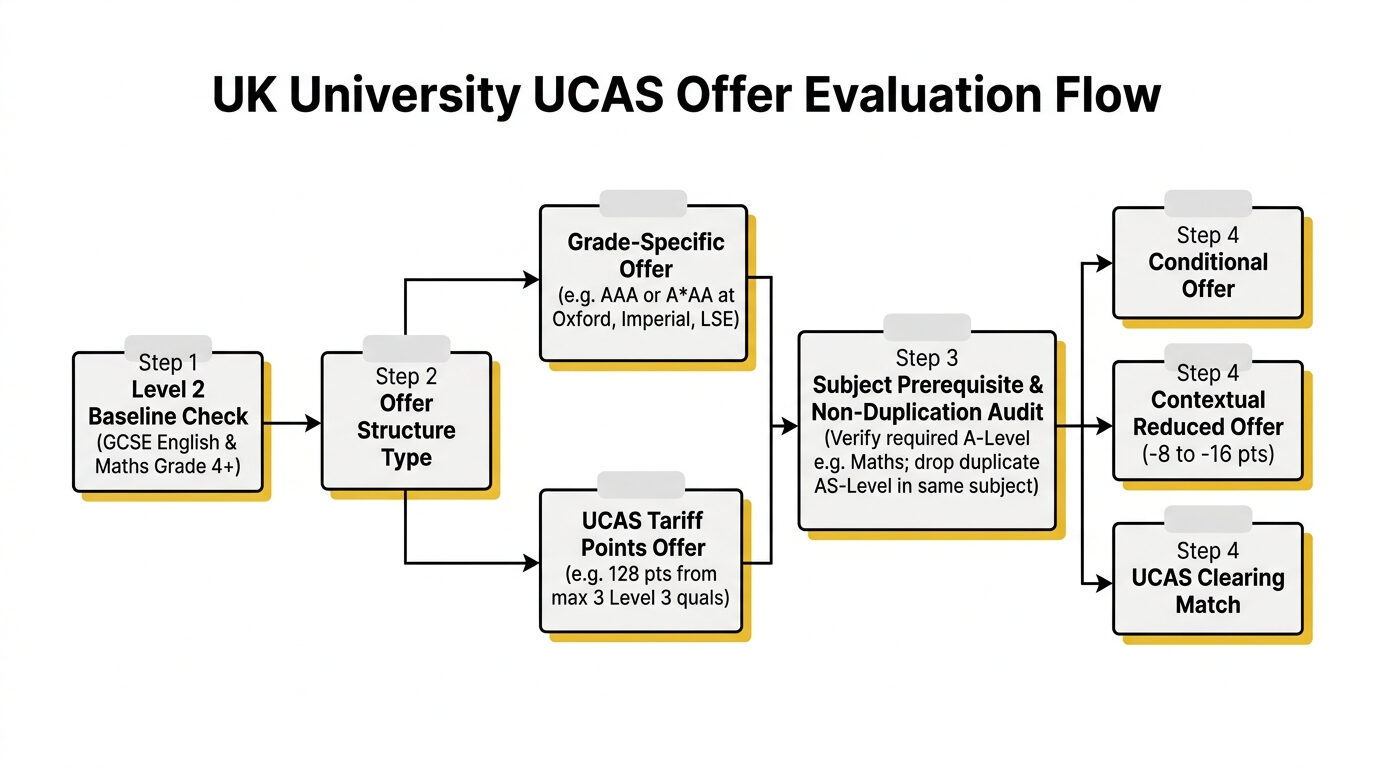
UK higher education providers broadly fall into three operational groups:
- Strict letter-grade selectors (Zero Tariff conversion): Oxford, Cambridge, Imperial College London, LSE, UCL, St Andrews, Durham, Warwick, Bristol, Bath, and Edinburgh (for non-Scottish entries) express standard offers exclusively in grades such as A*A*A, A*AA, or AAA. If an offer specifies AAA (which equals 144 points on paper), presenting A*AB (also 144 points) or ABB plus an A in EPQ (152 points) does not automatically satisfy the contract, because the grade B breaches the minimum A-grade floor.
- Hybrid selectors (Grades for A-Levels, Tariff or mixed rules for applied routes and Clearing): Universities such as Manchester, Leeds, Nottingham, Sheffield, Birmingham, Southampton, Newcastle, Liverpool, Queen Mary, Cardiff, and Lancaster publish most standard entries as AAB or ABB, yet several faculties—particularly Nursing, Healthcare Sciences, Environmental Science, Construction Management, Media, and Education—accept combined A-Level and BTEC profiles or switch to Tariff benchmarks during August Clearing.
- Tariff-primary selectors and Degree Apprenticeships: Modern and comprehensive universities—including Manchester Metropolitan, Nottingham Trent, Oxford Brookes, Coventry, Portsmouth, Swansea, UWE Bristol, Northumbria, Aston, and De Montfort—alongside major corporate Degree Apprenticeship employers (engineering, quantity surveying, digital technology, and chartered management schemes) routinely express entry requirements directly as 96 to 136 UCAS Tariff points.
Decoding real UCAS Course Search offer wording
Two courses that both display "120 UCAS points" in search results often enforce very different fine print. Use the table below to translate standard admissions phrasing before locking in your Firm and Insurance choices.
| Typical UCAS Offer Phrasing | What Counts Toward the Total | Portfolio That Passes | Portfolio That Fails Despite High Points |
|---|---|---|---|
| "128 UCAS Tariff points from a maximum of 3 A-Levels or equivalent" | At most three 360-GLH qualifications (or one 1,080-GLH Extended Diploma); excludes EPQ, AS, and music grades | ABB at A-Level (128), or BTEC DDM (128), or AB + BTEC Ext Cert D (136) | BBB (120) + EPQ Grade A (24) = 144 raw pts, because best 3 full quals equal only 120 |
| "120 UCAS Tariff points to include at least two full Level 3 qualifications" | Any Level 3 combination once at least two 360-GLH awards are present | BC at A-Level (72) + AS Maths B (16) + EPQ A* (28) + Core Maths C (12) = 128 pts | Five standalone AS-Levels + Grade 8 Music = 126 pts, because zero full A2/360-GLH awards exist |
| "128 points including 40 points from A-Level Mathematics or Physics" | Total of 128+, with at least grade B (40 pts) in the named A-Level subject | Maths B (40) + Geography A (48) + BTEC Business D (48) = 136 pts | Maths C (32) + Economics A* (56) + History A (48) = 136 pts (misses the 40-pt Maths floor) |
| "112 points excluding General Studies, Critical Thinking, and native-language A-Levels" | Standard approved Level 3 qualifications outside the department's exclusion list | BBC in Biology, Psychology, Sociology = 112 pts | BC in Biology and Psychology (72) + A in General Studies (48) = 120 raw pts, reduced to 72 |
Comparing qualification routes and compulsory subject traps
One genuine strength of the UCAS Tariff is how transparently it aligns academic, applied general, and technical routes across the main UK university recruitment bands.
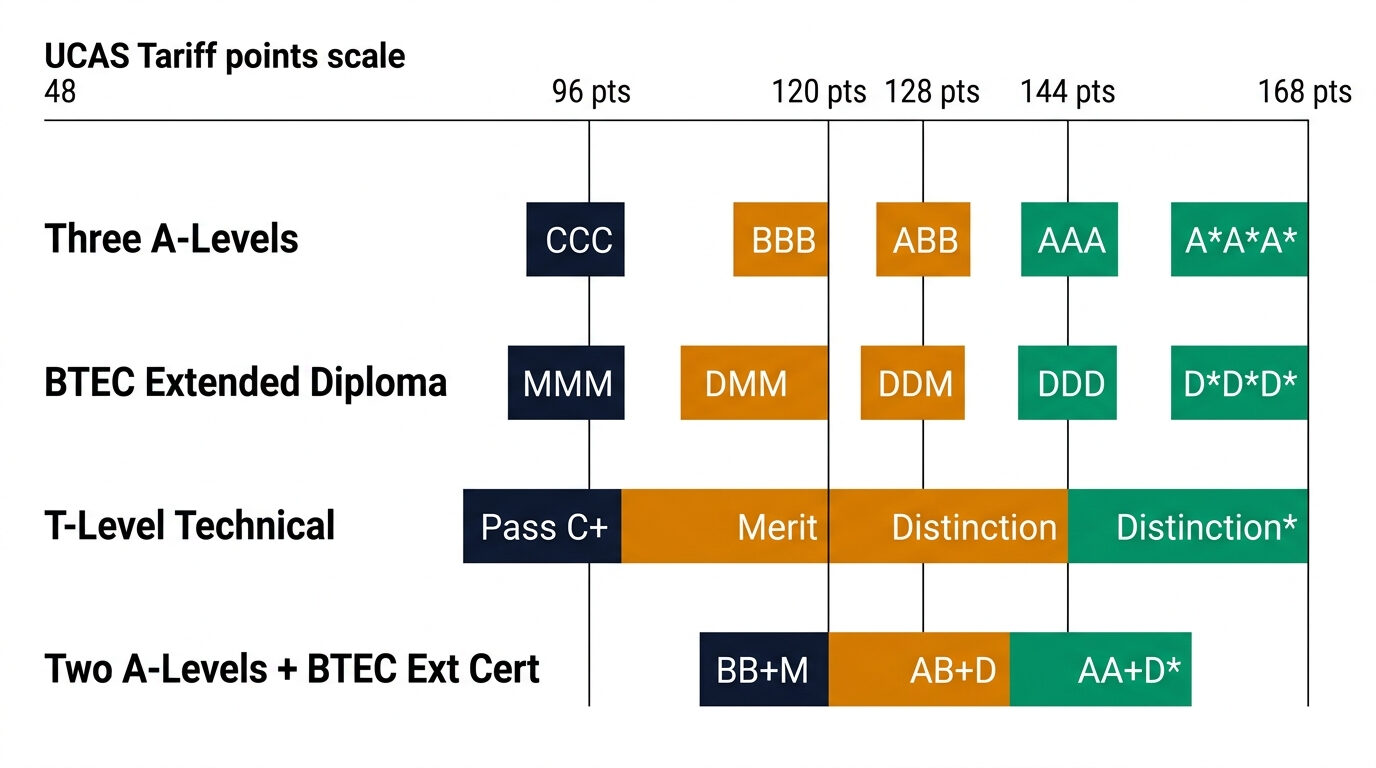
| UCAS Tariff Band | Three GCE / Int. A-Levels | BTEC Extended Diploma (1,080 GLH) | T-Level Technical Route | Mixed Portfolio (2 A-Levels + Applied / EPQ) |
|---|---|---|---|---|
| 168 points | A*A*A* | D*D*D* | Distinction* | AA (96) + BTEC Ext Cert D (48) + EPQ A (24) |
| 152 points | A*AA | D*DD | Between Distinction & D* | AA (96) + BTEC Ext Cert D* (56) |
| 144 points | AAA | DDD | Distinction | AB (88) + BTEC Ext Cert D* (56) |
| 128 points | ABB | DDM | Between Merit & Distinction | BB (80) + BTEC Ext Cert D (48) |
| 120 points | BBB | Between DMM (112) & DDM (128) | Merit | BC (72) + BTEC Ext Cert D (48) |
| 112 points | BBC | DMM | Between Pass C+ & Merit | BB (80) + BTEC Ext Cert M (32) |
| 96 points | CCC | MMM | Pass (C or above on core) | CC (64) + BTEC Ext Cert M (32) |
Notice the structural gap at 120 points for BTEC Extended Diploma learners: there is no 120-point BTEC Extended Diploma grade between DMM (112) and DDM (128). When a university course advertises a 120-point entry requirement, BTEC Extended Diploma applicants normally have to target DDM (128) to be safely above the bar, although many admissions departments explicitly publish "120 points (or DMM in a relevant BTEC Extended Diploma)" so vocational applicants are not unfairly penalised by the 16-point step interval.
Subject prerequisite traps that override Tariff points
Equivalence in Tariff points never overrides syllabus prerequisites. Four degree families routinely reject high-Tariff applicants who lack specific subject coverage:
- Engineering, Physics, and Quantitative Economics: Almost all accredited MEng/BEng Mechanical, Aerospace, Electrical, and Civil Engineering courses at research-intensive universities require A-Level Mathematics (and usually Physics). A student holding 168 points from BTEC Extended Diploma Engineering D*D*D* without A-Level Mathematics is often required either to sit A-Level Mathematics alongside the BTEC or enter via a Foundation Engineering year, because university first-year vector calculus assumes full A2 pure mathematics fluency.
- Medicine, Dentistry, and Veterinary Science: UK medical schools rarely use Tariff points at all; they mandate A-Level (or IB Higher Level) Chemistry and Biology plus UCAT admissions test percentiles and Multiple Mini Interviews (MMIs), typically excluding BTEC Applied Science as a standalone substitute.
- Computer Science and Data Science: Top-20 departments normally demand A-Level Mathematics at grade A or A*, whereas mid-tariff universities (112 to 128 points) frequently welcome BTEC Extended Diplomas in Computing or IT, T-Levels in Digital Production, Design and Development, or any three A-Levels without Mathematics.
- Nursing, Midwifery, Physiotherapy, and Allied Health: Regulated NHS clinical degrees enthusiastically use UCAS Tariff offers (typically 104 to 128 points) and welcome BTEC Health and Social Care, T-Level Health, and Access to HE (Health Professions) Diplomas, provided you meet biological science credit minimums and occupational health/DBS checks.
International and African qualifications in UCAS admissions
Thousands of applicants from Ghana, Nigeria, Kenya, South Africa, Uganda, Zimbabwe, Tanzania, and international schools worldwide apply to UK undergraduate degrees through UCAS each cycle. Whether your school-leaving results convert into UCAS Tariff points depends on which examination board issued your certificate.
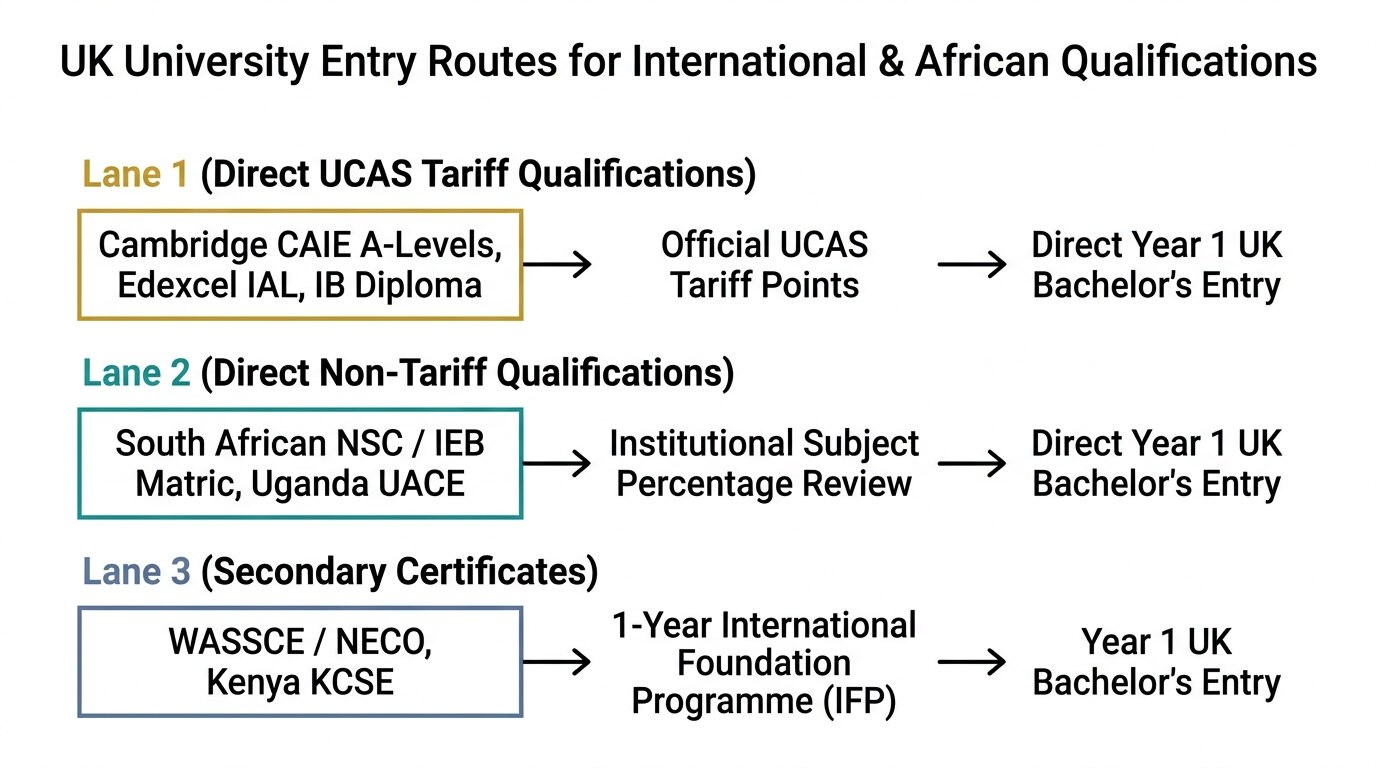
Lane 1: International qualifications that carry full UCAS Tariff points
If you studied at an international school or private sixth-form college offering Cambridge Assessment International Education (CAIE) AS and A-Levels, Pearson Edexcel International Advanced Levels (IAL), OxfordAQA International A-Levels, or the International Baccalaureate (IB) Diploma, your grades carry the exact same official UCAS Tariff points as domestic UK awards. An A* in CAIE Physics in Accra, Lagos, Nairobi, or Harare is worth 56 UCAS points—no downward adjustment or credential conversion fee applies. Zimbabwe's ZIMSEC Advanced Level is also widely benchmarked alongside GCE A-Level grades for direct Year 1 UK entry by international admissions teams.
Lane 2: Direct Year 1 entry without UCAS Tariff conversion (South Africa, Uganda, Tanzania)
Several 12-to-13-year national curricula sit outside the numerical UCAS Tariff tables yet are accepted by UK universities for direct Year 1 bachelor's entry using country-specific equivalency schedules:
- South African National Senior Certificate (NSC) and IEB Matric: Most UK universities accept the NSC/IEB with a Bachelor's Degree endorsement directly into Year 1 (excluding Life Orientation from academic subject counts). Rather than converting Matric achievement levels 1–7 into UCAS Tariff points, international offices map five relevant subjects directly to A-Level bands—for instance, requiring 75555 to 76666 (70% to 80%+ across five subjects) where a domestic applicant needs ABB (128 points), or 77766 where AAA (144 points) is required.
- Ugandan UACE and Tanzanian ACSEE: Because East African Advanced Certificates follow a two-year post-O-Level sixth-form structure modelled historically on GCE A-Levels, many UK universities consider strong Principal Pass profiles (such as AAB to BBB across three Principal subjects) for direct Year 1 admission via institutional country pages, even though UNEB and NECTA awards are not listed inside the automated UCAS Tariff calculator.
Lane 3: Secondary certificates requiring an International Foundation Year (WASSCE, NECO, KCSE)
West African WASSCE and NECO Senior School Certificate Examinations (12 years of schooling) and the Kenyan KCSE are evaluated by UK ENIC (formerly UK NARIC) as comparable in academic tier to GCSE/IGCSE/AS transition level rather than full Level 3 GCE A-Levels. Consequently, WASSCE and KCSE grades carry zero UCAS Tariff points and generally do not grant direct entry into Year 1 of a three-year English bachelor's degree. Instead, students follow one of two proven routes:
- One-Year International Foundation Programme (IFP): Offered on campus by almost every UK university (requiring typically 5 WASSCE credits at A1 to C6 including English and Mathematics, or a KCSE mean grade of C+ to B-). Completing the IFP progresses you straight into Year 1 of the bachelor's degree.
- Four-Year Scottish Undergraduate Degree: Because Scottish honours degrees run for four years rather than three, universities in Scotland (such as Aberdeen, Strathclyde, Dundee, and Stirling) sometimes admit exceptional WASSCE or KCSE candidates with top A1/A grades directly into Year 1 or dedicated international first-year pathways.
English language cost-saving tip for WASSCE, KCSE, and NSC applicants: Dozens of UK universities formally accept WASSCE English Language at grade C6 or B3+, KCSE English at grade C+ or B, or South African NSC English at Level 5 (60%+) as proof of English proficiency under UK Student Visa (UKVI) assessment rules, waiving the need to pay for a separate IELTS Academic exam. Always check the target university's English language country list before booking a test centre.
Clearing flexibility, contextual offers, and revision trade-offs
Understanding how Tariff points behave at the margins helps you allocate revision time before summer exams and act decisively on August results day.
Where an extra revision hour unlocks the biggest Tariff jump
Students juggling mixed qualifications often treat all subjects equally during revision season, ignoring how unevenly UCAS points step across qualification types:
- A-Level grade boundaries (+8 points per step): Moving a borderline C (32) to a B (40) or a B (40) to an A (48) adds a steady 8 Tariff points.
- IB Higher Level 5-to-6 jump (+16 points in one boundary): On the official UCAS Tariff, an IB Higher Level Grade 5 is worth 32 points while Grade 6 jumps straight to 48 points—a 16-point surge from a single point on the IB 1–7 scale. Pushing one borderline HL subject from 5 to 6 yields four times the UCAS Tariff gain of nudging an EPQ up one letter grade.
- BTEC Extended Certificate Merit-to-Distinction jump (+16 points): Because a 360-GLH BTEC Extended Certificate has no intermediate grade between Merit (32) and Distinction (48), securing the internal unit points needed to cross from M to D delivers +16 UCAS points—equivalent to raising two separate A-Levels by one grade each.
- EPQ and AS-Level boundaries (+4 points per step): Raising an EPQ from B (20) to A (24) adds just 4 Tariff points, yet its true value often lies in triggering a contextual/alternative grade reduction (dropping a main AAB offer to ABB, effectively saving 8 points on your core A-Levels).
Contextual offers and widening participation
Most UK universities operate automated contextual admissions policies using your postcode deprivation index (IMD/POLAR4), school attainment profile, care-experienced background, or Free School Meals record. Contextual offers commonly reduce standard requirements by one to two A-Level grades (8 to 16 UCAS Tariff points)—turning a published 136-point (AAB) course into a 120-point (BBB) offer. Because contextual flags are assessed from your UCAS application fields automatically, select the "Custom Tariff" or lower benchmark dropdown in the calculator above to test both the standard headline offer and the published contextual threshold for your target course.
How UCAS Clearing uses Tariff points in August
UCAS Clearing opens from early July and peaks on A-Level results day in mid-August. During the main cycle, universities publish aspirational entry tariffs; during Clearing, unfilled course seats become perishable inventory. A department advertising 128 points in October frequently drops its live Clearing threshold to 112 or 104 points on results morning if recruitment is light, provided you hold required GCSEs and any compulsory science or maths subject. Before phoning a Clearing hotline, calculate your exact verified Tariff score here, click Copy breakdown, and keep your UCAS Personal ID, GCSE English and Maths grades, and individual unit/module breakdown ready in front of you—admissions tutors on phone lines make provisional verbal decisions in under four minutes when candidates quote clear, non-duplicated numbers.
Common mistakes students make with UCAS points
Every admissions cycle, applicants misjudge their competitiveness because of six preventable calculation errors:
- Double-counting AS-Levels alongside the same A-Level: Entering both AS Biology and A-Level Biology inflates your score by up to 20 phantom points. Keep only the full A-Level whenever you complete the two-year course.
- Adding GCSE or IGCSE numeric grades (9 to 1) as Tariff points: Seeing numbers on a GCSE statement of results misleads some students into adding 9s, 8s, and 7s to their Tariff score. Level 2 certificates contribute zero UCAS points.
- Stacking sequential music or speech grades on the same instrument: Only your highest achieved Level 3 grade (Grade 6, 7, or 8) in a given instrument or discipline counts—never the sum of Grades 6, 7, and 8 together.
- Overlooking three-qualification caps on mixed portfolios: Holding four modest A-Levels at CCCD (120 points) will not satisfy an offer demanding "120 points from three A-Levels", because your best three grades (CCC) yield only 96 points.
- Confusing predicted grades with achieved bankable points: Conditional offers are made on teacher-predicted grades, which historically exceed final August examination outcomes for a substantial share of applicants. Run this calculator twice: once with your optimistic predicted grades for your two ambitious choices, and once with a conservative floor (one grade lower in your toughest subject) to ensure your Insurance choice is genuinely safe.
- Ignoring excluded subjects: Many universities explicitly disregard A-Level General Studies, Critical Thinking, Global Perspectives, or an A-Level taken in your native home language if sat late simply to boost points. Check the course entry profile's exclusion note before counting them.
Where this calculator stops and privacy notes
This calculator applies the official 2026/2027 UCAS Tariff lookup tables across A-Levels, AS-Levels, BTECs, T-Levels, IB subjects and core, EPQ, Core Maths, and Scottish SQA qualifications to produce an instant total and compare it against typical UK institutional entry bands.
Because it is a general-purpose calculator rather than an institutional admissions portal, it does not automatically delete duplicate AS/A-Level subject pairs if you manually enter both rows, enforce three-qualification caps specific to an individual university offer, verify compulsory subject or GCSE grade 4/6 prerequisites, or convert non-Tariff African secondary certificates such as WASSCE and KCSE. Always verify the binding entry criteria on the official UCAS Course Search page and the university's own undergraduate prospectus before submitting your choices.
Privacy and data handling: All UCAS Tariff point lookups, target comparisons, and clipboard summaries run locally in your web browser, and your qualification entries are never saved to an external database. Only if you choose to press the optional Get AI insight button does your browser send an anonymous calculation summary (total points, target benchmark, qualification count, grade list, and admission tier—never your name, school, or UCAS Personal ID) to /api/ai-insight to generate written commentary.
Sources and official references
- UCAS. Understanding how the UCAS Tariff works (Size Bands, Grade Bands, and Qualification Rules). ucas.com
- UCAS. Official UCAS Tariff Tables and Qualification Points Reference (2026/2027 Entry Cycles). ucas.com/ucas-tariff-points
- Department for Education (UK). T-Levels, Post-16 Level 3 Qualifications, and Higher Education Progression Guidance. gov.uk/dfe
- Ofqual. Register of Regulated Qualifications and Guided Learning Hours Specifications in England. gov.uk/ofqual
- Quality Assurance Agency for Higher Education (QAA). Access to HE Diploma Specification and UCAS Tariff Alignment. accesstohe.ac.uk
- Scottish Qualifications Authority (SQA). Scottish Credit and Qualifications Framework (SCQF) and UCAS Tariff Guidance. sqa.org.uk
- International Baccalaureate Organization (IBO). Diploma Programme Assessment Procedures and UK University Recognition. ibo.org