On this page
What this calculator measures
This tool takes the units you are registered for in a semester, the letter grade or percentage you earned in each, and the credit hours attached to each unit. It returns three numbers that Kenyan universities use to track academic standing: the semester Grade Point Average (GPA), the cumulative Grade Point Average (CGPA), and the credit-weighted quality points that back both figures up.
The calculator also projects a Degree Honours classification from your current cumulative record. The projection uses the standard thresholds applied across most Kenyan public and private universities, so you can see which band your current CGPA sits in and how far you are from the next one.
Everything runs in your browser. No course name, grade, or credit hour leaves your device. The only part of the page that reaches the network is the AI insight button, and it only fires when you press it.
Kenyan grading systems in plain language
Kenyan universities do not all grade on the same scale, and the difference matters when you are converting a mark into grade points. The Commission for University Education (CUE) sets the broad standards, but each university Senate publishes the exact scale its students are graded on.
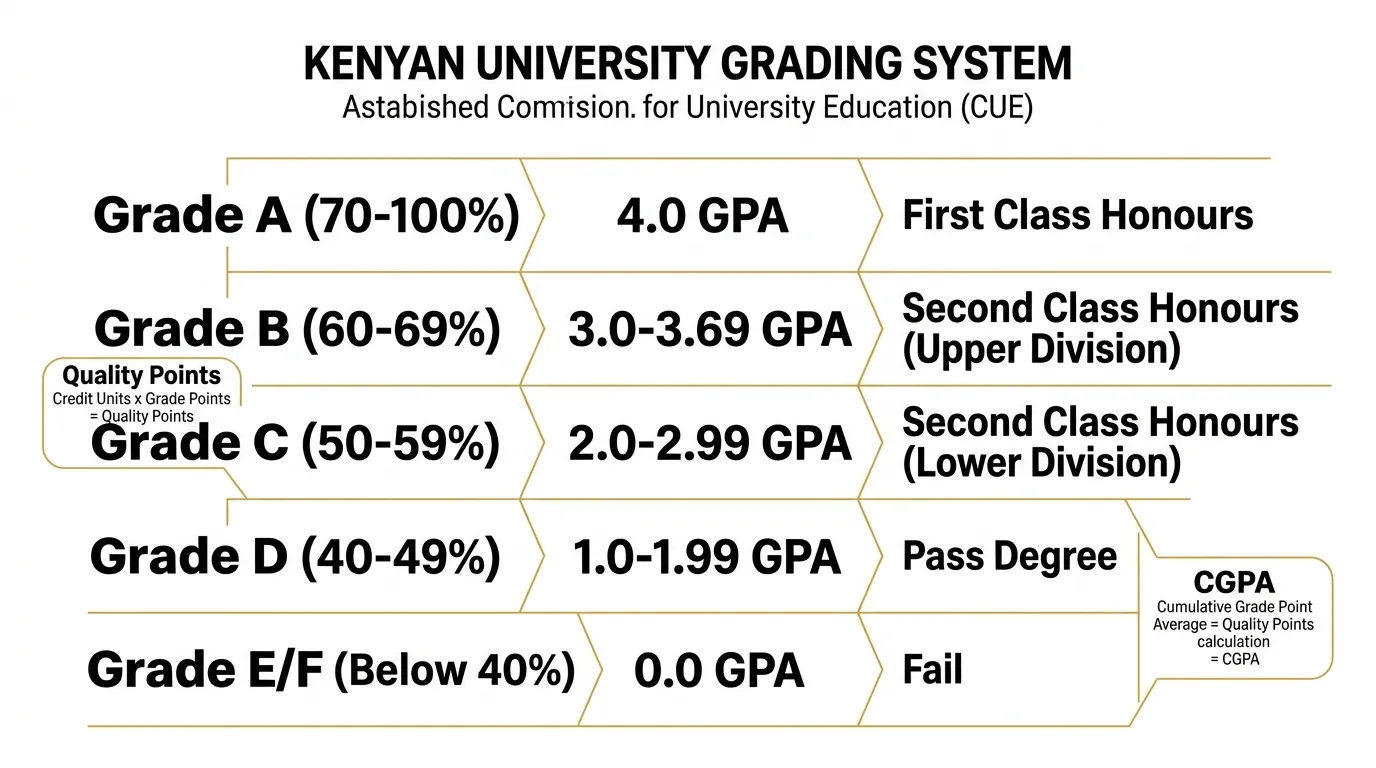
The five-tier public university scale is used by the University of Nairobi, Kenyatta University, JKUAT, Moi University, Egerton, and most other public institutions. It has five bands: A for 70 percent and above, B for 60 to 69, C for 50 to 59, D for 40 to 49, and E or F for anything below 40. Only grades A through D earn credit. E and F do not.
The granular 4.0 scale is used at Strathmore University, USIU-Africa, Daystar University, Mount Kenya University, and several other private institutions. It breaks the familiar A to F range into twelve bands, from A at 4.0 grade points down through A minus, B plus, B, B minus, C plus, C, C minus, D plus, D, and F at 0.0. This finer scale gives more credit for a strong B than a weak B, which matters when you are trying to lift a CGPA by a tenth of a point.
The Weighted Average Mark, often called WAM or CWA, is the third system. It does not use grade points at all. It keeps your raw percentage mark on each unit, multiplies by the credit hours, and divides by the total credits. Some universities report WAM alongside the GPA, and a handful use WAM alone for degree classification.
| Grade | Public scale | Points | Private 4.0 scale | Points |
|---|---|---|---|---|
| A | 70-100% | 4.0 | 90-100% | 4.0 |
| A- | -- | -- | 85-89% | 3.7 |
| B+ | -- | -- | 80-84% | 3.3 |
| B | 60-69% | 3.0 | 75-79% | 3.0 |
| B- | -- | -- | 70-74% | 2.7 |
| C+ | -- | -- | 65-69% | 2.3 |
| C | 50-59% | 2.0 | 60-64% | 2.0 |
| C- | -- | -- | 55-59% | 1.7 |
| D+ | -- | -- | 50-54% | 1.3 |
| D | 40-49% | 1.0 | 45-49% | 1.0 |
| E / F | 0-39% | 0.0 | 0-44% | 0.0 |
The GPA and CGPA formulas
The calculation is straightforward once you have grade points and credits in front of you.
The quality points for a single unit are the grade points multiplied by the credit hours. An A at 4.0 points in a 3-credit unit gives 12 quality points. A B at 3.0 points in a 4-credit unit gives 12 quality points as well. Same number, different route.
The semester GPA is the sum of all quality points in the semester divided by the sum of all credit hours in the semester. A semester with 66 quality points spread across 18 credits gives a GPA of 3.67.
The cumulative CGPA extends the calculation across every semester the student has completed. Add the prior cumulative quality points to the current semester's quality points, add the prior credits to the current credits, and divide. If you are using WAM instead, the same idea applies but the inputs are percentages rather than grade points.
Note on rounding. Most Kenyan universities keep GPA and CGPA at two decimal places. Do not round any intermediate step, or the final number can drift.
Degree honours thresholds
Kenyan universities classify the final bachelor's degree into one of five bands based on the cumulative CGPA at graduation. The thresholds below are the standard ones set out by the CUE and applied at the majority of public and private universities.
| Classification | CGPA (4.0 scale) | Percentage equivalent |
|---|---|---|
| First Class Honours | 3.70 to 4.00 | 70 percent and above |
| Second Class Honours, Upper Division | 3.00 to 3.69 | 60 to 69 percent |
| Second Class Honours, Lower Division | 2.00 to 2.99 | 50 to 59 percent |
| Pass Degree | 1.00 to 1.99 | 40 to 49 percent |
| Fail / Incomplete | Below 1.00 | Below 40 percent |
Second Class Upper Division is the band most graduate employers and Master's programs look for. First Class Honours is the band that opens research positions and scholarship funding. Second Class Lower Division still earns the degree and qualifies for general employment, but the door to some competitive paths narrows.
A few faculties apply progressive weighting instead of a flat cumulative CGPA. Under progressive weighting, year one and year two carry a smaller share of the final classification, and years three and four carry a larger share. If your faculty uses this system, check the handbook because the numbers this tool returns will be close but not identical to the final award.
A worked example
Take a second-year Computer Science student at the University of Nairobi who has just completed six units for the semester.
Data Structures, worth 3 credits, scores 74 percent, which is an A at 4.0 points. That is 12 quality points. Computer Networks, 3 credits, scores 68 percent, which is a B at 3.0 points. That is 9 quality points. Database Systems, 3 credits, scores 71 percent, which is an A at 4.0 points. That is 12 quality points. Discrete Mathematics, 3 credits, scores 62 percent, which is a B at 3.0 points. That is 9 quality points. Operating Systems, 4 credits, scores 78 percent, which is an A at 4.0 points. That is 16 quality points. Communication Skills, 2 credits, scores 82 percent, which is an A at 4.0 points. That is 8 quality points.
Total credits are 18. Total quality points are 66. The semester GPA is 66 divided by 18, which is 3.67. The weighted average mark, using the raw percentages, comes out to 72.28 percent. That places the student in the First Class Honours band, though the standing is provisional until the cumulative record is complete.
Now suppose the same student had entered the year with 90 prior credits and a cumulative CGPA of 3.45. Adding 18 new credits with 66 quality points to 90 prior credits with 310.5 quality points gives 108 total credits and 376.5 total quality points. The updated CGPA is 3.49, which sits comfortably in the Second Class Upper Division band and is within reach of First Class if the trend continues.
Supplementary exams and probation
Two academic rules catch students by surprise, and both are worth understanding before they cost you a semester.
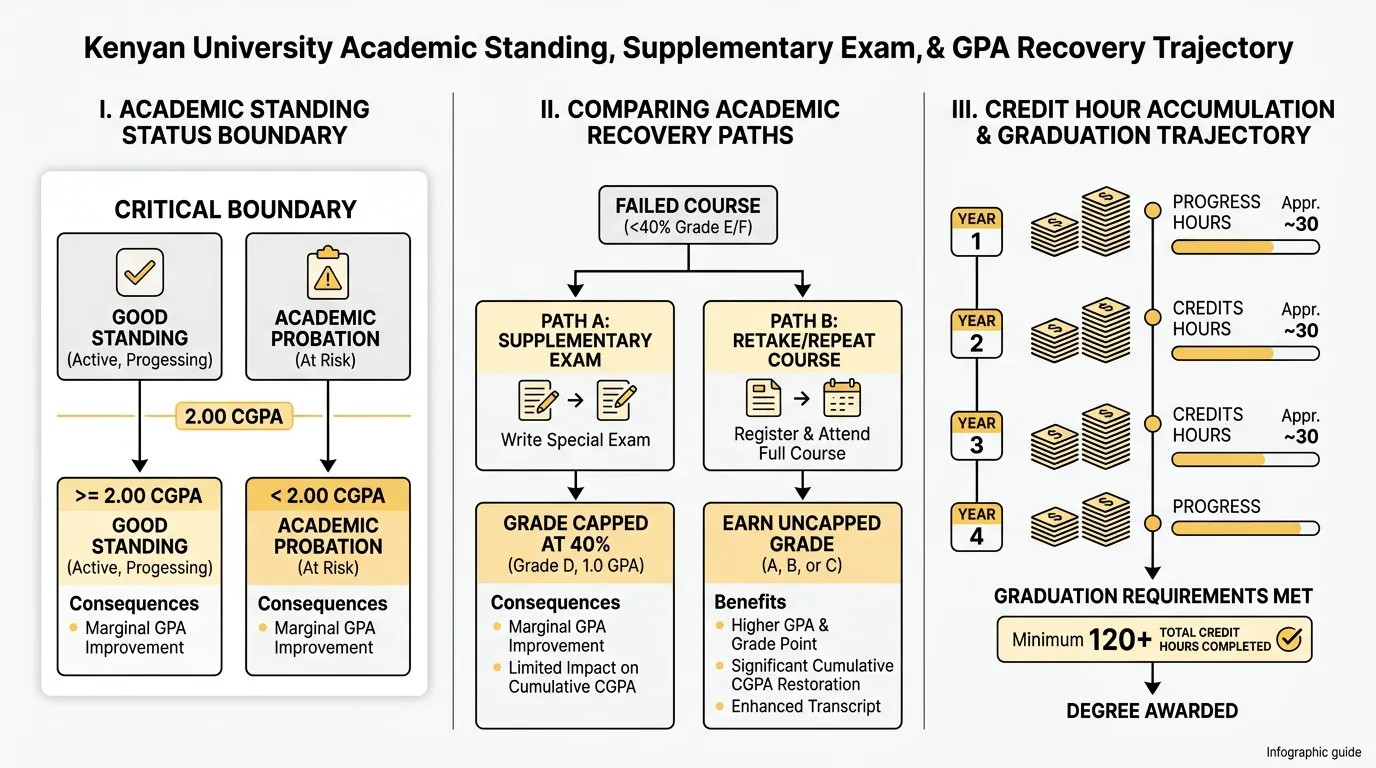
The first is the supplementary examination. If you score between 30 and 39 percent in a unit, most Kenyan universities allow you to sit a supplementary exam rather than repeat the whole unit. When the supplementary is passed, the recorded grade on your transcript is capped at D, which is 40 percent and 1.0 grade point. The higher mark you might have scored in the retake is not carried forward. This rule protects the transcript from being inflated by a second attempt, and it means a supplementary pass still pulls down the CGPA compared to a clean pass the first time.
The second is academic probation. Under CUE and Senate guidelines, a student whose semester GPA or cumulative CGPA falls below 2.00 is placed on probation for one semester. If the GPA does not rise above 2.00 during the probation, the student can be required to repeat the academic year or, in more serious cases, be discontinued from the programme. The probation system is meant to give a struggling student a clear window to recover, but the window is short and the consequences of missing it are severe.
Both rules interact with the calculator in a simple way. When you enter a supplementary pass, use grade D and its 1.0 point value, not the score you achieved in the retake. When you are checking whether you are on the probation line, look at the CGPA figure the tool returns and compare it to 2.00.
Common mistakes students make
Forgetting that E and F earn no credit. A failed unit still counts against you. The credit hours from a failed unit sit in the denominator, but the quality points from that unit are zero. That is what pulls a GPA down sharply after a bad semester.
Entering the wrong credit hours. A three-credit unit is not the same as a four-credit unit. Double-check the course handbook before you type anything in. A single wrong credit hour across several units can move the final GPA by a tenth of a point or more.
Mixing scales. If you are at a private university, use the private 4.0 preset. If you are at a public university, use the 5-tier preset. Mixing the two produces a number that does not match your transcript.
Ignoring the prior record. A semester GPA on its own does not tell you where you stand. The cumulative CGPA is what universities use for honours classification and probation decisions. Always enter the prior record if you want a meaningful picture.
Forgetting that only certain units count toward the CGPA. Some universities exclude failed retakes or certain elective units from the cumulative figure. Check your faculty handbook for the exact rule before you assume the tool is wrong.
Limits of the calculator
This tool computes what you tell it. It cannot see your transcript, it cannot verify your grades, and it cannot know if your faculty applies a weighting rule that differs from the standard one. It is a planning aid, not an official statement of your academic standing.
It also cannot predict how a future semester will change your CGPA, beyond letting you test scenarios. If you want to see what a target GPA would do to your cumulative record, run the calculation again with the hypothetical grade and credit values. That is the fastest way to know whether a target is realistic before you commit to it.
Finally, the honours classification the tool displays is a projection, not a guarantee. Some faculties reserve the right to adjust honours bands in a given year, especially where progressive weighting or borderline cases apply. The number on your final transcript comes from your university's Senate, not from this page. Use what you see here to plan, and confirm the final rules with your registrar.
Sources
- Commission for University Education (CUE). Standards and Guidelines for University Education in Kenya. cue.or.ke
- University of Nairobi. Academic Regulations and Examination Policy. uonbi.ac.ke
- Kenyatta University. Examinations and Grading Policy. ku.ac.ke
- JKUAT. Academic Affairs — Grading and Credit Accumulation. jkuat.ac.ke
- Strathmore University. Academic Regulations and Grading Scale. strathmore.edu
- United States International University Africa. Undergraduate Catalogue — Grading System. usiu.ac.ke