On this page
- What this calculator measures
- The Tanzanian 5.0 grading scale
- The GPA and CGPA formulas
- Degree classification thresholds
- A worked semester example
- Supplementary exams and probation
- Common mistakes students make
- Limits of the calculator
- Student learning hours and module credit weighting mechanics
- The mathematics of supplementary grading caps (C grade ceiling)
- Worked trajectory: Navigating from Lower Second to Upper Second
- Practical training (PT) and undergraduate dissertation impact
- TCU postgraduate admission benchmarks and global equivalence
- Sources
What this calculator measures
This tool takes the course units you are registered for in a semester, the credit weight attached to each one, and the letter grade you earned, and returns three numbers that Tanzanian universities use to track academic standing: the semester Grade Point Average, the cumulative Grade Point Average, and the credit-weighted quality points behind both figures.
The calculator also projects a degree classification from your cumulative record. On the 5.0 scale used across TCU-registered universities, the projection uses the thresholds published by UDSM, UDOM, SUA, Mzumbe, and most other public and private institutions.
Everything runs in your browser. No course code, credit weight, or grade leaves your device. The only part of the page that reaches the network is the AI insight button, and it only fires when you press it.
The Tanzanian 5.0 grading scale
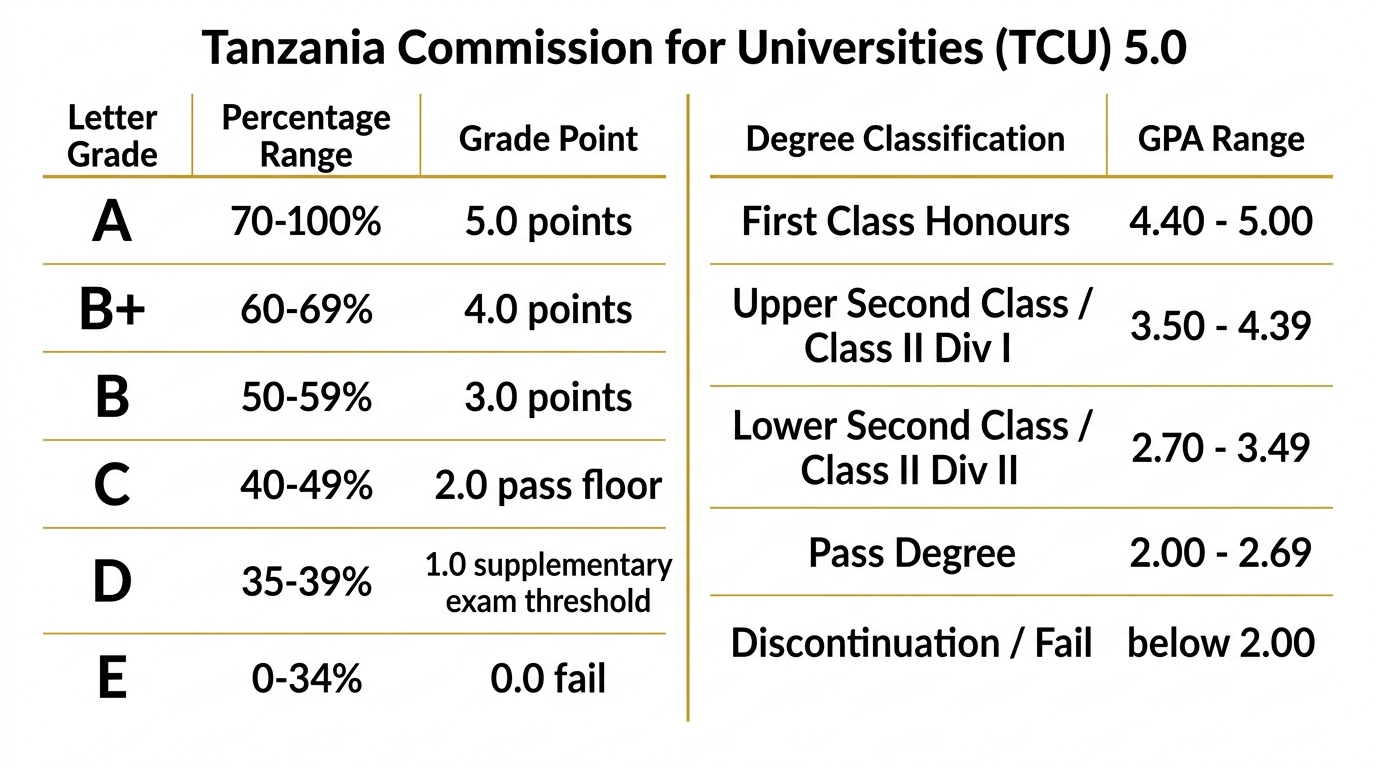
The Tanzania Commission for Universities sets the standard grading framework for undergraduate degrees across public and private universities. Marks combine continuous assessment, usually around 40 percent of the total, with the final university examination, usually around 60 percent, and the combined score maps to one of five letter grades.
| Grade | Score band | Grade point | Reading |
|---|---|---|---|
| A | 70 to 100 percent | 5.0 | Excellent |
| B+ | 60 to 69 percent | 4.0 | Very good |
| B | 50 to 59 percent | 3.0 | Good |
| C | 40 to 49 percent | 2.0 | Satisfactory pass |
| D | 35 to 39 percent | 1.0 | Marginal fail, supplementary route |
| E | 0 to 34 percent | 0.0 | Full fail, repeat required |
A grade of C at 2.0 points is the minimum statutory pass. A grade of D is a marginal fail that opens a supplementary examination route at most institutions, and a grade of E requires the student to repeat the unit. The point value of each grade is what feeds into the GPA calculation, not the raw percentage.
The GPA and CGPA formulas
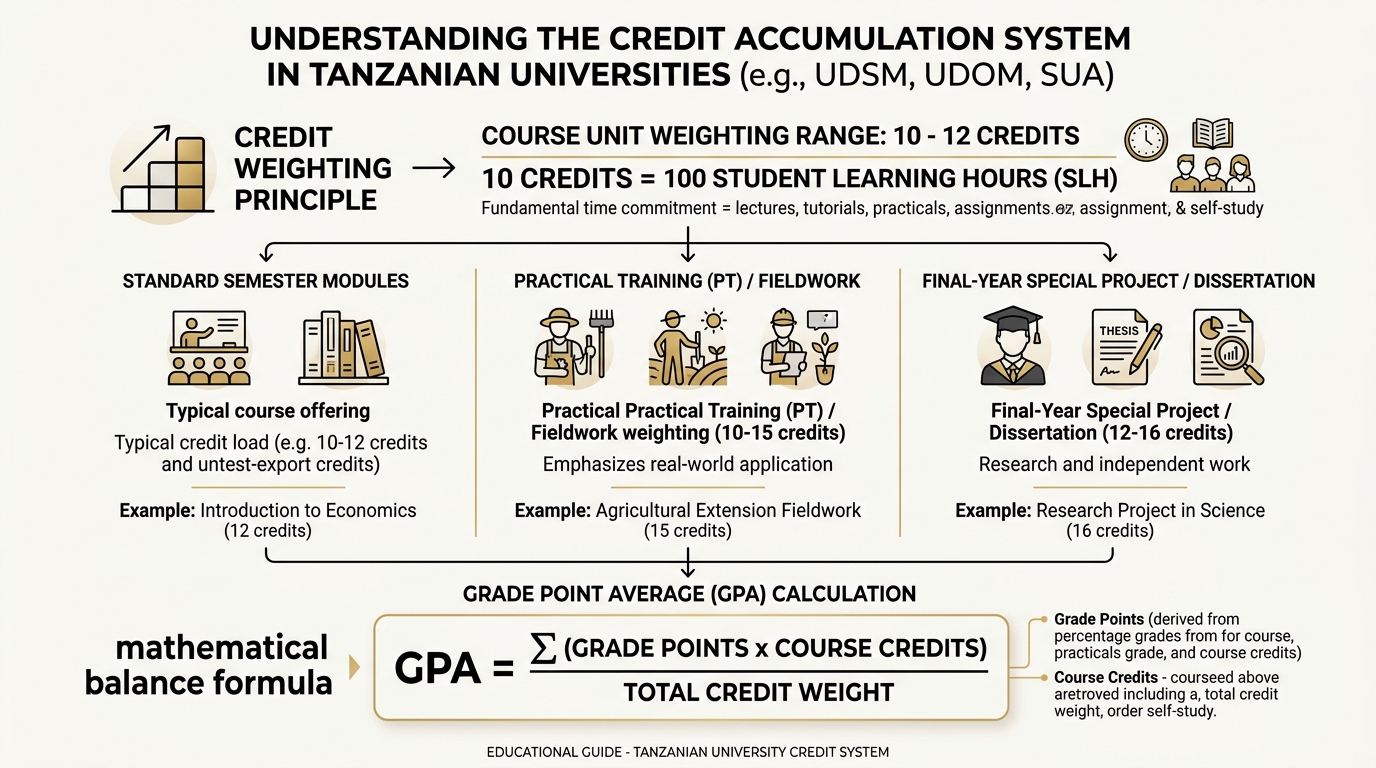
Higher education units in Tanzania carry a credit weight, most commonly 7.5, 10, 12, or 15 credits, where one credit represents roughly ten notional learning hours. The GPA is a credit-weighted average, not a plain average of the letter grades.
Quality points for one unit equal the credit weight multiplied by the grade point for that unit. A 12-credit unit passed with an A gives 12 times 5.0, which is 60 quality points. An 8-credit unit passed with a C gives 8 times 2.0, which is 16 quality points.
Semester GPA is the total semester quality points divided by the total semester credits. A semester with 178 quality points spread across 42 credits gives a GPA of about 4.24.
Cumulative CGPA extends the calculation across every semester a student has completed. Add the prior cumulative quality points to the current semester quality points, add the prior credits to the current credits, then divide. This is the figure that determines degree classification at graduation.
A note on rounding. Most Tanzanian universities report GPA and CGPA to two decimal places. Do not round any intermediate step, or the final figure will drift slightly from the one your registrar prints on the transcript.
Degree classification thresholds
At the end of the degree programme, the cumulative CGPA determines the classification awarded on the transcript. The table below matches the standard bands applied by TCU-registered universities.
| Classification | CGPA on 5.0 scale | Reading |
|---|---|---|
| First Class Honours | 4.40 to 5.00 | Outstanding |
| Upper Second Class, Class II Division I | 3.50 to 4.39 | Very good |
| Lower Second Class, Class II Division II | 2.70 to 3.49 | Good |
| Pass Degree | 2.00 to 2.69 | Minimum graduation threshold |
| Fail or Discontinuation | Below 2.00 | Below the statutory degree floor |
Upper Second Class is the classification most Tanzanian postgraduate programmes look for. TCU guidance states that direct Master's admission requires at least Upper Second at 3.50 or above. Lower Second Class at 2.70 to 3.49 is often accepted when combined with a postgraduate diploma or a strong record of relevant professional experience.
First Class Honours opens the door to academic staff positions such as Tutorial Assistant, to scholarship funding, and to competitive international postgraduate routes. It is a demanding band that requires sustained performance across the whole degree, not just the final year.
A worked semester example
Take a first-year B.Sc Computer Science student at the University of Dar es Salaam completing a 42-credit semester.
Basic Computer Programming is 12 credits and scored 74 percent, which is an A at 5.0 points, giving 60 quality points. Foundations of Analysis is 12 credits and scored 66 percent, a B+ at 4.0, giving 48 quality points. Computer Architecture is 10 credits and scored 55 percent, a B at 3.0, giving 30 quality points. Development Studies is 8 credits and scored 81 percent, an A at 5.0, giving 40 quality points.
Total credit weight is 42. Total quality points are 178. The semester GPA is 178 divided by 42, which is 4.24. That places the student in the Upper Second Class band at the end of the first semester, close to the First Class line but not quite there.
Now suppose the same student entered the year with a prior record of 120 credits and a cumulative CGPA of 3.65. The prior quality points are 120 times 3.65, which is 438. Adding the two together gives 162 credits and 616 total quality points. The updated CGPA is 3.80, still in the Upper Second band. Every strong semester from here moves the average further toward the First Class boundary at 4.40.
Supplementary exams and probation
Two academic rules catch students off guard, and both are worth understanding before they cost a semester.
The supplementary examination is the standard route back from a marginal fail. A grade of D at 35 to 39 percent usually opens the right to sit a supplementary paper at the start of the next academic year. When the supplementary is passed, most Tanzanian universities cap the recorded grade at C, which is 2.0 points, regardless of how high the retake score was. That cap exists to keep a second attempt from inflating the GPA, and it means a supplementary pass still pulls the CGPA down compared to a clean pass on the first attempt.
The academic probation rule sets a floor at 2.00. A student whose semester GPA or cumulative CGPA falls below 2.00 is placed on probation and may be required to repeat the year. Persistent failure to lift the average above 2.00 can lead to discontinuation from the programme. The probation system is meant to give a struggling student a defined window to recover, but the window is short and the consequences of missing it are real.
Common mistakes students make
Mixing credit weights. A 12-credit core unit is not the same as an 8-credit elective. Double-check the credit listing in your programme handbook before you type anything in. A single wrong credit weight across several units can move the final GPA by a tenth of a point or more.
Confusing a pass with a clean pass. A supplementary pass capped at C is not the same as a C earned on the first attempt, even though both appear on the transcript as C. The cap only affects the recorded grade, not the effort it took to get there, but it matters when you are tracking how many units you cleared cleanly.
Ignoring the prior record. A semester GPA on its own does not tell you where you stand. Universities use the cumulative CGPA for classification and probation decisions. Always enter the prior record if you want a meaningful picture of your actual standing.
Assuming a strong final year can rescue a weak start. The cumulative average is credit-weighted, and by the final year the denominator is large. A student who takes three weak years and then tries to lift the average in the last two semesters will find that the mathematics is against them. The most effective way to lift a CGPA is early, when each new credit still moves the average significantly.
Not checking what counts toward CGPA. Some universities exclude certain remedial or non-graded modules from the CGPA calculation. Others cap the number of times a failed unit can be retaken. Check your faculty handbook before you assume the calculator is wrong.
Limits of the calculator
This tool computes what you tell it. It cannot see your transcript, it cannot verify grades, and it cannot know if your faculty applies a weighting rule that differs from the standard one. It is a planning aid, not an official statement of your academic standing.
It also cannot predict a future semester with certainty, beyond letting you test scenarios. If you want to know whether a target CGPA is realistic, run the calculator with hypothetical grades and credit weights. That is the fastest way to judge before the semester starts whether a goal is achievable or whether a different strategy is needed.
Finally, the classification on this page is a projection, not a guarantee. Tanzanian universities reserve the right to adjust classification bands in a given year, especially in borderline cases or where a faculty applies progressive upper-year weighting. Confirm the exact rules with your faculty before you plan your final year around them.
Student learning hours and module credit weighting mechanics
Unlike educational systems that assign simple single-digit credits (such as 3 or 4 units per course), universities in Tanzania operate under the National Qualifications Framework established by the Tanzania Commission for Universities (TCU). Under TCU regulations, collegiate credit weighting is directly grounded in Student Learning Hours (SLH):
- The 10-Hour Rule: One academic credit represents precisely 10 notional student learning hours. This encompasses direct lecture instruction, practical laboratory sessions, seminar tutorials, library research, continuous assessment assignments, and independent examination revision.
- Standard Course Unit Weightings: A standard semester course unit in a Tanzanian degree program typically carries between 8 and 12 credits (representing 80 to 120 total learning hours). Intensive laboratory-based engineering, agricultural, or computational modules often carry 12 to 15 credits.
- Annual Credit Baseline: A standard full-time undergraduate academic year requires a minimum of 120 credits (60 credits per semester) across two 15-week semesters. A three-year bachelor's degree (such as B.A. or B.Sc. General) mandates a minimum graduation threshold of 360 credits, while professional four-year degrees (such as Engineering at UDSM or Veterinary Medicine at SUA) require 480 credits.
Impact on GPA calculation: Because credit weights are substantial (often 10, 12, or 14 credits per unit), a single high-credit course exerts a dominant gravitational pull on your semester grade point average. An A (5.0 GP) in a 14-credit core unit yields 70 quality points, whereas the same grade in an 8-credit general elective yields only 40 quality points. Prioritizing revision time in proportion to module credit values is the most effective academic strategy for maximizing GPA yield.
The mathematics of supplementary grading caps (C grade ceiling)
One of the most consequential examination regulations across Tanzanian public universities—including the University of Dar es Salaam (UDSM), the University of Dodoma (UDOM), Sokoine University of Agriculture (SUA), and Mzumbe University—is the mandatory supplementary grade capping rule.
When an undergraduate scores between 35% and 39% in a course (or fails the end-of-semester examination paper with less than 20 out of 60 marks, failing the university examination sub-minimum), they are awarded a marginal fail (Grade D) and slated for a supplementary examination before the subsequent academic year convenes. While sitting a supplementary examination offers a lifeline against academic discontinuation, the mathematical penalty on your cumulative record is severe:
- The Grade C Ceiling: University examination regulations dictate that regardless of the actual percentage mark scored on the supplementary paper (even if the student scores 85% or 90%), the maximum recorded score is frozen at exactly Grade C (40%, or 2.00 grade points).
- Quality Point Depreciation: Suppose a student takes a 12-credit core unit. If they had passed on the first sitting with a B+ (4.0 GP), the course would have generated 48 quality points. Under the supplementary C-cap, the unit generates only 24 quality points (12 multiplied by 2.0). The resulting 24 quality point deficit is permanently forfeited from the student's cumulative ledger.
- Disqualification from First Class Honours: At UDSM and other leading institutions, university senate regulations stipulate that candidates who have sat supplementary examinations in core degree courses are ineligible for First Class Honours upon graduation, capping their ultimate degree conferral at Upper Second Class (Class II Division I).
Worked trajectory: Navigating from Lower Second to Upper Second
A frequent challenge faced by Tanzanian undergraduates is determining whether their cumulative record can be elevated from Lower Second Class (Class II Division II) into Upper Second Class (Class II Division I) during their final academic year.
The Real-World Context
At the end of Year 2 (having completed 240 credits of a 360-credit degree), a student holds a cumulative CGPA of 3.20. Under TCU guidelines, direct admission into competitive Master's degree programs, national research grants, and graduate management trainee schemes mandates an Upper Second Class degree (a minimum CGPA of 3.50). The student must complete 120 credits across Year 3.
The Mathematical Recovery Walkthrough
- Current Quality Points Banked: Multiply completed credits by current CGPA: 240 credits multiplied by 3.20 CGPA equals 768.0 quality points currently accumulated.
- Graduation Quality Points Required: Multiply total degree credits by the target Upper Second threshold: 360 credits multiplied by 3.50 CGPA equals 1,260.0 quality points required at graduation.
- Final-Year Deficit Calculation: Subtract accumulated quality points from the target threshold: 1,260.0 minus 768.0 equals 492.0 quality points needed across the remaining 120 credits.
- Required Final-Year GPA Target: Divide needed quality points by final-year credits: 492.0 divided by 120 equals 4.10 GPA.
To achieve a 4.10 GPA across Year 3, the student must achieve an average performance slightly above B+ (4.00 GP). Practically, across ten 12-credit final-year course units, this requires earning at least two A's (5.0 GP) and eight B+'s (4.0 GP), with zero grades at B (3.0) or below. The student's goal is mathematically within reach, but leaves zero margin for supplementary examinations or C grades.
Practical training (PT) and undergraduate dissertation impact
In addition to regular classroom lectures, university curricula in Tanzania incorporate mandatory non-classroom experiential modules that carry heavy credit allocations on student transcripts:
- Practical Training (PT) / Field Attachment: Completed during the long vacation recess (typically 8 to 10 weeks between semesters), Practical Training carries between 10 and 15 academic credits. Evaluation is split between field supervisor logbooks (40%), academic faculty on-site visitation inspection (30%), and the formal technical report and oral defense (30%). Because practical training is graded on the standard A–E scale, earning an A (5.0 GP) in a 15-credit PT attachment adds 75 quality points to your degree ledger.
- Final-Year Special Project / Dissertation: In Year 3 or Year 4, candidates complete an independent empirical investigation or engineering capstone project. Dissertations typically carry 12 to 16 credits, often graded across proposal presentation, supervisor progress evaluations, final manuscript external review, and viva voce defense. A low grade in an independent study module has double the negative weight of a standard elective.
TCU postgraduate admission benchmarks and global equivalence
Graduating seniors planning for postgraduate studies in Tanzania or seeking international academic evaluations for Master's programs abroad need to understand how TCU degree classifications map into international admissions rubrics:
| Tanzanian TCU Degree Class | CGPA Range | TCU Postgraduate Admission Status | Indicative US 4.0 GPA | UK Degree Class Equivalent |
|---|---|---|---|---|
| First Class Honours | 4.40 to 5.00 | Automatic direct admission; priority for Tutorial Assistantships and full scholarships. | 3.80 – 4.00 | First Class (1st) |
| Upper Second Class (Class II Div I) | 3.50 to 4.39 | Direct admission threshold for all Master's programs across East Africa. | 3.30 – 3.79 | Upper Second Class (2:1) |
| Lower Second Class (Class II Div II) | 2.70 to 3.49 | Conditional admission; requires 2+ years relevant work experience or Postgraduate Diploma (PGD). | 2.70 – 3.29 | Lower Second Class (2:2) |
| Pass Degree | 2.00 to 2.69 | Ineligible for direct Master's admission; must complete bridging Postgraduate Diploma (PGD) with B average. | 2.00 – 2.69 | Third Class / Pass |
| Discontinuation / Fail | Below 2.00 | Degree not awarded; disqualified from university enrollment. | Below 2.00 | Fail |
Notice on East African Credit Harmonisation: Under the Inter-University Council for East Africa (IUCEA) regional framework, Tanzanian degree classifications enjoy direct reciprocal recognition across Uganda, Kenya, Rwanda, and Burundi. A Tanzanian Upper Second Class degree (3.50+ CGPA) directly satisfies the statutory admission floor for postgraduate degree programs at Makerere University, the University of Nairobi, and Kenyatta University without requiring specialized credential conversion.
Sources
- Tanzania Commission for Universities. Standards and Guidelines for University Education in Tanzania — National Qualifications Framework. tcu.go.tz
- Inter-University Council for East Africa (IUCEA). East African Higher Education Quality Assurance and Credit Harmonisation System. iucea.org
- University of Dar es Salaam. General Examination Regulations and Undergraduate Prospectus. udsm.ac.tz
- University of Dar es Salaam. Academic Regulations and Examination Policy. udsm.ac.tz
- University of Dodoma. Examinations and Grading Regulations. udom.ac.tz
- Sokoine University of Agriculture. Academic Affairs and Student Records. sua.ac.tz
- Mzumbe University. Academic Programmes and Grading Framework. mzumbe.ac.tz
- NACTVET. National Council for Technical and Vocational Education and Training — Regulations and Standards. nactvet.go.tz