On this page
- What this calculator measures
- The Uganda 5.0 grading scale
- The GPA and CGPA formulas
- Degree classification thresholds
- A worked semester example
- Retakes and probation
- Common mistakes students make
- Limits of the calculator
- Mathematical modeling of CGPA recovery and credit inertia
- University policy variations across Ugandan institutions
- Fieldwork, internship, and research project weighting
- International postgraduate equivalence and GPA conversion
- Transcript troubleshooting and registration checklist
- Sources
What this calculator measures
This tool takes the course units you are registered for in a semester, the credit units attached to each one, and the letter grade you earned, and returns three numbers that Ugandan universities use to track academic standing: the semester Grade Point Average, the cumulative Grade Point Average, and the credit-weighted quality points behind both figures.
The calculator also projects a degree classification from your cumulative record. On the 5.0 scale used across universities registered with the National Council for Higher Education, the projection uses the thresholds published by Makerere University, Kyambogo University, MUBS, and most other public and private institutions.
Everything runs in your browser. No course code, credit unit, or grade leaves your device. The only part of the page that reaches the network is the AI insight button, and it only fires when you press it.
The Uganda 5.0 grading scale
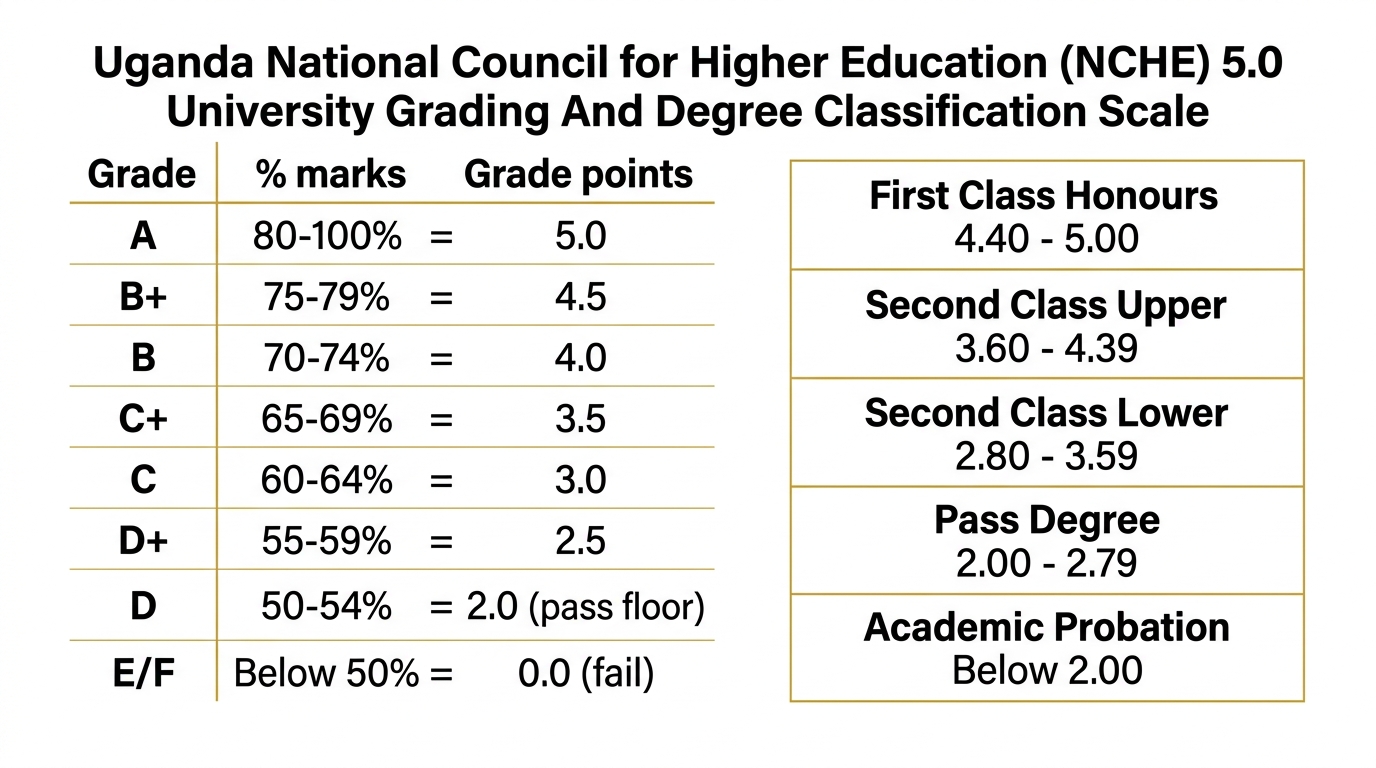
The National Council for Higher Education sets the standard grading framework for undergraduate degrees across Uganda. Marks combine coursework, which is usually 30 to 40 percent of the total, with the end-of-semester examination, which is usually 60 to 70 percent, and the combined score maps to one of nine letter grades.
| Grade | Score band | Grade point | Reading |
|---|---|---|---|
| A | 80 to 100 percent | 5.0 | Exceptional |
| B+ | 75 to 79 percent | 4.5 | Excellent |
| B | 70 to 74 percent | 4.0 | Very good |
| C+ / B- | 65 to 69 percent | 3.5 | Good |
| C | 60 to 64 percent | 3.0 | Fair |
| D+ / C- | 55 to 59 percent | 2.5 | Satisfactory |
| D | 50 to 54 percent | 2.0 | Minimum pass |
| E | 45 to 49 percent | 1.5 | Marginal fail, retake |
| F | 0 to 44 percent | 0.0 | Full fail, retake |
A grade of D at 2.0 points is the minimum statutory pass. Anything below 50 percent is a fail and requires the student to retake the unit when it is next offered. The grade point value, not the raw percentage, is what feeds into the GPA calculation.
The GPA and CGPA formulas
Higher education units in Uganda carry a credit unit value, most commonly between 2 and 5 CU for a single course, and 15 to 24 CU for a full semester. The GPA is a credit-weighted average, not a plain average of letter grades.
Quality points for one unit equal the credit units multiplied by the grade point for that unit. A four-credit course passed with an A gives 4 times 5.0, which is 20 quality points. A three-credit course passed with a C gives 3 times 3.0, which is 9 quality points.
Semester GPA is the total semester quality points divided by the total semester credit units. A semester with 75.5 quality points spread across 17 credit units gives a GPA of about 4.44.
Cumulative CGPA extends the calculation across every semester a student has completed. Add the prior cumulative quality points to the current semester quality points, add the prior credits to the current credits, then divide. This is the figure that determines degree classification at graduation.
A note on rounding. Most Ugandan universities report GPA and CGPA to two decimal places. Do not round any intermediate step, or the final figure will drift slightly from the one your registrar prints on the transcript.
Degree classification thresholds
At the end of the degree programme, the cumulative CGPA determines the classification awarded on the transcript. The table below matches the standard bands applied by NCHE-registered universities.
| Classification | CGPA on 5.0 scale | Reading |
|---|---|---|
| First Class Honours | 4.40 to 5.00 | Outstanding |
| Second Class Upper Division | 3.60 to 4.39 | Very good |
| Second Class Lower Division | 2.80 to 3.59 | Good |
| Pass Degree | 2.00 to 2.79 | Minimum graduation threshold |
| Probationary or Fail | Below 2.00 | Below the statutory degree floor |
Upper Second Division is the classification most Ugandan postgraduate programmes look for. First Class Honours opens the door to academic staff positions, to scholarship funding, and to competitive international postgraduate routes. It is a demanding band that requires sustained performance across the whole degree, not just the final year, and at most universities it also requires that the student has never failed a course unit and had to retake it.
A worked semester example
Take a second-year Bachelor of Commerce student at Makerere University completing a 17-credit semester.
Quantitative Methods is 4 CU and scored 82 percent, an A at 5.0, giving 20 quality points. Business Taxation is 4 CU and scored 76 percent, a B+ at 4.5, giving 18 quality points. Marketing Management is 3 CU and scored 71 percent, a B at 4.0, giving 12 quality points. Financial Accounting is 3 CU and scored 85 percent, an A at 5.0, giving 15 quality points. Business Ethics is 3 CU and scored 66 percent, a C+ at 3.5, giving 10.5 quality points.
Total credit units are 17. Total quality points are 75.5. The semester GPA is 75.5 divided by 17, which is 4.44. That places the student in the First Class band at the end of the semester.
Now suppose the same student had a prior record of 48 credit units and a cumulative CGPA of 3.90. The prior quality points are 48 times 3.90, which is 187.2. Adding the two together gives 65 total credits and 262.7 total quality points. The updated CGPA is 4.04, still in the Upper Second band. Every strong semester from here moves the average closer to the First Class boundary at 4.40.
Retakes and probation
Two academic rules catch students off guard, and both are worth understanding before they cost a semester.
The retake is the standard route back from a failing grade. A course scored below 50 percent earns either 0.0 or 1.5 grade points, and the student must sit the course again when it is next offered. Once the retake is passed, the new grade point replaces the failing grade point in the cumulative calculation, lifting the overall CGPA. However, at most Ugandan universities, a retake in any course unit disqualifies the student from receiving First Class Honours regardless of the final CGPA. In that case, the degree is capped at Second Class Upper Division.
The probationary progress rule sets a floor at 2.00. A student whose cumulative CGPA falls below 2.00 at the end of any semester is placed on Probationary Progress. The student must lift the average above 2.00 within the next semester or face discontinuation. The rule is designed to give a struggling student a defined window to recover, but the window is short and the consequences of missing it are real.
Common mistakes students make
Mixing credit units. A four-credit core unit is not the same as a two-credit elective. Double-check the credit listing in your programme handbook before you type anything in. A single wrong credit unit across several courses can move the final GPA by a tenth of a point or more.
Assuming a retake is invisible. Even when the retake grade replaces the failing grade in the CGPA, most Ugandan universities record the fact of the retake on the transcript, and many programmes treat the retake as disqualifying for First Class. Check your faculty handbook before you decide to retake or not.
Ignoring the prior record. A semester GPA on its own does not tell you where you stand. Universities use the cumulative CGPA for classification and probation decisions. Always enter the prior record if you want a meaningful picture.
Assuming a strong final year can rescue a weak start. The cumulative average is credit-weighted, and by the final year the denominator is large. A student who takes three weak years and then tries to lift the average in the last two semesters will find that the mathematics is against them. The most effective way to lift a CGPA is early, when each new credit still moves the average significantly.
Not checking what counts toward CGPA. Some universities exclude certain non-graded or Pass/Fail modules from the CGPA calculation. Others apply a cap on the number of times a failed unit can be retaken. Check your faculty handbook before you assume the calculator is wrong.
Limits of the calculator
This tool computes what you tell it. It cannot see your transcript, it cannot verify grades, and it cannot know if your faculty applies a weighting rule that differs from the standard one. It is a planning aid, not an official statement of your academic standing.
It also cannot predict a future semester with certainty, beyond letting you test scenarios. If you want to know whether a target CGPA is realistic, run the calculator with hypothetical grades and credit units. That is the fastest way to judge before the semester starts whether a goal is achievable or whether a different strategy is needed.
Finally, the classification on this page is a projection, not a guarantee. Ugandan universities reserve the right to adjust classification bands in a given year, especially in borderline cases or where a faculty applies progressive upper-year weighting. Confirm the exact rules with your faculty before you plan your final year around them.
Mathematical modeling of CGPA recovery and credit inertia
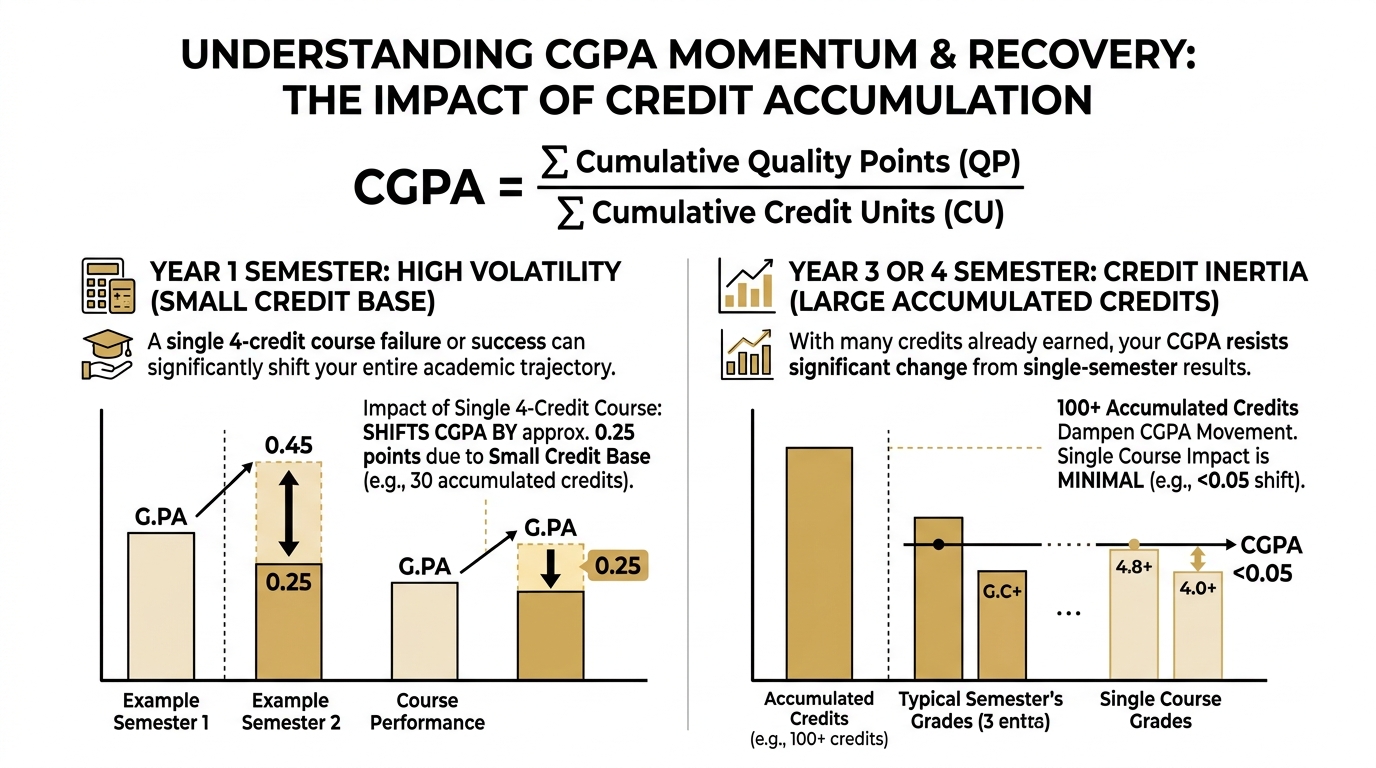
One of the most consequential mathematical realities of the Ugandan collegiate credit framework is the concept of credit inertia. When a student begins Year 1 Semester 1, every course unit carries tremendous statistical weight. In a semester of 18 credit units (CU), a single 4-credit course represents over 22% of the student's entire collegiate record. Scoring an A (5.0 GP) versus a D (2.0 GP) in that single unit will swing the cumulative GPA by approximately 0.67 points on the 5.0 scale.
By Year 3 Semester 2, however, an undergraduate has accumulated between 85 and 110 credit units. In that context, that same 4-credit course represents less than 4% of the cumulative credit denominator. Even an outstanding performance (a perfect 5.0 A) in that course will only shift the cumulative CGPA by approximately 0.05 to 0.08 points. This phenomenon means that early academic deficits become mathematically resistant to late recovery.
Worked recovery scenario: The 3.40 to 3.60 upper-second threshold
Consider a real-world scenario commonly encountered by third-year students at Makerere University, Kyambogo University, or Uganda Christian University (UCU). A student enters their final academic year (Year 3 of a three-year bachelor's degree) having completed 72 credit units with a cumulative CGPA of 3.40 (placing them squarely in the Second Class Lower Division). Their academic ambition is to graduate with a Second Class Upper Division degree, which requires achieving a final CGPA of at least 3.60.
The student must register for 36 credit units across Year 3 Semester 1 and Year 3 Semester 2 (18 credits per semester), bringing their total graduation load to 108 credit units. To determine the exact semester GPA needed across the final year, we apply the cumulative quality point balance equation:
- Calculate accumulated quality points: 72 completed credit units multiplied by 3.40 CGPA yields exactly 244.80 quality points currently banked on the transcript.
- Calculate required graduation quality points: To achieve a 3.60 CGPA across 108 graduation credit units, the student requires: 108 multiplied by 3.60 equals 388.80 total quality points.
- Determine the quality point deficit: Subtract current quality points from the target: 388.80 minus 244.80 equals 144.00 quality points required across the remaining 36 credit units.
- Compute the required average grade point: Divide required quality points by remaining credits: 144.00 divided by 36 equals exactly 4.00 GPA (a straight B average, or 70% to 74% in every single final-year course unit).
Strategic takeaway: In this scenario, graduating with Second Class Upper is mathematically feasible, but it requires maintaining a strict 4.00 (B) average across all 10 to 12 remaining course units without slipping into a C+ or C grade. If the student entered the final year with a 3.20 CGPA instead of 3.40, the required final-year GPA would rise to 4.40 (requiring nearly straight A's), highlighting why students must monitor their CGPA after every single semester.
University policy variations across Ugandan institutions
While the National Council for Higher Education (NCHE) sets the broad national standard (the 5.0 scale with a 2.0 degree floor), individual universities in Uganda enforce institutional examination policies that govern grading nuances, retake calculations, and honours eligibility:
| University | Grading System Nuance | Retake GP Replacement Rule | First Class Disqualification Policy |
|---|---|---|---|
| Makerere University (MAK) | Standard 9-tier letter scale (A=5.0, B+=4.5, B=4.0, C+=3.5, C=3.0, D+=2.5, D=2.0) | The retake grade replaces the failed grade in the cumulative CGPA, but the original fail remains recorded on the permanent transcript. | Students who have retaken any course unit are disqualified from First Class Honours by university senate policy. |
| Kyambogo University (KYU) | NCHE 5.0 harmonised scale with 50% pass mark floor. | Retake grade replaces previous mark in CGPA calculation upon registration and payment of retake examination fees. | Senate review considers clear first-attempt passes across core departmental subjects before awarding honours. |
| Uganda Christian University (UCU) | Trimester model (Easter, Trinity, Advent); strict continuous assessment (coursework weighted 50%, final exam 50%). | Failed course must be retaken when next offered; retaken grade is capped or tracked on the cumulative ledger. | Strict ethical and academic record criteria; retakes and disciplinary actions disqualify candidates from honours summas. |
| Mbarara University (MUST) | Faculty of Medicine and Applied Sciences uses progressive clinical logbooks alongside standard theoretical exams. | Special examinations (supplementary) allowed for marginal failures in select medical disciplines before formal retake. | Unbroken progression without supplementary examinations required for top-tier academic recognition. |
| Makerere University Business School (MUBS) | Affiliated with MAK; follows identical NCHE 5.0 degree classification cutoffs (4.40 First Class, 3.60 Upper Second). | Follows MAK policy; retake fee per credit unit applies; new score updates cumulative ledger upon senate approval. | Strictly enforces MAK senate rules against awarding First Class Honours to candidates with prior retakes. |
Fieldwork, internship, and research project weighting
A frequent blind spot for undergraduate students in Uganda is the disproportionate credit weighting assigned to final-year capstone units, including industrial training (fieldwork / internship), community practice, and undergraduate dissertations:
- Industrial Attachment / Internship (Fieldwork): Typically scheduled during the recess term between Year 2 and Year 3, industrial training usually carries between 3 and 5 credit units. Grading is split between the field supervisor's workplace evaluation (40%) and the university academic supervisor's report and oral presentation (60%). Earning an A (5.0 GP) in a 5-credit internship provides 25 quality points, offering a significant boost to your cumulative balance.
- Final-Year Research Project / Dissertation: Most undergraduate honours programs allocate 4 to 6 credit units to the research project, often split across two semesters (e.g., Proposal Defense in Semester 1 as 2 CU, Final Thesis Defense in Semester 2 as 4 CU). Because dissertations carry double the credit weight of standard classroom electives, scoring a low grade (such as a C at 3.0) can significantly depress your final graduation CGPA.
- Recess Term Course Units: Course units taken during the June–August recess term are computed directly into the cumulative CGPA denominator. Failing to account for recess credit loads in your tracking tool will lead to inaccurate degree classification estimates.
International postgraduate equivalence and GPA conversion
Ugandan university graduates applying for international master's and doctoral scholarships (such as Commonwealth Scholarships, Erasmus Mundus, Chevening, DAAD, or Fulbright) frequently need to convert their NCHE 5.0 CGPA into foreign grading scales:
| Uganda NCHE 5.0 Tier | Indicative US 4.0 GPA | UK Degree Equivalence | German Scale (Bavarian Formula) | Scholarship Competitiveness |
|---|---|---|---|---|
| First Class Honours (4.40 – 5.00) | 3.75 – 4.00 GPA | First Class Honours (1st) | 1.0 – 1.6 (Sehr gut) | Highly competitive for full funding (Commonwealth, Rhodes, Erasmus Mundus, DAAD). |
| Second Class Upper (3.60 – 4.39) | 3.20 – 3.74 GPA | Upper Second Class (2:1) | 1.7 – 2.5 (Gut) | Meets standard entry prerequisites for top-tier UK, European, and Canadian universities. |
| Second Class Lower (2.80 – 3.59) | 2.50 – 3.19 GPA | Lower Second Class (2:2) | 2.6 – 3.3 (Befriedigend) | Admissible to professional master's programs; scholarships typically require professional experience. |
| Pass Degree (2.00 – 2.79) | 2.00 – 2.49 GPA | Third Class / Pass Degree | 3.4 – 4.0 (Ausreichend) | Requires postgraduate diploma (PGD) bridging qualifications before master's admission. |
Conversion methodology notice: Credential evaluators like World Education Services (WES) in the United States and Canada do not simply multiply a 5.0 CGPA by 0.8. Instead, WES performs a course-by-course conversion where Ugandan grades of A and B+ map to an American A (4.0), B maps to B+ (3.3), C+ maps to B (3.0), and D maps to C (2.0). Because of this non-linear mapping, a student with a 3.80 CGPA in Uganda often converts to a 3.40–3.50 US GPA on a WES evaluation report.
Transcript troubleshooting and registration checklist
To avoid administrative surprises when verifying your end-of-semester transcript on university management portals (such as Makerere's ACMIS, Kyambogo's Zeenith/e-campus, or UCU's Alpha system), follow this procedural checklist:
- Verify missing marks within the statutory appeal window: Under Ugandan university regulations, missing marks (coded as MIS, INC, or ABS) must be formally queried with the department examination coordinator within two to four weeks of results release. If unaddressed, portal algorithms frequently convert an unverified course to an automatic F (0.0 GP), dragging down your published CGPA.
- Confirm official credit unit allocations: Always cross-reference the credit units listed on your portal registration slip against your approved faculty curriculum handbook. Portals occasionally misconfigure elective modules with default 3.0 credits when the department specifies 4.0 or 2.0 credits, skewing quality point arithmetic.
- Audit coursework submission receipts: In Uganda, coursework tests, term papers, and laboratory assignments account for 30% to 50% of your final grade. Maintain signed submission receipts or digital submission timestamps. A student who scores 80% on the final exam but has missing coursework marks will fail the unit due to the mandatory combined passing threshold.
- Track retake registration and fee clearing: Merely sitting a retake examination paper does not automatically update your transcript. You must formally register for the retake unit on your student portal during the designated registration period, clear the requisite retake billing fee, and ensure the academic registrar clears your exam attendance card.
Sources
- Uganda National Council for Higher Education. Higher Education Grading, Quality Assurance, and Credit Accumulation Framework. unche.or.ug
- Inter-University Council for East Africa (IUCEA). East African Higher Education Quality Assurance and Credit Harmonisation System. iucea.org
- World Education Services (WES). Country Education Profiles: Academic Credential Evaluation for Uganda. wes.org
- Makerere University. Academic Registrar — Undergraduate Examination Regulations and Degree Classification Guide. mak.ac.ug
- Kyambogo University. Academic Grading Policy and Credit Unit Guidelines. kyu.ac.ug
- Makerere University Business School. Degree Classification Standards. mubs.ac.ug
- Uganda Christian University. Academic Regulations and Grading Scale. ucu.ac.ug
- Mbarara University of Science and Technology. Academic Affairs — Examination and Grading. must.ac.ug