On this page
- What this calculator measures and ZIMCHE credit structures
- Zimbabwe university grading scales and coursework moderation
- Exact formulas for Quality Points, GPA, CGPA, and WAM
- Degree classification bands, progressive weighting, and attachment
- Three worked semester and final-year target examples
- Supplementary exams, carry-overs, repeats, and probation rules
- Converting Zimbabwean grades for scholarships, SAQA, and WES
- Common mistakes students make when tracking their GPA
- Limits of the calculator and privacy notes
- Official sources and university references
What this calculator measures and ZIMCHE credit structures
This calculator takes the modules you are registered for in an academic semester, the credit weight attached to each unit, and the final percentage mark awarded after examination moderation, then computes three figures that govern academic standing across Zimbabwean higher education: your semester Grade Point Average (GPA), your cumulative Grade Point Average (CGPA), and your Weighted Average Mark (WAM). From those figures, it projects your Honours degree classification across the standard Zimbabwean 4.0 scale, the five-point 5.0 engineering/faculty scale, or pure percentage WAM.
All public and chartered private universities in Zimbabwe operate under the statutory quality-assurance mandate of the Zimbabwe Council for Higher Education (ZIMCHE) and the Education 5.0 doctrine introduced by the Ministry of Higher and Tertiary Education, Innovation, Science and Technology Development. Under Education 5.0—which aligned university curricula around Teaching, Research, Community Service, Innovation, and Industrialisation—ZIMCHE harmonised degree structures through Minimum Bodies of Knowledge and Skills (MBKS) and the Zimbabwe National Qualifications Framework (ZNQF).
Understanding ZNQF notional credits versus departmental unit weights
When you open your student portal at the University of Zimbabwe (UZ), Midlands State University (MSU), the National University of Science and Technology (NUST), Chinhoyi University of Technology (CUT), Harare Institute of Technology (HIT), Bindura University of Science Education (BUSE), Great Zimbabwe University (GZU), Lupane State University (LSU), or Zimbabwe Open University (ZOU), you will encounter one of two credit-numbering conventions:
- ZNQF notional-hour credits (12, 15, or 24 credits per module): Under ZIMCHE MBKS regulations, 1 ZNQF credit represents 10 notional study hours (combining lectures, tutorials, laboratory practicals, independent reading, and examinations). A standard semester module carries 12 or 15 ZNQF credits (120 to 150 hours), a typical five-module semester totals 60 credits, a full academic year totals 120 credits, and a four-year Bachelor's Honours degree (ZNQF Level 8) requires at least 480 credits (rising to 600+ credits for five-year Bachelor of Engineering, Architecture, or Pharmacy programmes).
- Contact-hour credit units (2, 3, 4, or 6 credits per module): Legacy faculty handbooks and US-patterned chartered institutions such as Africa University (AU) and Solusi University express module weights in weekly lecture/lab contact units—typically 3 or 4 credits for a core semester course, 2 credits for a university-wide foundation course, and 6 credits for a full-year dissertation.
Mathematically, multiplying every credit weight by a constant factor (for instance, entering 12, 12, and 16 ZNQF credits instead of 3, 3, and 4 contact units) produces the exact same GPA and WAM. The only rule you must never break is consistency: if your prior cumulative credits are entered using ZNQF credits (such as 120 credits after Part I), enter your current semester modules in ZNQF credits (12 or 15 per unit) as well, never 3 or 4.
Zimbabwe university grading scales and coursework moderation
Although ZIMCHE sets national credit minimums and benchmark pass standards, each university senate ratifies its own examination ordinance. Across Zimbabwean campuses, three grading architectures dominate undergraduate transcripts, and you can switch between all three at the top of the calculator.
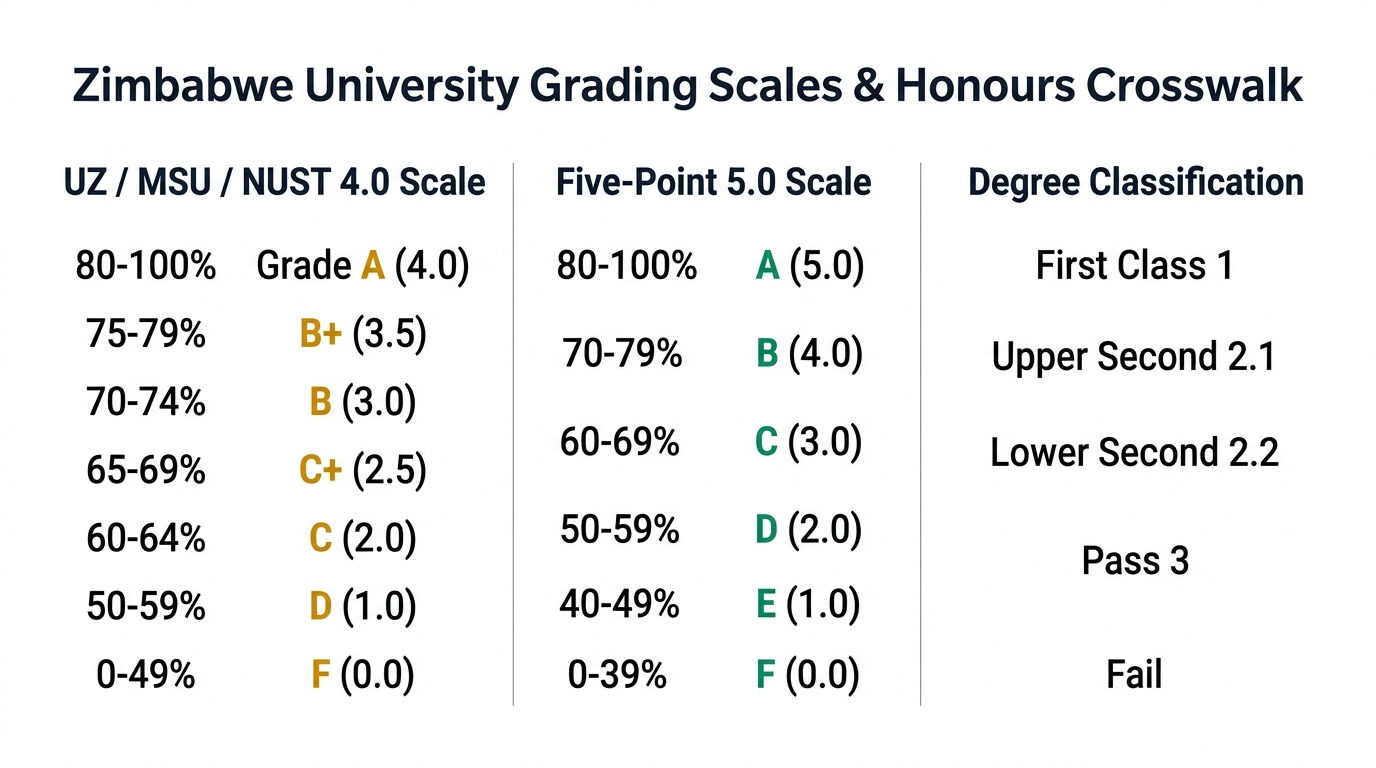
| Percentage Mark | 4.0 Scale Grade | 4.0 Grade Points | 5.0 Scale Grade | 5.0 Grade Points | Traditional Senate Division |
|---|---|---|---|---|---|
| 80% to 100% | A | 4.0 | A | 5.0 | 1 (First Class / Distinction) |
| 75% to 79% | B+ | 3.5 | A | 5.0 | 2.1 (Upper Second — High) |
| 70% to 74% | B | 3.0 | B | 4.0 | 2.1 (Upper Second) |
| 65% to 69% | C+ | 2.5 | B | 4.0 | 2.2 (Lower Second — High) |
| 60% to 64% | C | 2.0 | C | 3.0 | 2.2 (Lower Second) |
| 50% to 59% | D (or P) | 1.0 | D | 2.0 | 3 (Pass) |
| 40% to 49% | F (Supp zone) | 0.0 | E (Marginal fail) | 1.0 | F / Supplementary eligible |
| 0% to 39% | F (Fail) | 0.0 | F (Clear fail) | 0.0 | F / Repeat or Carry |
Why older Zimbabwean transcripts show 75% for First Class while current cohorts need 80%
One of the most frequent points of confusion among Zimbabwean students comparing notes with older graduates is the 75% versus 80% First Class boundary. Prior to the 2019–2020 Education 5.0 curriculum harmonisation, traditional British-model ordinances at UZ, NUST, MSU, and GZU placed First Class (`1`) at 75% to 100%, Upper Second (`2.1`) at 65% to 74%, Lower Second (`2.2`) at 60% to 64%, and Pass (`3`) at 50% to 59%. When UZ and sister state universities revised their general academic regulations for Education 5.0 modularised degrees, senates raised the Distinction/First Class threshold to 80% and the Upper Second threshold to 70%. If you matriculated under current regulations, use the standard 80% / 70% / 60% / 50% bands built into this calculator; if you are auditing an older pre-2019 transcript, check the grading key printed on the reverse side of your official academic record.
How Continuous Assessment (CA) and final exams combine into your module mark
The percentage you enter into the Mark % box is the moderated composite module mark, not your raw final exam score alone. Across Zimbabwean faculties, module marks combine two weighted components:
- Continuous Assessment (CA — typically 30% to 40%): Comprises in-semester written tests, group assignments, laboratory reports, clinical logbooks, moot-court memorials, or Education 5.0 innovation hub prototypes. At technical institutions such as HIT and CUT, practical studio or technopreneurship modules frequently weight CA at 40% to 50%.
- End-of-Semester Written Examination (typically 60% to 70%): Moderated internally and vetted by an external examiner appointed from a peer university before presentation to the Departmental and Faculty Boards of Examiners.
Watch out for Due Performance (DP) and sub-minimum exam floors: At several engineering, law, pharmacy, and health-science faculties at UZ and NUST, earning a combined composite score of 52% (for example, 34/40 in coursework plus 18/60—just 30%—on the final written paper) can still be recorded as a technical fail if the faculty enforces a 40% written-exam sub-minimum. Similarly, failing to attain minimum Continuous Assessment or lecture attendance forfeits Due Performance (DP), barring a candidate from sitting the final exam altogether.
Exact formulas for Quality Points, GPA, CGPA, and WAM
Because university modules carry unequal credit loads, neither GPA nor WAM is ever calculated by adding your marks and dividing by the number of courses. Every calculation weights each module by its credit value.
- Module Quality Points (QP): Multiply the module's credit weight by the grade points earned for its percentage band. On the 4.0 scale, a 4-credit module scored at 82% (Grade A = 4.0) earns
4 × 4.0 = 16.0 Quality Points, whereas a 3-credit module scored at 68% (Grade C+ = 2.5) earns3 × 2.5 = 7.5 Quality Points. - Semester GPA: Sum the Quality Points across all graded modules registered in the semester and divide by total registered semester credits:
Semester GPA = Total Semester Quality Points ÷ Total Semester Credits - Semester Weighted Average Mark (WAM): Multiply each module's raw percentage mark directly by its credit weight, sum those products, and divide by total semester credits:
Semester WAM = Sum of (Module Mark % × Module Credits) ÷ Total Semester Credits - Cumulative CGPA and Cumulative WAM: Combine your prior completed credits and quality points with the current semester's totals:
Cumulative CGPA = [(Prior CGPA × Prior Credits) + Current Semester QP] ÷ (Prior Credits + Current Semester Credits)
Why your GPA and WAM can tell slightly different stories near a boundary
Students are sometimes puzzled when a classmate with a 69.6% WAM has a higher GPA than someone with a 70.1% WAM, or vice versa. That divergence comes from step-band discretisation. In GPA calculations, every percentage inside a bracket collapses to the same point value: scoring 50% and scoring 59% both produce 1.0 grade point (Grade D) on the 4.0 scale, throwing away 9 percentage points of hard-won exam marks! By contrast, WAM retains every exact integer from 0 to 100. Conversely, nudging a 79% up by just 1 mark to 80% adds only +1% to that module's WAM contribution, yet jumps your 4.0-scale grade points by a full +0.50 points per credit (from 3.5 B+ to 4.0 A). When planning exam revision, raising a module sitting at 58–59%, 69%, 74%, or 79% across the next bracket boundary delivers the highest possible GPA jump per hour of study.
Rounding discipline: Registrars at UZ, MSU, NUST, and CUT retain full floating-point precision across intermediate semester sums and round only the final displayed GPA/CGPA to two decimal places (and WAM commonly to one decimal place). Note that most faculty senates apply strict mathematical cutoffs—meaning 69.4% remains a 2.2 Lower Second unless senate borderline rules (often 69.5% rounded to 70% with a majority of final-year credits already in the higher class) explicitly apply.
Degree classification bands, progressive weighting, and attachment
At graduation, the Academic Senate confers your Honours degree in one of four passing divisions. Understanding both the threshold table and how your faculty weights Parts I through IV is essential for realistic multi-year planning.
| Degree Classification | Senate Division Code | WAM Band | 4.0 Scale CGPA | 5.0 Scale CGPA | Typical Academic & Career Impact |
|---|---|---|---|---|---|
| First Class Honours | 1 (or 1.0) | 80% to 100% | 3.75 to 4.00 | 4.50 to 5.00 | University Book Prize, Staff Development Fellow (SDF) track, direct PhD/funded MSc scholarships |
| Upper Second Class Honours | 2.1 | 70% to 79% | 3.00 to 3.74 | 3.80 to 4.49 | Standard benchmark for Zimbabwean Graduate Trainee (GT) schemes, Master's degrees, and Chevening/Commonwealth awards |
| Lower Second Class Honours | 2.2 | 60% to 69% | 2.00 to 2.99 | 2.80 to 3.79 | Qualifies for professional employment, Postgraduate Diplomas, and Master's entry after relevant work experience |
| Pass Degree | 3 | 50% to 59% | 1.00 to 1.99 | 2.00 to 2.79 | Meets statutory ZNQF Level 8 degree conferral; usually requires bridging PGDip for postgraduate study |
| Fail / Unclassified | F | Below 50% | Below 1.00 | Below 2.00 | Below statutory graduation floor; requires supplementary or module repeat |
Cumulative credit weighting versus progressive Part weighting
Zimbabwean universities use two distinct methods to aggregate your multi-year record into the final graduation classification:
- Equal-credit cumulative aggregation: Every graded credit from Part I Semester 1 through Part IV Semester 2 contributes in direct proportion to its credit value. Under this model (which the calculator computes directly via Prior Cumulative Record), Part I carries 25% of a four-year 480-credit degree simply because it accounts for 120 of the 480 credits.
- Progressive Senate Part-Weighting: Many faculties at MSU, NUST, CUT, HIT, and UZ apply escalating percentage weights to reward academic maturity in upper levels. Two common progressive schedules are:
- Four-Year Degree with Industrial Attachment: Part I = 10%, Part II = 20%, Part III (Work-Related Learning) = 20%, and Part IV (Final Year + Dissertation / Capstone Innovation Project) = 50%.
- Part I Qualifying-Only Model: Several faculties require students to pass all Part I modules to proceed, but exclude Part I marks from final degree classification altogether—weighting Part II at 25% to 30%, Part III at 20%, and Part IV at 50% to 55%.
If your faculty uses progressive Part weights (`10% / 20% / 20% / 50%`), use this calculator first to compute the exact GPA or WAM for each Part separately, then multiply each Part's average by `0.10`, `0.20`, `0.20`, and `0.50` and sum the four results.
How Part III Industrial Attachment (Work-Related Learning) affects your classification
Pioneered nationally by NUST and MSU and now embedded across CUT, HIT, BUSE, GZU, LSU, and UZ modularised programmes, the 8-to-10-month Part III Work-Related Learning (WRL / Industrial Attachment) year is one of the highest-leverage periods in a Zimbabwean degree. Rather than being a Pass/Fail internship, attachment typically carries a full academic year's credit load (such as 120 ZNQF credits split across two or three assessment codes) graded across three pillars:
- Host Industry Supervisor Continuous Assessment (typically 30% to 40%): Evaluates professional competence, problem-solving, punctuality, and monthly logbook sign-offs at your placement organisation.
- University Academic Supervisor Assessment / Oral Visitation (typically 20% to 30%): Assessed on-site or via structured defence panels verifying how you applied theoretical coursework to workplace engineering, accounting, clinical, or IT workflows.
- Industrial Attachment Technical Report (typically 30% to 40%): A formal academic report analysing organisational systems and proposing an Education 5.0 innovation or efficiency improvement.
Note that each course row in the calculator above accepts up to 30 credits. If your university records attachment as separate component codes (for example, Continuous Workplace Assessment — 15 credits and Attachment Report — 15 credits, or two 24-credit semester blocks), enter each component code on its own row with its exact mark so your WAM and QP remain exact.
Three worked semester and final-year target examples
Walking through three realistic student scenarios demonstrates how the 4.0 scale, 5.0 scale, WAM, and reverse target-grade planning work in practice.
Example 1: UZ Part II Bachelor of Laws (LLBS) semester on the 4.0 scale and WAM
Consider a second-year Law student at the University of Zimbabwe completing five semester modules totalling 16 contact-hour credit units:
| Course Unit | Credits | Mark % | 4.0 Grade | Grade Points | Quality Points (Cr × GP) | Weighted Mark (Cr × %) |
|---|---|---|---|---|---|---|
| Constitutional Law | 4 | 82% | A | 4.0 | 16.0 | 328 |
| Law of Contract | 4 | 76% | B+ | 3.5 | 14.0 | 304 |
| Criminal Law | 3 | 71% | B | 3.0 | 9.0 | 213 |
| Commercial Law | 3 | 68% | C+ | 2.5 | 7.5 | 204 |
| Legal Research & Writing | 2 | 85% | A | 4.0 | 8.0 | 170 |
| Semester Totals | 16 | — | — | — | 54.5 QP | 1,219 |
- Semester GPA:
54.5 ÷ 16 = 3.40625, reported as 3.41. - Semester WAM:
1,219 ÷ 16 = 76.1875%, reported as 76.2%. Both metrics place the semester solidly inside the Upper Second Class (2.1) band (70% to 79% WAM; 3.00 to 3.74 GPA), sitting 3.8 percentage points shy of the 80% First Class WAM threshold. - Updating Cumulative CGPA: Suppose this student entered the semester with 48 prior completed credits at a 3.20 prior CGPA (
48 × 3.20 = 153.6 prior QP). Combining both records gives48 + 16 = 64 total creditsand153.6 + 54.5 = 208.1 total QP. Dividing208.1 ÷ 64yields an updated Cumulative CGPA of 3.25.
Example 2: Engineering technology semester on the 5.0 scale versus the 4.0 scale
Suppose a Part II Electronic Engineering student completes five 12-credit ZNQF modules (60 ZNQF credits total) with marks of 81%, 77%, 72%, 66%, and 58%:
- On the 5.0 scale: Both 81% and 77% earn Grade A (`5.0`), 72% earns B (`4.0`), 66% earns B (`4.0`), and 58% earns D (`2.0`). Quality points =
(12 × 5) + (12 × 5) + (12 × 4) + (12 × 4) + (12 × 2) = 240 QP. Dividing by 60 credits yields 4.00 / 5.00 (Upper Second Class, 3.80 to 4.49 band). - On the 4.0 UZ/ZIMCHE scale: The exact same marks convert to 4.0 (81%), 3.5 (77%), 3.0 (72%), 2.5 (66%), and 1.0 (58%), giving
(12 × 14.0) = 168 QP ÷ 60 = 2.80 / 4.00, while the raw WAM is 70.8%! Notice why faculty handbook scale rules matter so much here: that single 58% module (1.0 GP on the 4.0 scale) drags the 4.0 GPA below 3.00 to 2.80 even though the student's 70.8% WAM clears the 70% Upper Second mark!
Example 3: Reverse-calculating the final-year (Part IV) GPA needed to rescue a 2.1
A final-year Bachelor of Commerce Accounting student enters Part IV Semester 2 (their final 15-credit semester, consisting of three 3-credit taught modules plus a 6-credit Research Project/Dissertation) holding 90 completed credits at a 2.94 CGPA (`90 × 2.94 = 264.6 QP`). To graduate with at least a 3.00 CGPA (Upper Second Class 2.1) across `90 + 15 = 105` total credits:
- Multiply target CGPA by final total credits:
3.00 × 105 = 315.0 total Quality Points required. - Subtract bankable prior Quality Points:
315.0 − 264.6 = 50.4 Quality Points neededin the final 15-credit semester. - Divide by final semester credits:
50.4 ÷ 15 = 3.36 minimum Semester GPA.
How does the student hit 3.36? Scoring an A (80%+, 4.0 GP) on the double-weighted 6-credit Dissertation delivers 24.0 QP right away, meaning the remaining three 3-credit taught papers only need an average of 26.4 ÷ 9 = 2.93 (for instance, two Bs at 71% and one B+ at 75%, giving 9.0 + 9.0 + 10.5 = 28.5 QP, taking the final graduation CGPA to `3.02`).
Supplementary exams, carry-overs, repeats, and probation rules
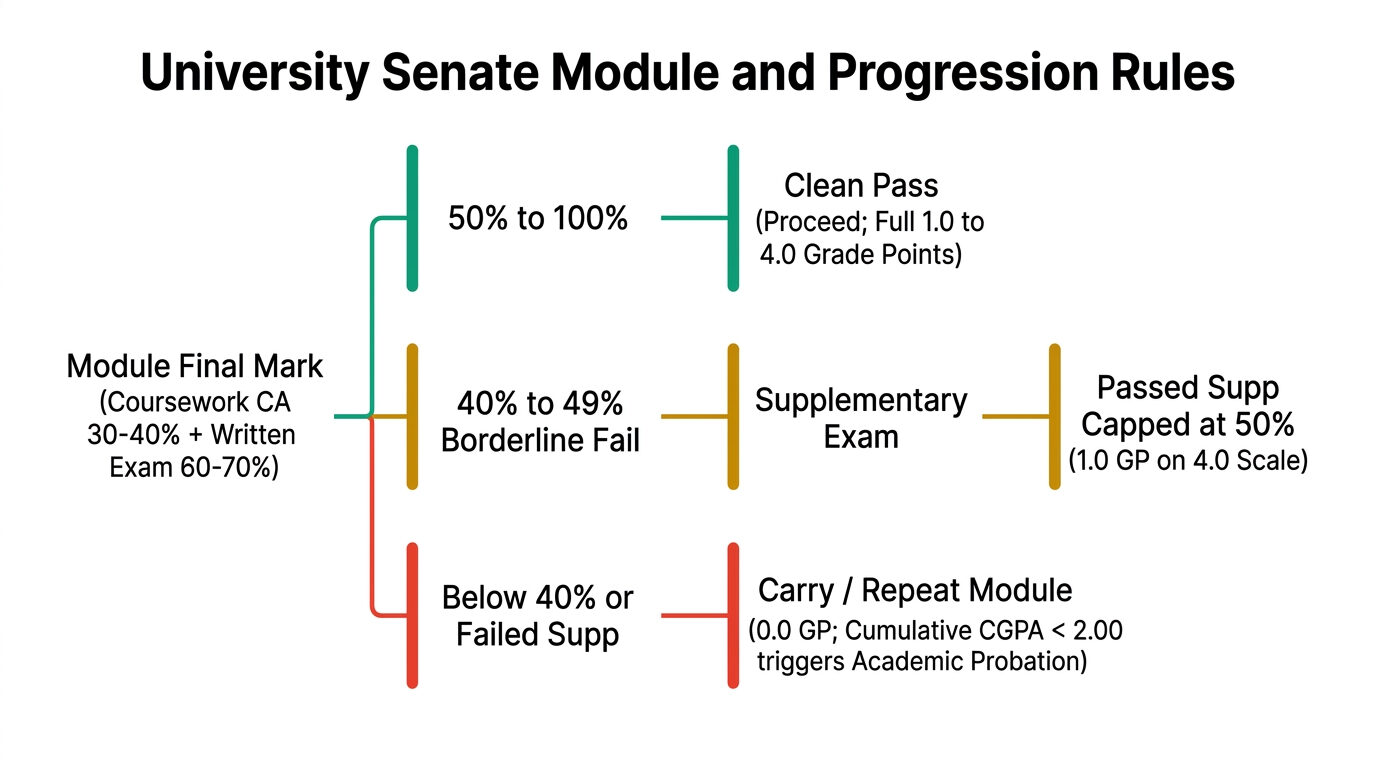
Failing a university module in Zimbabwe triggers specific senate progression codes printed at the bottom of your semester results slip. Knowing the rules governing each status prevents a single bad examination sitting from snowballing into academic exclusion.
Decoding senate decision statuses on Zimbabwean transcripts
- Proceed (Pass): You passed every registered module at 50% or above and may register normally for the next academic part.
- Supplement (Supp — typically 40% to 49%): Granted for marginal failures up to a faculty-specified cap (commonly no more than two or three failed modules in a semester), provided you achieved Due Performance in coursework. Supplementary exams sit before the next academic year opens. When passed, university senates almost universally cap the recorded module mark at 50%—earning 1.0 grade point (Grade D) on the 4.0 scale (or 2.0 grade points on the 5.0 scale) regardless of whether you scored 78% on the supplementary script. In addition, passing a degree via a supplementary or repeat examination disqualifies a candidate from First Class Honours and Vice-Chancellor's Book Prizes under most senate ordinances.
- Proceed and Carry (Carry-Over): If you fail below the supplementary threshold (under 40%), fail a supplementary paper, or fail one or two modules (typically not exceeding 25% of the annual credit load) that are not strict prerequisites for every upper-level unit, senate permits you to advance to the next Part while carrying the failed module(s) to re-attend and re-examine when next offered. Be careful: many universities impose a strict semester credit ceiling, meaning carrying two Part I courses into Part II may force you to defer electives or overload timetable clashes, and you are generally barred from proceeding to Part III Industrial Attachment if you still have un-cleared Part I carry modules.
- Repeat Part: Triggered when you fail more than 25% to 50% of an academic part's modules. You remain in the current academic Part for another year solely to retake and clear the failed modules before advancing.
- Special / Deferred / Aegrotat Examination: If hospitalisation, acute illness, or close family bereavement prevents you from writing a scheduled exam—and you submit certified medical or official evidence to the Faculty Registrar within the statutory 48-to-72-hour window—senate grants a Special Examination during the supplementary session. Crucially, a Special Exam counts as a first sitting: your full earned mark (such as 79%) goes onto the transcript uncapped! Never skip filing medical documentation and let a missed paper default to `0% Absent Fail`.
- Academic Probation and Withdrawal (Discontinue): Falling below a cumulative GPA of 2.00 (or cumulative WAM below 50%), or failing more than 50% to 75% of registered modules across consecutive semesters, places you on Academic Probation or triggers Discontinuation/Withdrawal from the degree programme (often with a two-year bar before reapplying to the same faculty).
Credit inertia: why early recovery in Part II beats waiting for Part IV
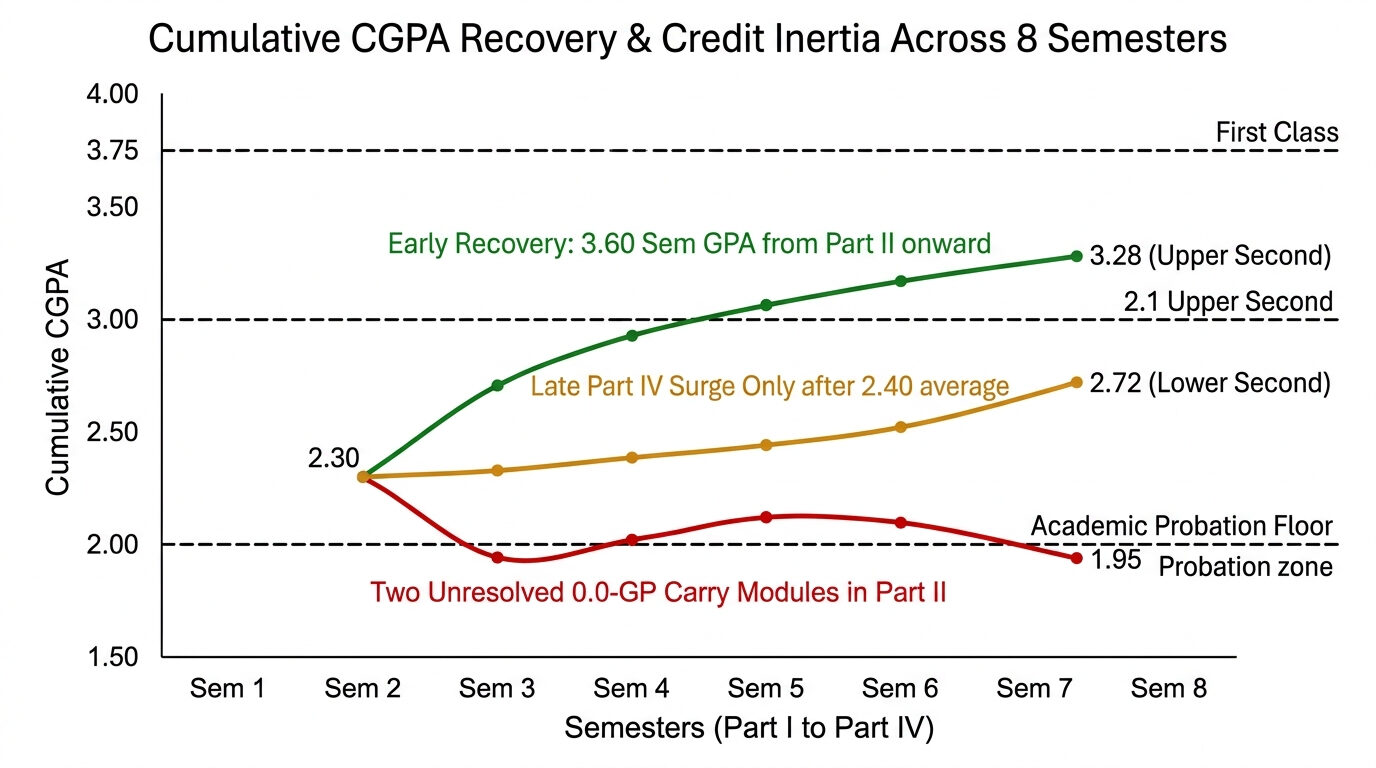
As Figure 3 illustrates, every completed semester adds credit weight to the denominator of your cumulative average. At the end of Part I (120 ZNQF credits), one strong 60-credit semester in Part II shifts one-third of your entire academic record at once. By Part IV Semester 2 (420 completed credits), a final 60-credit semester represents just one-eighth (12.5%) of your cumulative credits—meaning even straight As (4.00) in your final semester can lift an unweighted cumulative CGPA of 2.65 by at most `+0.17` to `2.82`, falling short of `3.00` unless your faculty uses progressive Part IV heavy weighting (`50%`). Run hypothetical target grades in the calculator at the start of Part II, not two months before graduation.
Converting Zimbabwean grades for scholarships, SAQA, and WES
Zimbabwean graduates compete heavily for regional postgraduate degrees in South Africa and international scholarships in the UK, Europe, North America, and Australia. Because Zimbabwe's 80% First Class threshold is substantially stricter than US/Canadian 90% A-scales and even stricter than UK 70% First Class scales, presenting your GPA carelessly on international applications can cost you interviews.
- UK Master's admissions, Chevening, and Commonwealth Scholarships: British admissions tutors classify degrees by Honours Division rather than 4.0 GPAs. A Zimbabwean Upper Second Class Honours (2.1 — 70% to 79% WAM) from a ZIMCHE-accredited university is recognised directly as equivalent to a UK 2:1 bachelor's honours degree, and a Zimbabwean First Class (`80%+`) maps directly to a UK First. Always write "Upper Second Class Honours (2.1), Weighted Average Mark: 73.4%" on your CV and application form rather than writing "GPA: 3.10/4.0" alone.
- South African universities and SAQA (NQF Level 7 vs Level 8): Under the SADC Qualifications Framework and South African Qualifications Authority (SAQA) evaluations, a four-year Zimbabwean Bachelor's Honours degree (ZNQF Level 8, 480+ credits including a research dissertation) normally evaluates at South African NQF Level 8, qualifying you to apply directly for Research or Coursework Master's (NQF Level 9) at UCT, Wits, UP, Stellenbosch, or UJ (typically requiring a 65% to 70%+ WAM). A three-year ordinary/general degree without an honours research component usually evaluates at NQF Level 7, requiring a one-year South African Honours year first.
- US and Canadian graduate schools (WES / ECE credential evaluations): Never convert your Zimbabwean WAM to a US 4.0 GPA using linear cross-multiplication (`72% / 100 × 4 = 2.88`)! Official credential evaluators such as World Education Services (WES) map each individual Zimbabwean module grade to US letter equivalents recognizing Commonwealth grading rigour—typically converting Zimbabwean `A / 1 (80%+)` and `B+ (75–79%)` to `A (4.0)`, `B (70–74%)` to `A- / B+ (3.3–3.7)`, and `C+ / C (60–69%)` to `B (3.0)`. As a result, a UZ or NUST student with a local `3.15` CGPA and `72%` WAM frequently receives a WES-evaluated US GPA between 3.50 and 3.70.
Common mistakes students make when tracking their GPA
- Mixing ZNQF credits (12 or 15) with contact-hour units (3 or 4): Entering 48 prior contact-hour credits alongside five 12-credit ZNQF semester modules makes the current semester outweigh your entire prior two years! Verify that every credit number uses the exact same unit system.
- Entering raw exam marks instead of moderated composite module marks: Always compute your weighted Continuous Assessment plus Exam composite (`0.40 × CA + 0.60 × Exam`, or your syllabus ratio) before entering `Mark %`.
- Entering un-capped marks for passed supplementary exams: If you cleared a failed module via a supplementary exam and scored 68% on the rewrite, enter 50% in the calculator (yielding 1.0 GP on the 4.0 scale), not 68%, unless you sat an approved uncapped Special/Deferred exam.
- Omitting 0.0-GP failed modules still sitting on your transcript: Until a failed module is officially repeated and replaced according to your faculty's repeat-replacement ordinance, its credit weight remains in the GPA denominator with `0.0` Quality Points. Leaving failed rows out artificially inflates your current standing and hides academic probation risk.
- Including non-credit or Pass/Fail audit modules: If your faculty marks a compulsory orientation, community-service log, or non-credit workshop solely as Satisfactory / Unsatisfactory (P/F) with zero GPA weight, omit it from the credit-weighted rows.
Limits of the calculator and privacy notes
This calculator implements standard credit-weighted GPA, CGPA, and WAM arithmetic across the 4.0 UZ/ZIMCHE division scale, the 5.0 five-point scale, and direct percentage WAM. Because autonomous university senates periodically amend faculty ordinances, the tool does not automatically enforce progressive Part-weighting (`10% / 20% / 20% / 50%`), written-exam 40% sub-minimum fails, supplementary First-Class disqualifications, or senate borderline discretionary upgrades. Treat the projected classification as an accurate mathematical planning guide and confirm binding graduation rules in your current Faculty Prospectus and General Academic Regulations.
Privacy and local processing: All GPA, CGPA, WAM, and classification calculations run entirely inside your browser tab, and no course codes, marks, or credit weights are stored on any server. Only if you press the optional Get AI insight button does your browser transmit an anonymous numerical summary (chosen scale, computed semester and cumulative averages, credit totals, and projected honours class—with zero personal or student-ID details) to /api/ai-insight to generate a short commentary.
Official sources and university references
- Zimbabwe Council for Higher Education (ZIMCHE). Zimbabwe National Qualifications Framework (ZNQF), Credit Accumulation Standards, and Minimum Bodies of Knowledge and Skills (MBKS). zimche.ac.zw
- Ministry of Higher and Tertiary Education, Innovation, Science and Technology Development. Education 5.0 Modularised Curriculum and Higher Education Policy Guidelines. mhtestd.gov.zw
- University of Zimbabwe (UZ). General Academic Regulations for Undergraduate Honours Degrees and Examination Ordinances. uz.ac.zw
- National University of Science and Technology (NUST). General Academic Regulations, Grading Scale, and Industrial Attachment Assessment Rules. nust.ac.zw
- Midlands State University (MSU). General Academic Regulations and Work-Related Learning Guidelines. msu.ac.zw
- Chinhoyi University of Technology (CUT). Undergraduate Academic Regulations and Degree Classification Criteria. cut.ac.zw
- Harare Institute of Technology (HIT). Academic Programmes, Technopreneurship Assessment, and Grading Policy. hit.ac.zw